
Publication date: 14 July 2025
DOI: https://doi.org/10.14324/111.9781800088658
Number of illustrations: 15

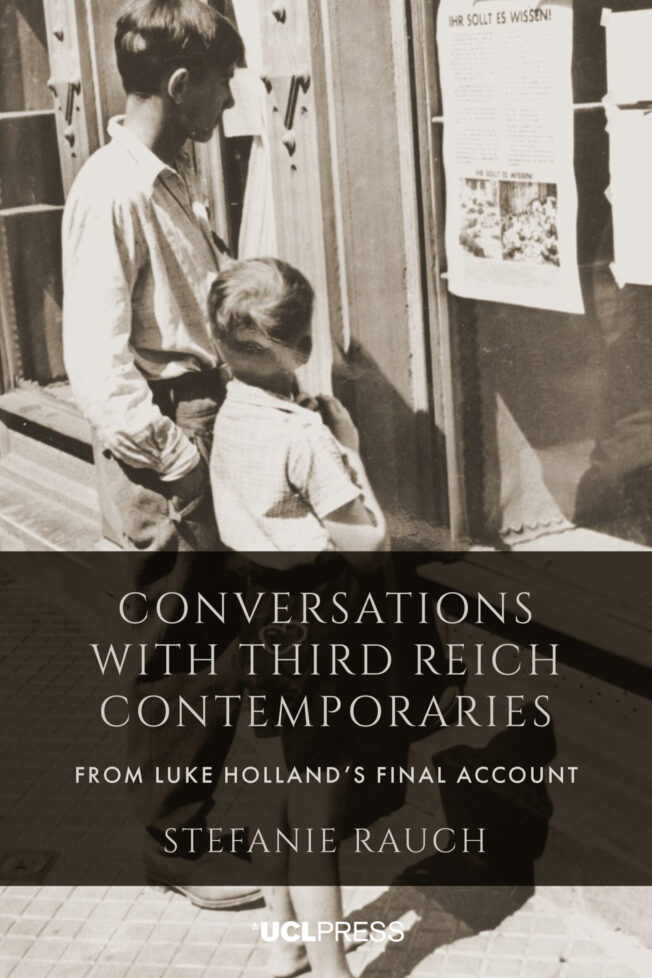
Conversations with Third Reich Contemporaries
From Luke Holland’s Final Account
Stefanie Rauch (Author)
Conversations with Third Reich Contemporaries presents a selection of excerpts from a recently opened collection of filmed interviews conducted by British documentary filmmaker Luke Holland (1948-2020). Most of the interviewees were young adults when the war ended. Some of them, or their families, had benefited materially through ‘Aryanisation’, Party-facilitated careers or exploiting forced labour. Others had enabled and enacted persecution or perpetrated violence, perhaps in anti-partisan warfare. They all built new lives in the three successor states of West Germany (FRG), East Germany (GDR), and Austria, and dealt with the Nazi past in different ways, including Holocaust denial, attempts at separating their lives from Nazi crimes, and reform.
The role played by ‘ordinary Germans’ in the ‘Third Reich’ and the Holocaust continues to stir debate. In the wider context of mass public engagement with the Holocaust and in light of new forms of racism, antisemitism and prejudice, this compelling sourcebook raises critical awareness of important issues around representation, authenticity, and the co-production of narratives. It attends to the issues of how and by whom knowledge is produced, the contingency of life narratives, performativity, and pedagogy. By suggesting critical questions and providing a reading list, it is an urgent and effective tool for thinking and teaching.
Related titles
Conversations with Third Reich Contemporaries
From Luke Holland’s Final Account
Publication date: July 14, 2025
Open Access PDF ISBN: 9781800088658
Paperback ISBN: 9781800088641
Hardback ISBN: 9781800088634
Trim size (hardback): 23.4cm x 15.6cm
Trim size (paperback): 23.4cm x 15.6cm
Conversations with Third Reich Contemporaries presents a selection of excerpts from a recently opened collection of filmed interviews conducted by British documentary filmmaker Luke Holland (1948-2020). Most of the interviewees were young adults when the war ended. Some of them, or their families, had benefited materially through ‘Aryanisation’, Party-facilitated careers or exploiting forced labour. Others had enabled and enacted persecution or perpetrated violence, perhaps in anti-partisan warfare. They all built new lives in the three successor states of West Germany (FRG), East Germany (GDR), and Austria, and dealt with the Nazi past in different ways, including Holocaust denial, attempts at separating their lives from Nazi crimes, and reform.
The role played by ‘ordinary Germans’ in the ‘Third Reich’ and the Holocaust continues to stir debate. In the wider context of mass public engagement with the Holocaust and in light of new forms of racism, antisemitism and prejudice, this compelling sourcebook raises critical awareness of important issues around representation, authenticity, and the co-production of narratives. It attends to the issues of how and by whom knowledge is produced, the contingency of life narratives, performativity, and pedagogy. By suggesting critical questions and providing a reading list, it is an urgent and effective tool for thinking and teaching.
‘A useful source of inspiration for discussion topics in history and PSHE lessons. Hearing the views held now and back then from people who lived through the era as children provides an important warning for our times, and gives us an illuminating alternative perspective of the period.’
Teach Secondary
‘Taken as a whole, Conversations with Third Reich Contemporaries succeeds on every level. It is a rigorous, well-contextualized, thoughtfully curated and genuinely readable body of primary source material that opens a corpus long underused by historians and educators. That UCL Press has made it freely available as an open-access publication only amplifies its value. This is precisely the kind of resource that benefits from the widest possible readership, from university seminar rooms to secondary school classrooms to the general reader. It speaks to anyone trying to understand how ordinary people lived through, and later lived with, complicity in one of history’ s great crimes. Rauch has done a genuine service to the field, and to anyone teaching or studying this history, in making Holland’s remarkable archive speak so clearly.’
History: The Journal of the Historical Association
‘How do we approach testimonies by those complicit in mass violence in a way that is attuned to the historical context, the passing of time, and the needs of the present? This vital and timely sourcebook offers critical approaches to carefully curated excerpts of Luke Holland’s interview collection. It challenges static interpretations of perpetrator narratives, foregrounding agency, memory, and the ethics of testimony. This will be an essential resource for scholars and educators working on Holocaust testimony and oral history.’
Susanne C. Knittel, Utrecht University