
Publication date: 25 March 2026
DOI: https://doi.org/10.14324/111.9781800089976
Number of illustrations: 58

Urban Violence and Marginalised Communities
Multidisciplinary interpretations
Ashvin Devasundaram (Editor), Stamatis Zografos (Editor), Márcio Mattos (Editor), Zoe Holman (Editor)
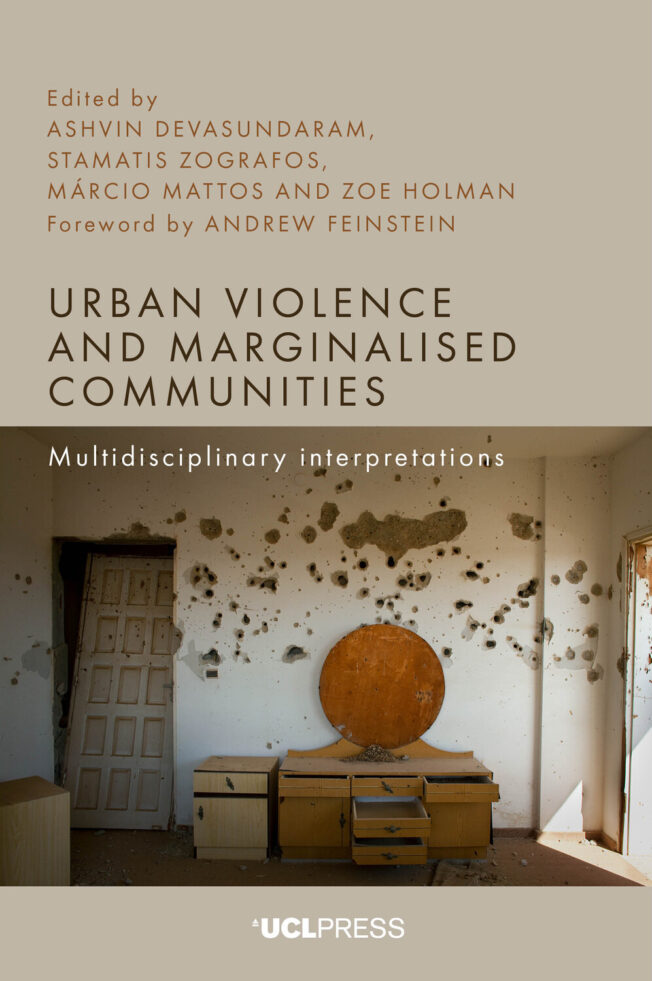
Placing peripheralised people at its centre, this edited collection unpacks how urban violence must be understood from multiple points of view: powerholders, decision makers, law enforcers, built environment professionals, creative artists, and particularly from the lived standpoint of less empowered communities. It illustrates how listening to often unheard voices of the excluded, disproportionately experiencing daily precarity and violence, can inform and broaden our shared understanding of urban violence.
Urban Violence and Marginalised Communities presents a nuanced and revealing picture of how urban violence manifests and operates in multiple and unprecedented ways, challenging the common conception of urban violence solely as criminal physical acts performed by predictable perpetrators. This volume blurs geographical borders through an equitable and representative synthesis of Global South and North interpretations, focusing on a range of marginalised communities. The chapters are inventively crafted as local-meets-global case studies, with a broad regional sweep from Brazil, US, UK and Ukraine to India, South Africa and Palestine. This is mirrored in the volume’s multidisciplinary diversity of topical themes including migration and politics, policing, law and order, built environment/architecture, film, media and performing arts.
Afterlives of Urban Cosmopolitanism
Magnus Marsden, Vera Skvirskaja, Paul Anderson,
01 February 2027
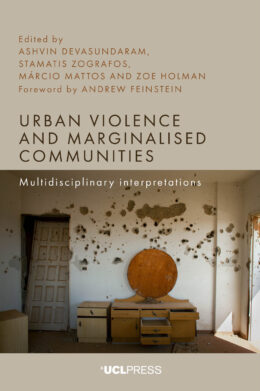
Urban Violence and Marginalised Communities
Ashvin Devasundaram, Stamatis Zografos, Márcio Mattos, Zoe Holman,
25 March 2026
Co-production of Knowledge in Action
Cassidy Johnson, Vanesa Castán Broto, Wilbard Kombe, Catalina Ortiz, Barbara Lipietz, Emmanuel Osuteye, Caren Levy,
15 September 2025

Urban Informality and the Built Environment
Nerea Amorós Elorduy, Nikhilesh Sinha, Colin Marx,
12 March 2024
Urban Violence and Marginalised Communities
Multidisciplinary interpretations
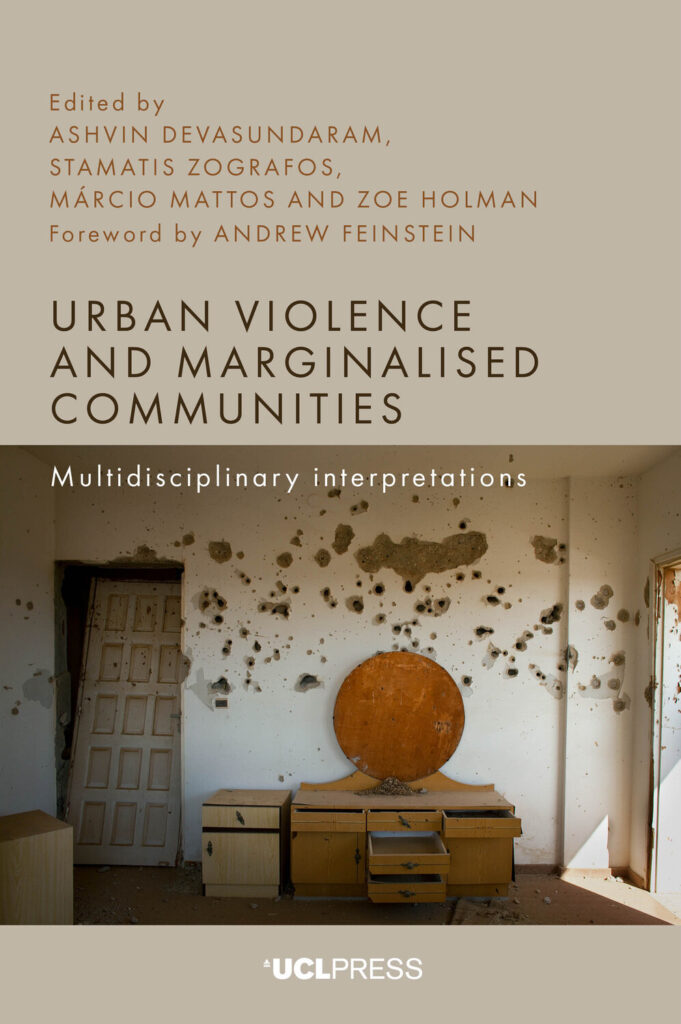
Publication date: March 25, 2026
Open Access PDF ISBN: 9781800089976
Paperback ISBN: 9781800089969
Hardback ISBN: 9781800089952
Trim size (hardback): 23.4cm x 15.6cm
Trim size (paperback): 23.4cm x 15.6cm
Placing peripheralised people at its centre, this edited collection unpacks how urban violence must be understood from multiple points of view: powerholders, decision makers, law enforcers, built environment professionals, creative artists, and particularly from the lived standpoint of less empowered communities. It illustrates how listening to often unheard voices of the excluded, disproportionately experiencing daily precarity and violence, can inform and broaden our shared understanding of urban violence.
Urban Violence and Marginalised Communities presents a nuanced and revealing picture of how urban violence manifests and operates in multiple and unprecedented ways, challenging the common conception of urban violence solely as criminal physical acts performed by predictable perpetrators. This volume blurs geographical borders through an equitable and representative synthesis of Global South and North interpretations, focusing on a range of marginalised communities. The chapters are inventively crafted as local-meets-global case studies, with a broad regional sweep from Brazil, US, UK and Ukraine to India, South Africa and Palestine. This is mirrored in the volume’s multidisciplinary diversity of topical themes including migration and politics, policing, law and order, built environment/architecture, film, media and performing arts.
‘Urban Violence and Marginalised Communities guides scholars to rethink the way we learn from the violence that has indeed wracked the cities of our world. A billion people live in slums. That’s violence too. Billions are underemployed or unemployed, and hundreds of million starve. That’s violence too. The marginalised speak in this book to tell you that they understand violence in a way that should serve as the basis for the politics of our cities.’
Vijay Prashad, Tricontinental: Institute for Social Research and Correspondent for Globetrotter
‘When we despair at the sight of yet another police killing in the Maré favela in Rio de Janeiro, a situation that has been going on for decades; when we gasp as we helplessly watch the genocide in Gaza; when we are shocked by the brutality meted out against pro-Palestinian student protests at elite universities; it’s time for a revolution in the concept of urban violence. The traditional concept is so worn out and ineffective in helping us understand the complexities at play in countless global contexts – some more hidden, others more scandalous. A revolution in perspectives – not only from social scientists, but also from artists and especially activists; a conceptual revolution in words, temporalities, and spatialities; a revolution in voices accredited to speak about community pain and experiences; a revolution that grants the same legitimacy in the debate on urban violence to highly accredited scholars, filmmakers, artists and community leaders. The collection you hold in your hands is a stunning, surprising, and necessary shift in direction, allowing you to engage with new articulations and experiences of urban violence in the global and radically local contexts of the twenty-first century.’
Silvia Ramos, social scientist, director of the Center for Security and Citizenship Studies, Brazil
‘The urban condition cannot be grasped without the spatial grammars of violence. This book is indispensable to understanding the polyhedric nature of urban violence. This volume disrupts Global North–South binaries to reveal how violence pervades and reshapes all urban contexts in distinct and entangled ways.’
Catalina Ortiz, University College London, UK
‘This volume is a profound contribution to our understandings of urban violence as a manifestation of multiple dimensions of marginalisation and epistemic and systemic erasures and predations. The book is a must-read for students and researchers seeking to see beyond the language of violence in order to see and question the structures which produce it and maintain it.’
Navtej Purewal, University of the Arts London, UK
‘This book is a significant contribution to the growing global project that expands understanding of violence and its mechanisms from the margins. This is a very timely and much needed contribution in these uncertain times.’
Christopher C. Sonn, Victoria University, Melbourne, Australia
‘Arguing for an appreciation of the epistemic violence of colonial histories, this important collection foregrounds the perspectives of ordinary people and integrates disciplines. Inclusion and equity lie at the heart of this powerful invitation for critical global reflection.’
Clare Anderson FBA, University of Leicester, UK
‘This book emphasises urban violence, based on diverse social groups: powerholders, law enforcers, built environment professionals, creative artists, and less empowered communities. Three significant approaches reveal the originality of this edited volume: the complexity of violence and its territoriality and social control; the case studies based on everyday life across the world; and the cultural expressions of violence.’
José Vicente Tavares dos Santos, Federal University of Rio Grande do Sul, Porto Alegre, Brazil
‘Violence is the cruellest expression of social inequalities, afflicting territories and populations most vulnerable to the daily impacts of crime and war. The authors are timely, broadening the discussion by addressing the topic in its different dimensions of race, gender, age and class, both in developing countries and in wealthier nations.’
Raul Jungmann, Former Minister of Public Security and Minister of Defence, Brazil
‘Placing a microscopic lens before roving and writhing forms of urban violence, this ambitious volume offers insights into the constitution of cities that teem with conflict. It integrates creative methods with rigorous research to share the perspectives of those exposed to its viral effects.’
Rebecca Jarman, University of Leeds, UK
‘This provides a much-needed interdisciplinary exploration of urban violence not only from a social science standpoint, but also the arts and humanities. Furthermore, it is so refreshing to combine insights from the grassroots and margins together with a global perspective.’
Cathy McIlwaine, King’s College London, UK
‘This extraordinary anthology confronts the many scales of urban violence, from the intimate and emplaced to the transnational and systemic. It captures both the urgency and persistence of violence, as well as the solidarities that emerge in resistance across cities worldwide. Including intersectional feminist, action-oriented and arts-based approaches, the book offers a vital engagement with how we think, live and act in fraught and troubling times.’
Rike Sitas, African Centre for Cities, University of Cape Town