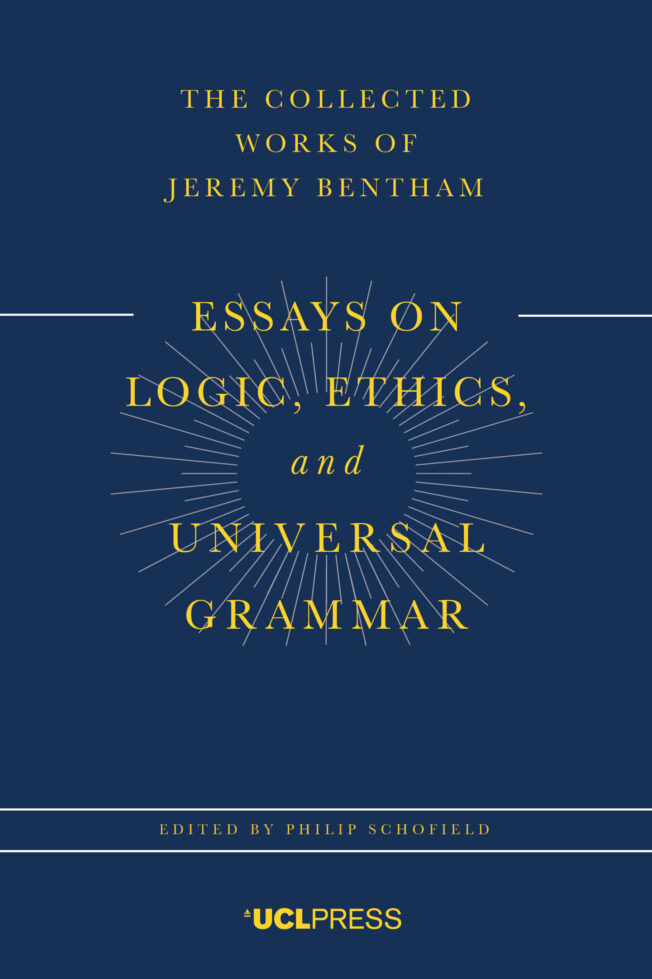

Essays on Logic, Ethics, and Universal Grammar
Philip Schofield (Editor)
This new volume of Bentham’s philosophical writings deals with his most fundamental ideas concerning logic, language, ethics, and grammar. It includes four major essays written between 1814 and 1816, namely ‘Essay on Logic’, ‘Essay on Ethics’, ‘Didacologia’, and ‘Universal Grammar’, all of them closely related to Chrestomathia, Bentham’s major work on education.
In ‘Essay on Logic’, Bentham contrasts the præcognita of Aristotle with his own ‘characteristics’ of logic and deals with methodization, ontology, and the relationship between logic and language. In ‘Essay on Ethics’, he offers a critique of the Aristotelian virtues and outlines his own division of ethics into prudence, probity, and benevolence. In ‘Didacologia’, he presents an outline of a comprehensive plan for the division of the arts and sciences based on the method of exhaustive bifurcation and a new nomenclature. In ‘Universal Grammar’, Bentham deals with language as the basis for thought and communication and investigates the nature of the different parts of speech. The volume is completed with an Appendix containing fragmentary material, written in August and September 1813, with a focus on language. All the texts are based on Bentham’s original manuscripts and have never before been published in authentic form.

Who are the Humans behind Human Rights?
Agnieszka Kubal, Beáta Huszka, Hanna Oliinyk, Denis Shedov,
01 February 2027
Franziska Arnold-Dwyer, Mark Dsouza, Jeevan Hariharan, Maria Lee,
05 November 2026
The Correspondence of Jeremy Bentham, Volume 14
Philip Schofield, Tim Causer, Chris Riley,
07 May 2026
The Correspondence of Jeremy Bentham, Volume 13
Philip Schofield, Tim Causer, Chris Riley, Jeremy Bentham,
11 April 2024
New Directions in Private Law Theory
Fabiana Bettini, Martin Fischer, Charles Mitchell, Prince Saprai,
16 October 2023

Essays on Logic, Ethics, and Universal Grammar
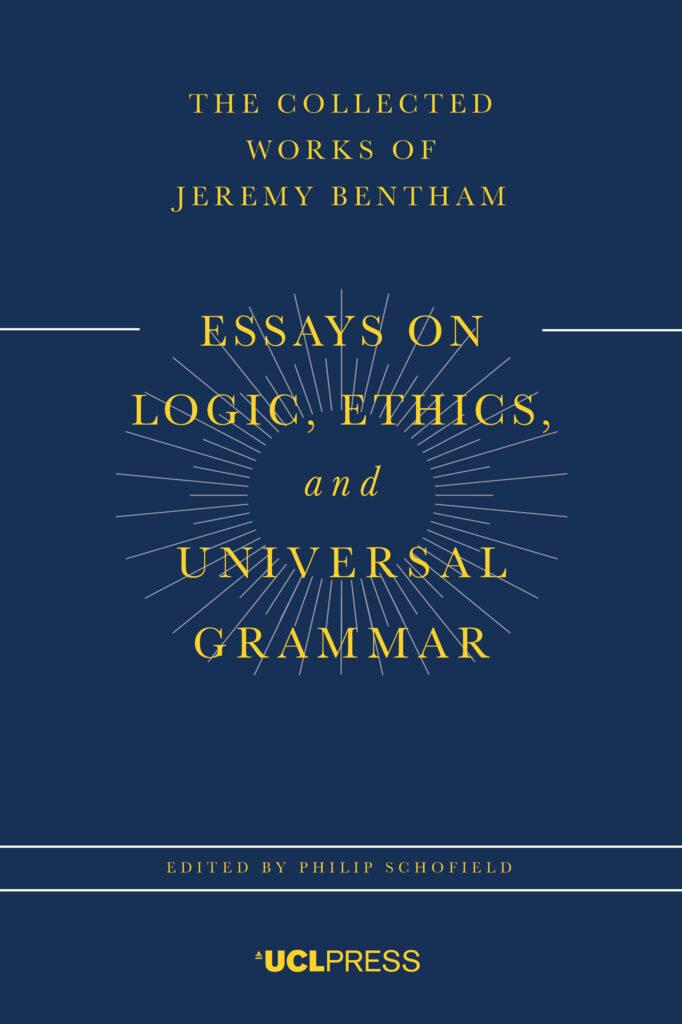
Series: The Collected Works of Jeremy Bentham
Publication date: December 1, 2025
Open Access PDF ISBN: 9781800089211
Paperback ISBN: 9781800089204
Hardback ISBN: 9781800089198
Trim size (hardback): 23.4cm x 15.6cm
Trim size (paperback): 23.4cm x 15.6cm

This new volume of Bentham’s philosophical writings deals with his most fundamental ideas concerning logic, language, ethics, and grammar. It includes four major essays written between 1814 and 1816, namely ‘Essay on Logic’, ‘Essay on Ethics’, ‘Didacologia’, and ‘Universal Grammar’, all of them closely related to Chrestomathia, Bentham’s major work on education.
In ‘Essay on Logic’, Bentham contrasts the præcognita of Aristotle with his own ‘characteristics’ of logic and deals with methodization, ontology, and the relationship between logic and language. In ‘Essay on Ethics’, he offers a critique of the Aristotelian virtues and outlines his own division of ethics into prudence, probity, and benevolence. In ‘Didacologia’, he presents an outline of a comprehensive plan for the division of the arts and sciences based on the method of exhaustive bifurcation and a new nomenclature. In ‘Universal Grammar’, Bentham deals with language as the basis for thought and communication and investigates the nature of the different parts of speech. The volume is completed with an Appendix containing fragmentary material, written in August and September 1813, with a focus on language. All the texts are based on Bentham’s original manuscripts and have never before been published in authentic form.
‘The publication of this work is a definitive event in the field of Bentham studies and even in the research of modern philosophy as a whole. The publication of this book not only restores an important philosophical work but also revives the true image of an intellectual giant who has long been misunderstood.’
Utilitas
‘Through the efforts of Philip Schofield, this volume has been published by UCL Press in open access, as exemplifies the principle of ‘the greatest happiness of the greatest number’—a development at which Bentham himself, I think, would surely smile. Schofield’s edition ultimately compels renewed attention to Bentham not merely as a utilitarian moralist, but as a systematic philosopher of ontology, language, and empiricist psychology.’
History of European Ideas