
Publication date: 10 June 2021
DOI: https://doi.org/10.14324/111.9781787358287
Number of illustrations: 31

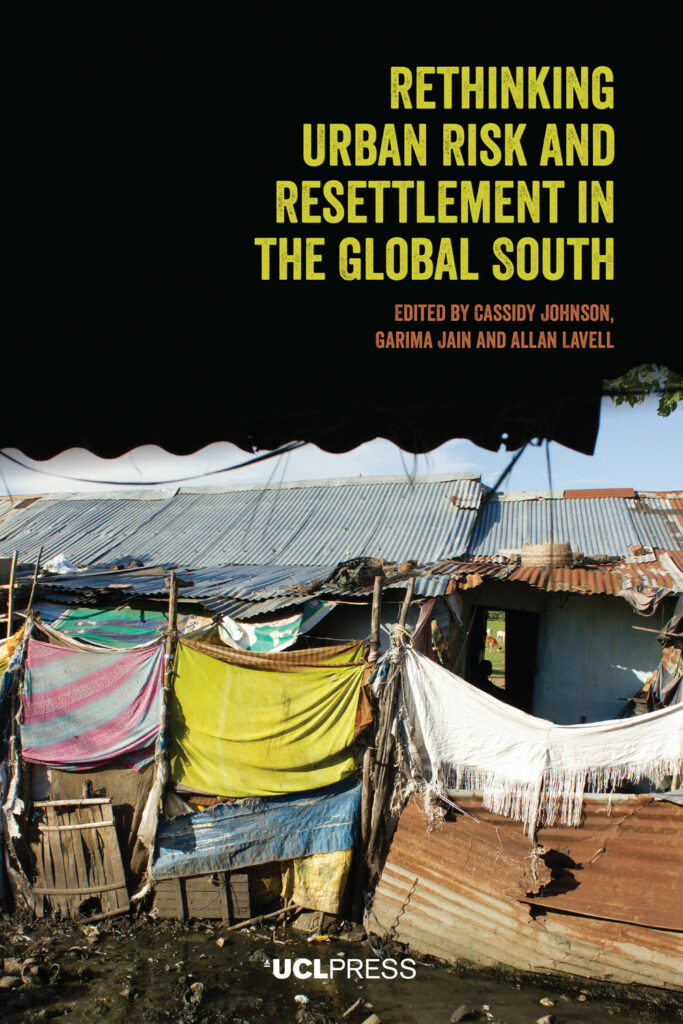
Rethinking Urban Risk and Resettlement in the Global South
Cassidy Johnson (Editor), Garima Jain (Editor), Allan Lavell (Editor)
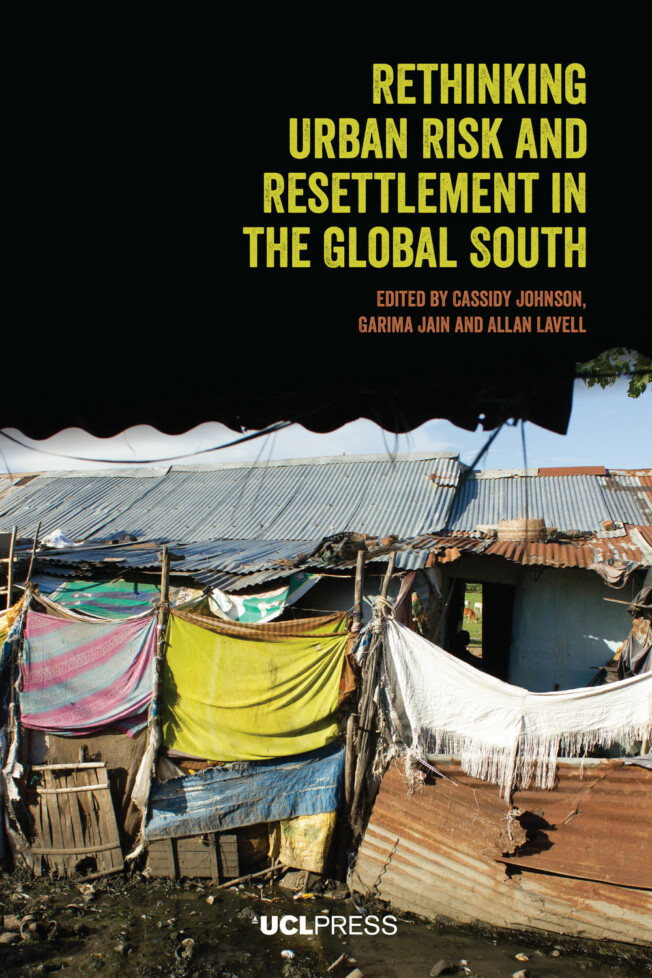
Environmental changes have significant impacts on people’s lives and livelihoods, particularly the urban poor and those living in informal settlements. In an effort to reduce urban residents’ exposure to climate change and hazards such as natural disasters, resettlement programmes are becoming widespread across the Global South. While resettlement may reduce a region’s future climate-related disaster risk, it often increases poverty and vulnerability, and can be used as a reason to evict people from areas undergoing redevelopment.
A collaboration between the Bartlett Development Planning Unit at UCL, the Indian Institute for Human Settlements and the Latin American Social Science Faculty, Rethinking Urban Risk and Resettlement in the Global South collates the findings from ‘Reducing Relocation Risks’, a research project that studied urban areas across India, Uganda, Peru, Colombia and Mexico. The findings are augmented with chapters by researchers with many years of insight into resettlement, property rights and evictions, who offer cases from Monserrat, Cambodia, Philippines and elsewhere.
The contributors collectively argue that the processes for making and implementing decisions play a large part in determining whether outcomes are socially just, and examine various value systems and strategies adopted by individuals versus authorities. Considering perceptions of risk, the volume offers a unique way to think about economic assessments in the context of resettlement and draws parallels between different country contexts to compare fully urbanised areas with those experiencing urban growth. It also provides an opportunity to re-think how disaster risk management can better address the accumulation of urban risks through urban planning.
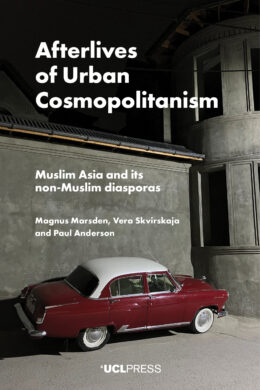
Afterlives of Urban Cosmopolitanism
Magnus Marsden, Vera Skvirskaja, Paul Anderson,
01 February 2027

Toby Butler, Felix Driver, Barbara Brayshay, Chris Church, Jeremy Iles, Oli Mould, Saskia Papadakis,
12 November 2026

Urban Violence and Marginalised Communities
Ashvin Devasundaram, Stamatis Zografos, Márcio Mattos, Zoe Holman,
25 March 2026
Co-production of Knowledge in Action
Cassidy Johnson, Vanesa Castán Broto, Wilbard Kombe, Catalina Ortiz, Barbara Lipietz, Emmanuel Osuteye, Caren Levy,
15 September 2025
Nick Gallent, Menelaos Gkartzios, Mark Scott, Andrew Purves,
06 February 2025
Urban Transformations in Sierra Leone
Joseph M. Macarthy, Braima Koroma, Andrea Rigon, Alexandre Apsan Frediani, Andrea Klingel,
05 December 2024
Rethinking Urban Risk and Resettlement in the Global South
Publication date: June 10, 2021
Open Access PDF ISBN: 9781787358287
Paperback ISBN: 9781787358294
Hardback ISBN: 9781787358300
Trim size (hardback): 23.4cm x 15.6cm
Trim size (paperback): 23.4cm x 15.6cm
Environmental changes have significant impacts on people’s lives and livelihoods, particularly the urban poor and those living in informal settlements. In an effort to reduce urban residents’ exposure to climate change and hazards such as natural disasters, resettlement programmes are becoming widespread across the Global South. While resettlement may reduce a region’s future climate-related disaster risk, it often increases poverty and vulnerability, and can be used as a reason to evict people from areas undergoing redevelopment.
A collaboration between the Bartlett Development Planning Unit at UCL, the Indian Institute for Human Settlements and the Latin American Social Science Faculty, Rethinking Urban Risk and Resettlement in the Global South collates the findings from ‘Reducing Relocation Risks’, a research project that studied urban areas across India, Uganda, Peru, Colombia and Mexico. The findings are augmented with chapters by researchers with many years of insight into resettlement, property rights and evictions, who offer cases from Monserrat, Cambodia, Philippines and elsewhere.
The contributors collectively argue that the processes for making and implementing decisions play a large part in determining whether outcomes are socially just, and examine various value systems and strategies adopted by individuals versus authorities. Considering perceptions of risk, the volume offers a unique way to think about economic assessments in the context of resettlement and draws parallels between different country contexts to compare fully urbanised areas with those experiencing urban growth. It also provides an opportunity to re-think how disaster risk management can better address the accumulation of urban risks through urban planning.
‘This open-access resource provides a holistic view of urban resettlement and lays a foundation for further research.’ Choice
‘This volume draws upon a diverse range of cases within the framework of risk and resettlement. It has a strong empirical basis and is a very accessible and valuable resource on this complex and multi-faceted topic.’
Environment and Urbanization