
Publication date: 6 May 2021
DOI: https://doi.org/10.14324/111.9781787359611
Number of illustrations: 105

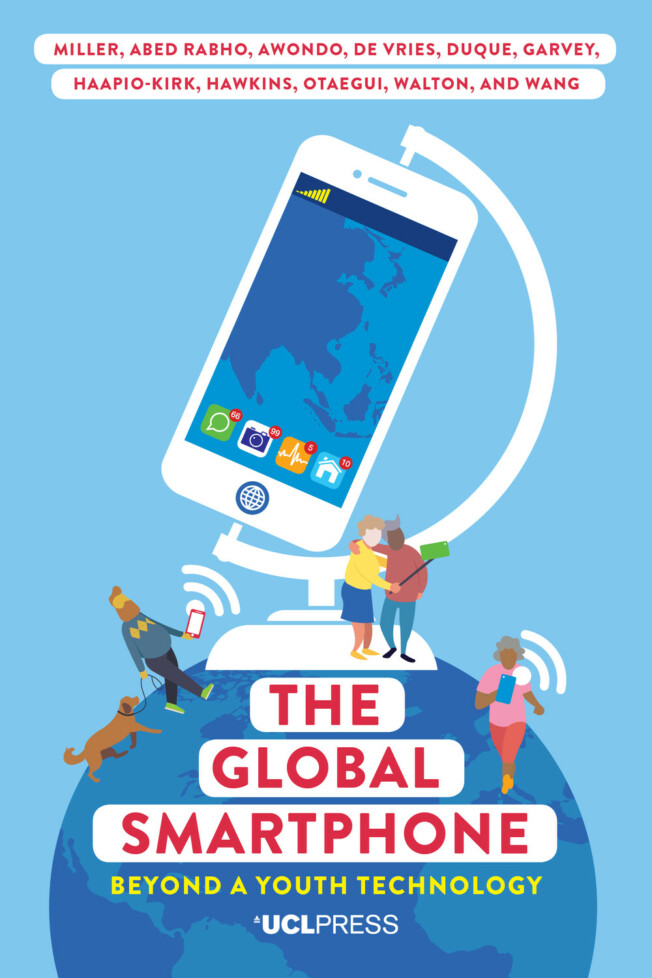
The Global Smartphone
Beyond a youth technology
Daniel Miller (Author), Laila Abed Rabho (Author), Patrick Awondo (Author), Maya de Vries (Author), Marília Duque (Author), Pauline Garvey (Author), Laura Haapio-Kirk (Author), Charlotte Hawkins (Author), Alfonso Otaegui (Author), Shireen Walton (Author), Xinyuan Wang (Author)
Series: Ageing with Smartphones
The smartphone is often literally right in front of our nose, so you would think we would know what it is. But do we? To find out, 11 anthropologists each spent 16 months living in communities in Africa, Asia, Europe and South America, focusing on the take up of smartphones by older people. Their research reveals that smartphones are technology for everyone, not just for the young.
The Global Smartphone presents a series of original perspectives deriving from this global and comparative research project. Smartphones have become as much a place within which we live as a device we use to provide ‘perpetual opportunism’, as they are always with us. The authors show how the smartphone is more than an ‘app device’ and explore differences between what people say about smartphones and how they use them.
The smartphone is unprecedented in the degree to which we can transform it. As a result, it quickly assimilates personal values. In order to comprehend it, we must take into consideration a range of national and cultural nuances, such as visual communication in China and Japan, mobile money in Cameroon and Uganda, and access to health information in Chile and Ireland – all alongside diverse trajectories of ageing in Al Quds, Brazil and Italy. Only then can we know what a smartphone is and understand its consequences for people’s lives around the world.
Related titles
An Anthropological Approach to mHealth
Charlotte Hawkins, Patrick Awondo, Daniel Miller,
28 October 2024
O Smartphone Global: Uma tecnologia para além dos jovens
Daniel Miller, Laila Abed Rabho, Patrick Awondo, Maya de Vries, Marília Duque, Pauline Garvey, Laura Haapio-Kirk, Charlotte Hawkins, Alfonso Otaegui, Shireen Walton, Xinyuan Wang, Cecília Elisabeth Barbosa Soares,
25 February 2022
How the World Changed Social Media
Daniel Miller, Elisabetta Costa, Dr Nell Haynes, Tom McDonald, Razvan Nicolescu, Dr Jolynna Sinanan, Juliano Spyer, Shriram Venkatraman, Xinyuan Wang,
29 February 2016
El Smartphone Global: Más allá de una tecnología para jóvenes
Daniel Miller, Laila Abed Rabho, Patrick Awondo, Maya de Vries, Marília Duque, Pauline Garvey, Laura Haapio-Kirk, Charlotte Hawkins, Alfonso Otaegui, Shireen Walton, Xinyuan Wang, Marcela Fuentealba, Ian Davidson,
11 November 2021
Lo Smartphone Globale: Non solo una tecnologia per giovani
Daniel Miller, Laila Abed Rabho, Patrick Awondo, Maya de Vries, Marília Duque, Pauline Garvey, Laura Haapio-Kirk, Charlotte Hawkins, Alfonso Otaegui, Shireen Walton, Xinyuan Wang, Laura Liucci,
09 December 2021
Le Smartphone Global: Au-delà d’une culture jeune
Daniel Miller, Laila Abed Rabho, Patrick Awondo, Maya de Vries, Marília Duque, Pauline Garvey, Laura Haapio-Kirk, Charlotte Hawkins, Alfonso Otaegui, Shireen Walton, Xinyuan Wang, Stephanie Engola,
10 February 2022
The Global Smartphone
Beyond a youth technology
Series: Ageing with Smartphones
Publication date: May 6, 2021
Open Access PDF ISBN: 9781787359611
Paperback ISBN: 9781787359628
Hardback ISBN: 9781787359635
Trim size (hardback): 23.4cm x 15.6cm
Trim size (paperback): 23.4cm x 15.6cm
The smartphone is often literally right in front of our nose, so you would think we would know what it is. But do we? To find out, 11 anthropologists each spent 16 months living in communities in Africa, Asia, Europe and South America, focusing on the take up of smartphones by older people. Their research reveals that smartphones are technology for everyone, not just for the young.
The Global Smartphone presents a series of original perspectives deriving from this global and comparative research project. Smartphones have become as much a place within which we live as a device we use to provide ‘perpetual opportunism’, as they are always with us. The authors show how the smartphone is more than an ‘app device’ and explore differences between what people say about smartphones and how they use them.
The smartphone is unprecedented in the degree to which we can transform it. As a result, it quickly assimilates personal values. In order to comprehend it, we must take into consideration a range of national and cultural nuances, such as visual communication in China and Japan, mobile money in Cameroon and Uganda, and access to health information in Chile and Ireland – all alongside diverse trajectories of ageing in Al Quds, Brazil and Italy. Only then can we know what a smartphone is and understand its consequences for people’s lives around the world.
‘Interesting ethnographic insights into the use of the smartphone.’
European Journal of Communication
‘ethnographically rich… lavishly illustrated not only with color photographs but with links to helpful, short videos the authors filmed’
Journal of Anthropological Research
‘Laced with ethnographic vignettes, images and screenshots of devices, and infographics of smartphone usage across sites and written in a highly accessible language devoid of heavy academic jargon, The Global Smartphone makes for an interesting read. This book offers a much needed contribution to the literature on smartphone adoption amongst older populations. It will be of interest to scholars working in the field of aging and gerontology, elder care, social change, media and communication. Being published open access will ensure its reach to a wider audience.’
Anthropology and Aging
‘a rich and nuanced portrayal of how smartphones are engaged in different contexts’
International Journal of Communication
‘By masterfully combining rigorous multi-sited ethnographic research with a broad global comparative analysis of mobile media use among older adults, the book is a must-read for scholars, policymakers, and practitioners who seek a deeper understanding of smartphones’ cultural shades, global impacts, and distinct nuances. In conclusion, as an incisive contribution to the mobile media and communication field, readers will find the book compelling to comprehend a more nuanced and empathetic approach to understanding a mobile world navigated by diverse populations.’
Mobile Media & Communication
‘The Global Smartphone…opens a broader range of issues and topics and although of particular interest for researchers engaged in digital technologies, it can be helpful for anyone dealing with contemporary anthropology, including non-academic readers. The study, conducted in a contemporary context and dealing with both contemporary and timeless disciplinary and human issues, is reminiscent of classical ethnographic studies, which offer guidance on what it means to deal with present-day anthropology.’
Scientific Criticism and Controversy (Научна критика и полемика)