
Publication date: 28 September 2026
DOI: https://doi.org/10.14324/111.9781800081307
Number of illustrations: 14

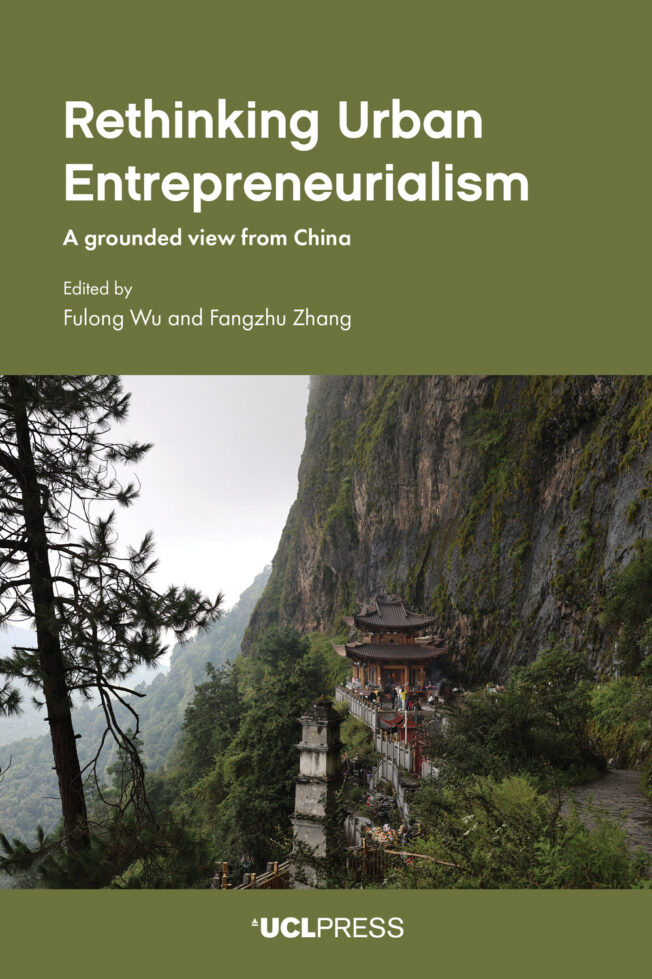
Rethinking Urban Entrepreneurialism
A grounded view from China
Fulong Wu (Editor), Fangzhu Zhang (Editor)
China’s urban governance demonstrates perplexing and contradictory features. Despite market-oriented reform, the role of the state remains salient. What is the logic behind governing urban China? Chinese scholars provide a grounded view.
Rethinking Urban Entrepreneurialism challenges the conventional understanding of urban entrepreneurialism and argues that Chinese urban governance comprises two interrelated aspects: entrepreneurial governance and innovative statecraft. The first refers to the deployment of market-based approaches to urban development, and the second refers to versatile techniques. Urban entrepreneurialism encompasses both market-oriented approaches and administrative innovations. The state upholds its strategic and extra-economic objectives by deploying and mobilising the market and society. Urban entrepreneurialism also demonstrates a strong state intentionality rather than following the market logic. The book reveals the challenges to urban entrepreneurialism, the limits of entrepreneurial governance, and multiple managerial practices in China.
By examining entrepreneurial urban development and governance experiments, it paints a comprehensive picture of contemporary urban governance in China. It transcends the binary view of authoritarianism versus urban entrepreneurialism, showcasing a wide spectrum of entrepreneurial and managerial governance features. To rethink urban entrepreneurialism, the book suggests that it extends public-private partnerships into a broader form of statecraft known as ‘state entrepreneurialism’.
Related titles
Critical Dialogues of Urban Governance, Development and Activism
Susannah Bunce, Nicola Livingstone, Loren March, Susan Moore, Alan Walks,
01 December 2020

Rethinking Urban Entrepreneurialism
A grounded view from China
Publication date: September 28, 2026
Open Access PDF ISBN: 9781800081307
Paperback ISBN: 9781800081291
Hardback ISBN: 9781800081284
Trim size (hardback): 23.4cm x 15.6cm
Trim size (paperback): 23.4cm x 15.6cm
China’s urban governance demonstrates perplexing and contradictory features. Despite market-oriented reform, the role of the state remains salient. What is the logic behind governing urban China? Chinese scholars provide a grounded view.
Rethinking Urban Entrepreneurialism challenges the conventional understanding of urban entrepreneurialism and argues that Chinese urban governance comprises two interrelated aspects: entrepreneurial governance and innovative statecraft. The first refers to the deployment of market-based approaches to urban development, and the second refers to versatile techniques. Urban entrepreneurialism encompasses both market-oriented approaches and administrative innovations. The state upholds its strategic and extra-economic objectives by deploying and mobilising the market and society. Urban entrepreneurialism also demonstrates a strong state intentionality rather than following the market logic. The book reveals the challenges to urban entrepreneurialism, the limits of entrepreneurial governance, and multiple managerial practices in China.
By examining entrepreneurial urban development and governance experiments, it paints a comprehensive picture of contemporary urban governance in China. It transcends the binary view of authoritarianism versus urban entrepreneurialism, showcasing a wide spectrum of entrepreneurial and managerial governance features. To rethink urban entrepreneurialism, the book suggests that it extends public-private partnerships into a broader form of statecraft known as ‘state entrepreneurialism’.