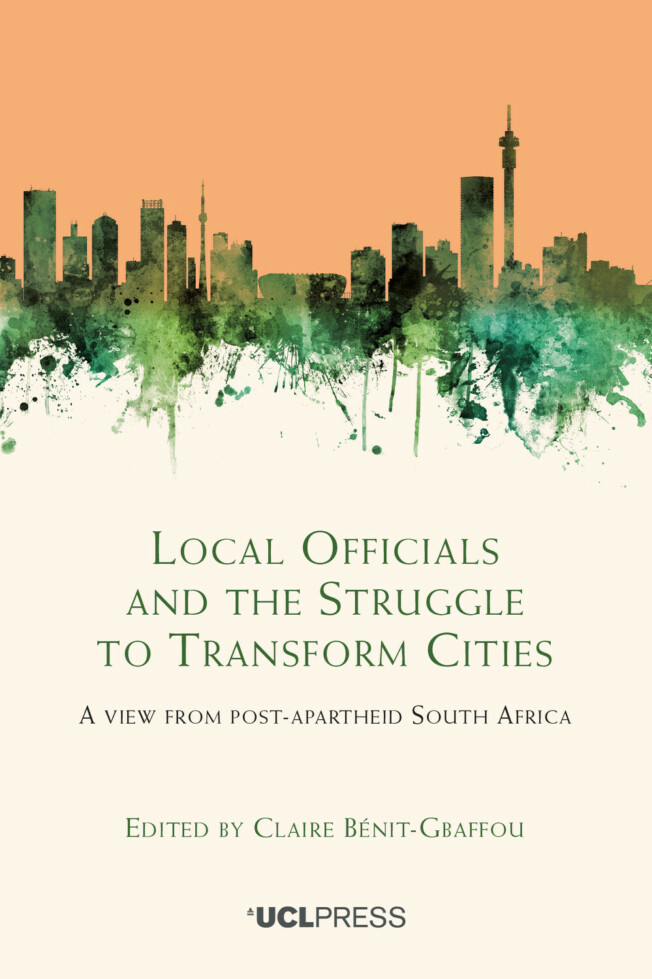

Local Officials and the Struggle to Transform Cities
A view from post-apartheid South Africa
Claire Bénit-Gbaffou (Editor)
Why are even progressive local authorities with the ‘will to improve’ seldom able to change cities? Why does it seem almost impossible to redress spatial inequalities, deliver and maintain basic services, elevate impoverished areas and protect the marginalised communities? Why do municipalities in the Global South refuse to work with prevailing social informalities, and resort instead to interventions that are known to displace and aggravate the very issues they aim to address?
Local Officials and the Struggle to Transform Cities analyses these challenges in South African cities, where the brief post-apartheid moment opened a window for progressive city government and made research into state practices both possible and necessary. In debate with other ‘progressive moments’ in large cities in Brazil, the USA and India, the book interrogates City officials’ practices. It considers the instruments they invent and negotiate to implement urban policies, the agency they develop and the constraints they navigate in governing unequal cities. This focus on actual officials’ practices is captured through first-hand experience, state ethnographies and engaged research. These reveal day-to-day practice that question generalised explanations of state failure in complex urban societies as essential malevolence, contextual weakness, corruption and inefficiency. It is hoped that opening the black box of the workings of state opens paths for the construction of progressive policies in contemporary cities.
Related titles
Critical Dialogues of Urban Governance, Development and Activism
Susannah Bunce, Nicola Livingstone, Loren March, Susan Moore, Alan Walks,
01 December 2020
Local Officials and the Struggle to Transform Cities
A view from post-apartheid South Africa
Publication date: February 27, 2024
Open Access PDF ISBN: 9781800085466
Paperback ISBN: 9781800085473
Hardback ISBN: 9781800085480
Trim size (hardback): 23.4cm x 15.6cm
Trim size (paperback): 23.4cm x 15.6cm

Why are even progressive local authorities with the ‘will to improve’ seldom able to change cities? Why does it seem almost impossible to redress spatial inequalities, deliver and maintain basic services, elevate impoverished areas and protect the marginalised communities? Why do municipalities in the Global South refuse to work with prevailing social informalities, and resort instead to interventions that are known to displace and aggravate the very issues they aim to address?
Local Officials and the Struggle to Transform Cities analyses these challenges in South African cities, where the brief post-apartheid moment opened a window for progressive city government and made research into state practices both possible and necessary. In debate with other ‘progressive moments’ in large cities in Brazil, the USA and India, the book interrogates City officials’ practices. It considers the instruments they invent and negotiate to implement urban policies, the agency they develop and the constraints they navigate in governing unequal cities. This focus on actual officials’ practices is captured through first-hand experience, state ethnographies and engaged research. These reveal day-to-day practice that question generalised explanations of state failure in complex urban societies as essential malevolence, contextual weakness, corruption and inefficiency. It is hoped that opening the black box of the workings of state opens paths for the construction of progressive policies in contemporary cities.
‘Poignant and timely, [Local Officials and the Struggle to Transform Cities] provides an important resource for understanding how city officials negotiate and interpret codes… gives a rare and textured insight into the everyday realities of urban planners and policymakers… It tells these stories from the coal face.’
Journal of the American Planning Association