We are currently upgrading our shopping cart; in the interim all orders are being diverted to Waterstones. If you would like to redeem a promotional code, or are an author wanting to place an order, please email us.
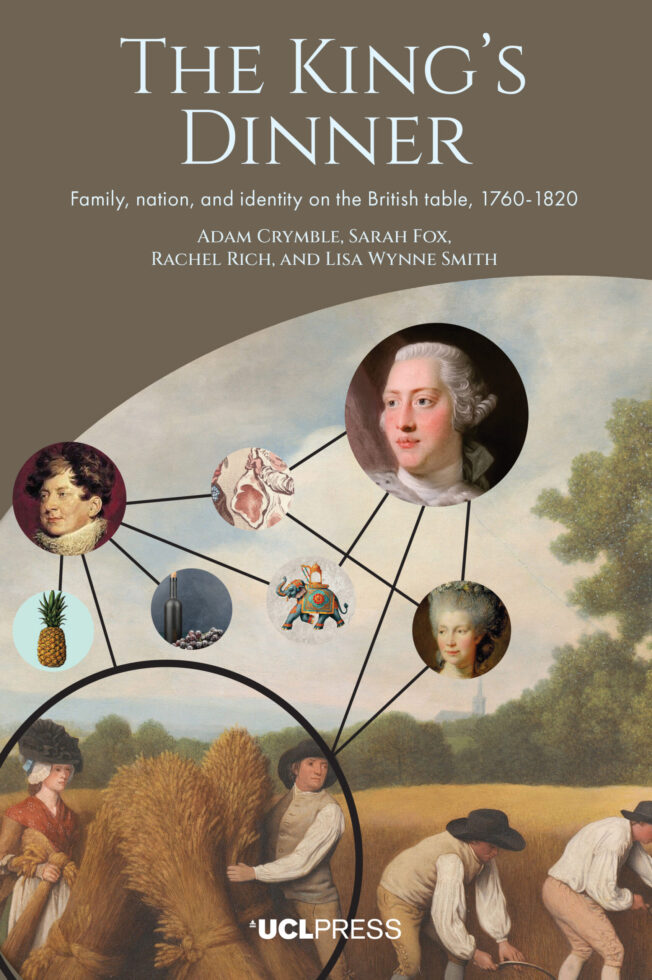
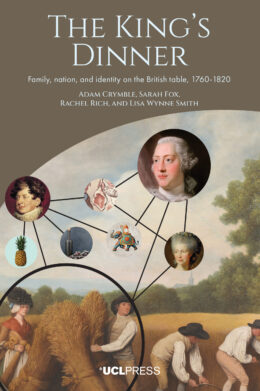
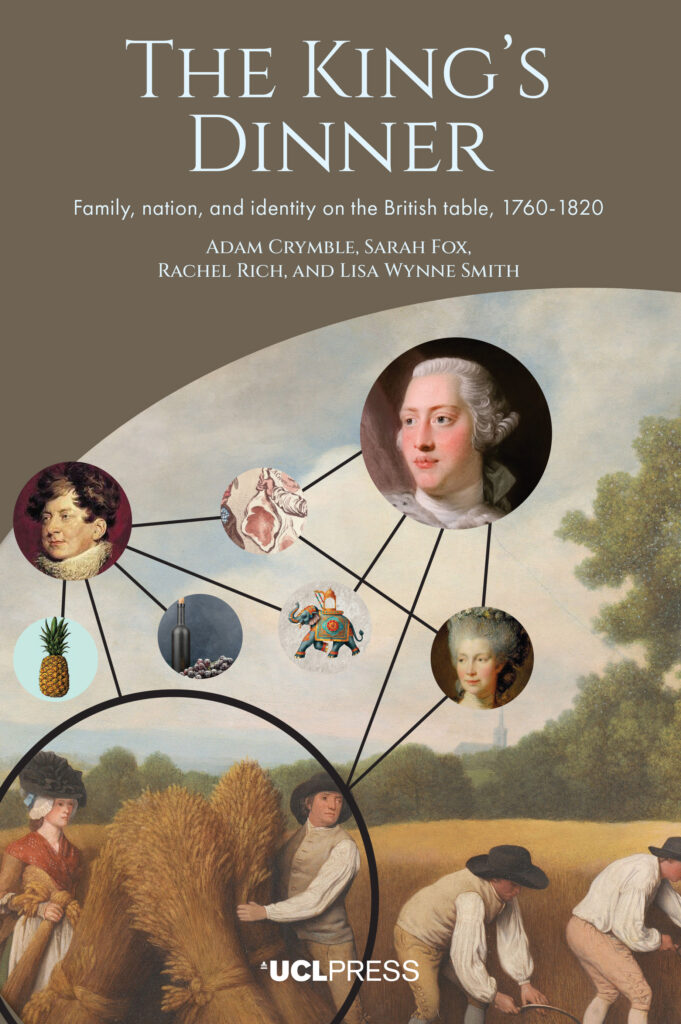
The King’s Dinner is about what it meant to be British at the end of the eighteenth century. Drawing on the vast kitchen ledgers of two royal households made newly available to research through digitisation, the authors study the role and influence of food in understanding British identity. Analysing trade routes, migration, agricultural changes, recipes, and flavours they argue that Britishness was more complex and more multicultural than previously recognised.
Starting at George III’s Kew Palace and the Prince Regent’s Carlton House, then moving in ever wider circles, the book considers the significance of food for understanding the royal family, the wider British population, their European neighbours, and the British and colonised people in the Atlantic world and the Indian subcontinent. With a growing overseas empire, Britain was an increasingly powerful nation, and the ability to choose was one of the ways this power was exercised. The cuisine that emerged was complex, with wealthy Britons adopting, adapting, or rejecting the foods of European enemies and allies or colonised peoples and places. ‘Britishness’ was an ever-shifting balance of European multiculturalism, imperial ambition, tradition and experimentation, a messy mix that reveals the entanglement of cultures and cuisines, continually changed by the people who cook and eat the food.
Family, nation, and identity on the British table, 1760-1820
Publication date: June 11, 2026
Open Access PDF ISBN: 9781806550869
Paperback ISBN: 9781806550852
Hardback ISBN: 9781806550845
Trim size (hardback): 23.4cm x 15.6cm
Trim size (paperback): 23.4cm x 15.6cm
Download free PDF online
https://uclpress.co.uk/book/the-kings-dinner/
The King’s Dinner is about what it meant to be British at the end of the eighteenth century. Drawing on the vast kitchen ledgers of two royal households made newly available to research through digitisation, the authors study the role and influence of food in understanding British identity. Analysing trade routes, migration, agricultural changes, recipes, and flavours they argue that Britishness was more complex and more multicultural than previously recognised.
Starting at George III’s Kew Palace and the Prince Regent’s Carlton House, then moving in ever wider circles, the book considers the significance of food for understanding the royal family, the wider British population, their European neighbours, and the British and colonised people in the Atlantic world and the Indian subcontinent. With a growing overseas empire, Britain was an increasingly powerful nation, and the ability to choose was one of the ways this power was exercised. The cuisine that emerged was complex, with wealthy Britons adopting, adapting, or rejecting the foods of European enemies and allies or colonised peoples and places. ‘Britishness’ was an ever-shifting balance of European multiculturalism, imperial ambition, tradition and experimentation, a messy mix that reveals the entanglement of cultures and cuisines, continually changed by the people who cook and eat the food.
‘The King’s Dinner is a genuine milestone in historiography because of its new and pertinent insights in a very broad spectrum that not only considers food, but also Britishness, social hierarchies, colonialism, language, and cultural exchanges. Warmly recommended.’
Peter Scholliers, Vrije Universiteit Brussel
Adam Crymble (Author)
Adam Crymble is Associate Professor of Digital Humanities in the department of Information Studies at UCL. His research has focused on the experience of migrants in eighteenth and early nineteenth century Britain. This has included work on Irish, Black, and English internal migrants in London. He has an interest in historical method, and data science in the service of the humanities. He is a founding editor of Programming Historian and the author of Technology & the Historian (2021). This project provided an opportunity to expand his social history research into cultural history, for the first time.
Sarah Fox (Author)
Sarah Fox is Senior Lecturer in History at Edge Hill University. Her research explores the lives and relationships of ordinary people in eighteenth-century England, and their connection to the broader structures that organise their lives. She has written and co-authored publications on the social history of law and regulation (with Margaret Brazier), the role of empathy in historical research, and embodied experiences of growing old in the past (with Karen Harvey). Her first book, Giving Birth in Eighteenth-Century England (2022) was published open access by the University of London and was shortlisted for the Royal Historical Society’s Whitfield Prize.
Rachel Rich (Author)
Rachel Rich is Reader in Modern European History at Leeds Beckett University, and co-editor-in-chief of Food & History, the journal of the IEHCA. Her research has focused on food and eating, and in particular on women’s domestic roles, and on female authors of cookbooks and other forms of domestic advice. Rachel is the author of Bourgeois Consumption: Food, Space and Identity in London and Paris, 1850-1914 (2010) as well as articles on domesticity and timekeeping, and on women cookery writers, in journals including Gender & History and Cultural and Social History.
Lisa Smith (Author)
Lisa Wynne Smith is Senior Lecturer in History at the University of Essex. She has published widely on recipes, health, gender, the household, and the body. She developed a database of Sir Hans Sloane’s correspondence, co-founded the Early Modern Recipes Online Collective (2012), and co-founded The Recipes Project blog (2012). Recent publications include book chapters on eighteenth-century fertility and beauty (2026) and early modern loneliness and food (2023), a prize-winning article (with Cathy McClive) on women and medical entrepreneurialism in eighteenth-century Lyon (2024), and an edited volume A Cultural History of Medicine in the Age of Enlightenment (2021).
Sign up to our newsletter
Don't miss out! Subscribe to the UCL Press newsletter for the latest open access books, journal CfPs, news and views from our authors and much more!