
Publication date: 23 March 2026
DOI: https://doi.org/10.14324/111.9781806550579
Number of illustrations: 12

Imperial Science, the Organic Movement and the Path to Shangri-La, 1900-1969
Ashok Malhotra (Author)
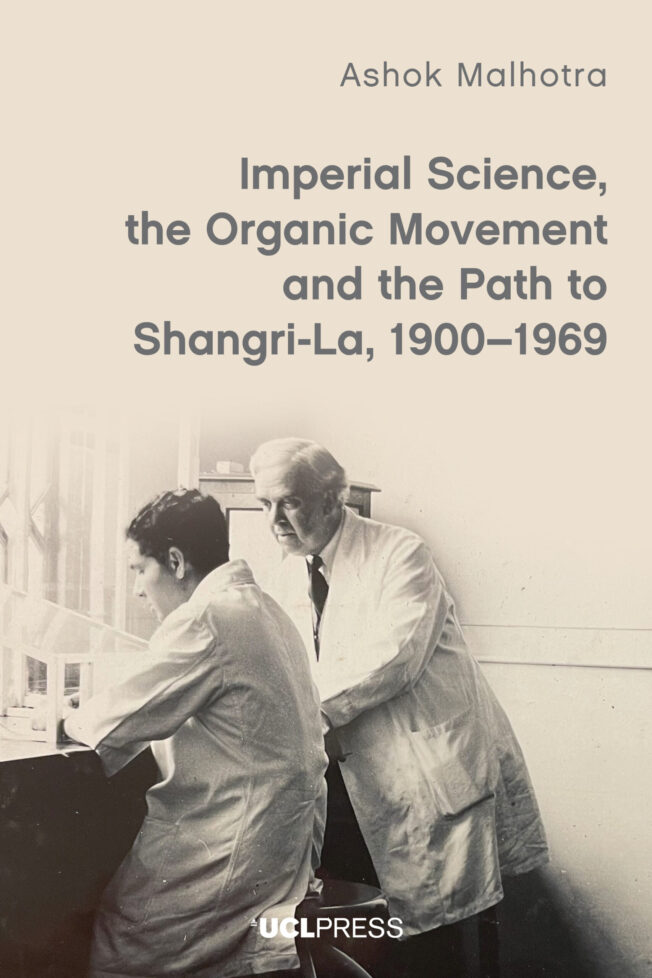
Imperial Science, the Organic Movement and the Path to Shangri-La, 1900-1969 investigates scientific studies undertaken in British India by Robert McCarrison and Albert Howard in the 1920s, and how this research was later adapted in Britain and the USA. It examines how imperial agendas and colonial stereotyping shaped McCarrison’s dietary laboratory experiments and Howard’s development of the Indore Composting Process. Ashok Malhotra reveals how Indian scientists and Indian Princes contributed to the research culture in the institutes that were founded by these two British scientists, and in so doing, he draws attention to figures whose contributions have previously been overlooked by scholars. Malhotra demonstrates how McCarrison’s and Howard’s research was interpreted by British and US-based organic farming advocates to advocate for agricultural methods which returned organic matter to the soil and rejected chemical fertilisers.
It discusses how organic advocates on both sides of the Atlantic deployed the Hunzas, a community in British India (later Pakistan), as an example of a ‘tribe’ whose vigour could be ascribed to their farming techniques and diets. The narrative concludes by demonstrating how US travel writers in the 1950s and 1960s represented Hunza as a Shangri-La – a paradise whose inhabitants lived prolonged lives in blissful contentment.
Eglė Rindzevičiūtė, Anna Storm, Linara Dovydaitytė, Karin Edberg, Rodney Harrison, Linda Ross,
01 April 2027

Toby Butler, Felix Driver, Barbara Brayshay, Chris Church, Jeremy Iles, Oli Mould, Saskia Papadakis,
12 November 2026
Imperial Science, the Organic Movement and the Path to Shangri-La, 1900-1969
Ashok Malhotra,
23 March 2026
Imperial Science, the Organic Movement and the Path to Shangri-La, 1900-1969
Publication date: March 23, 2026
Open Access PDF ISBN: 9781806550579
Paperback ISBN: 9781806550562
Hardback ISBN: 9781806550555
Trim size (hardback): 23.4cm x 15.6cm
Trim size (paperback): 23.4cm x 15.6cm
Imperial Science, the Organic Movement and the Path to Shangri-La, 1900-1969 investigates scientific studies undertaken in British India by Robert McCarrison and Albert Howard in the 1920s, and how this research was later adapted in Britain and the USA. It examines how imperial agendas and colonial stereotyping shaped McCarrison’s dietary laboratory experiments and Howard’s development of the Indore Composting Process. Ashok Malhotra reveals how Indian scientists and Indian Princes contributed to the research culture in the institutes that were founded by these two British scientists, and in so doing, he draws attention to figures whose contributions have previously been overlooked by scholars. Malhotra demonstrates how McCarrison’s and Howard’s research was interpreted by British and US-based organic farming advocates to advocate for agricultural methods which returned organic matter to the soil and rejected chemical fertilisers.
It discusses how organic advocates on both sides of the Atlantic deployed the Hunzas, a community in British India (later Pakistan), as an example of a ‘tribe’ whose vigour could be ascribed to their farming techniques and diets. The narrative concludes by demonstrating how US travel writers in the 1950s and 1960s represented Hunza as a Shangri-La – a paradise whose inhabitants lived prolonged lives in blissful contentment.
‘this is an impressive book. It effectively situates McCarrison and Howard within both the domain of colonial science and the Western world of organic farming and diet politics. Malhotra judiciously shows how ideas generated, however problematically, in the colony could fashion or conjoin with a metropolitan agenda and how readily medical science and geographical fantasies might collude with each other’.
Social History of Medicine
‘…an extremely timely, engaging, and compelling book. By tracing an important lineage between colonial science and what comes un der the category of Western organic movement, the book reveals how ideas, knowledge, and narratives emerge, mutate, and travel across different contexts, making a clear case for why understanding these dynamics matters today.’
Journal of Historical Geography
‘A valuable contribution to a growing literature on food science as well as to a more established set of studies of imperial science and medicine. Malhotra’s approach is fresh, his topic is fascinating and he is focused on figures who have thus far received scant attention. It’s likely to be of interest well beyond history: to policy makers, nutrition and foodways scholars, in science studies and STS.’
Philippa Levine, Queen Mary University of London
‘Imperial Science is a fascinating read. It provides a compelling narrative of colonial science in British India and its links with wider popular science movements in the early to the mid-twentieth century. Malhotra effortlessly melds interdisciplinary methodologies with transnational perspectives and offers a scholarly and engaging narrative of imperialism and agronomy, diet cultures and institutionalized sciences, in the nineteenth and twentieth centuries.’
Nandini Bhattacharya, University of Houston
‘Ashok Malhotra’s manuscript represents an original and fascinating contribution to the fields of history of science, environmental history and cultural/postcolonial studies. By exploring the intersection of British imperial science in India and the twentieth-century organic movement, this fine storyteller gives a textured sense of the period and the key characters under study. His book breaks new ground by demonstrating how colonial agricultural and nutritional research was selectively interpreted and deployed by organic farming and soil protection movements in Britain and the US’
Claire Chambers, University of York
‘A brilliant, sophisticated and probing account of the colonial pre-history of Anglo-American ecological research and proselytism. Ashok Malhotra’s highly readable volume is an important intervention in global food studies and the history of sustainability, demonstrating the imperial dimension of nutritional and environmental science.’
Miles Taylor, Humboldt University of Berlin