
Publication date: 21 January 2025
DOI: https://doi.org/10.14324/111.9781800085824
Number of illustrations: 74

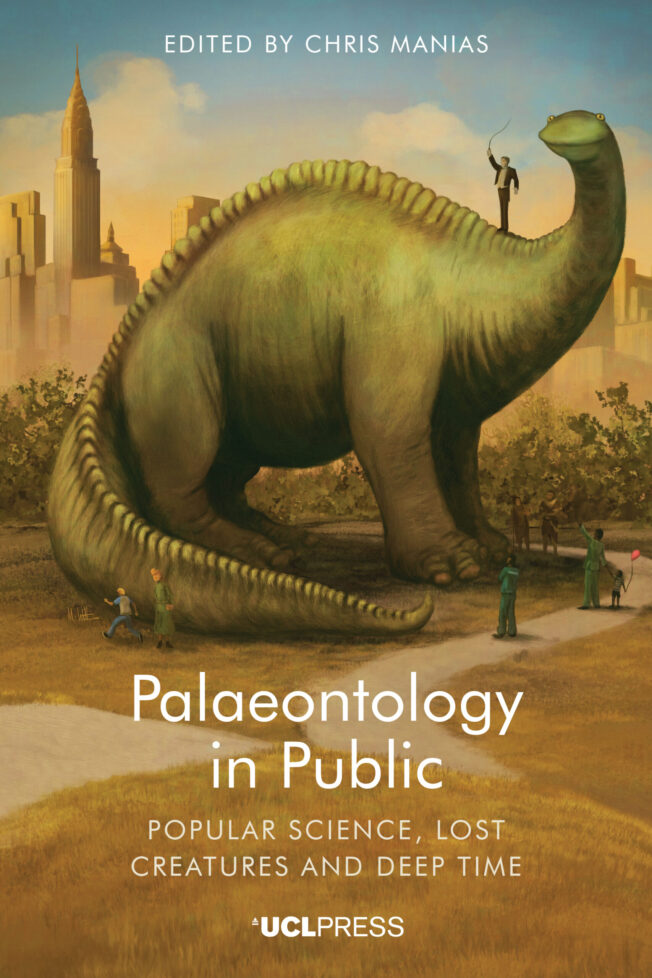
Palaeontology in Public
Popular science, lost creatures and deep time
Chris Manias (Editor)
Since the establishment of concepts of deep time in the late eighteenth and early nineteenth centuries, palaeontology has been one of the most high-profile sciences. Dinosaurs, mammoths, human ancestors and other lost creatures from Earth’s history are some of the most prominent icons of science, and are essential for our understanding of nature and time. Palaeontology and its practitioners have had a huge impact on public understandings of science, despite their often precarious and unsteady position within scientific institutions and networks.
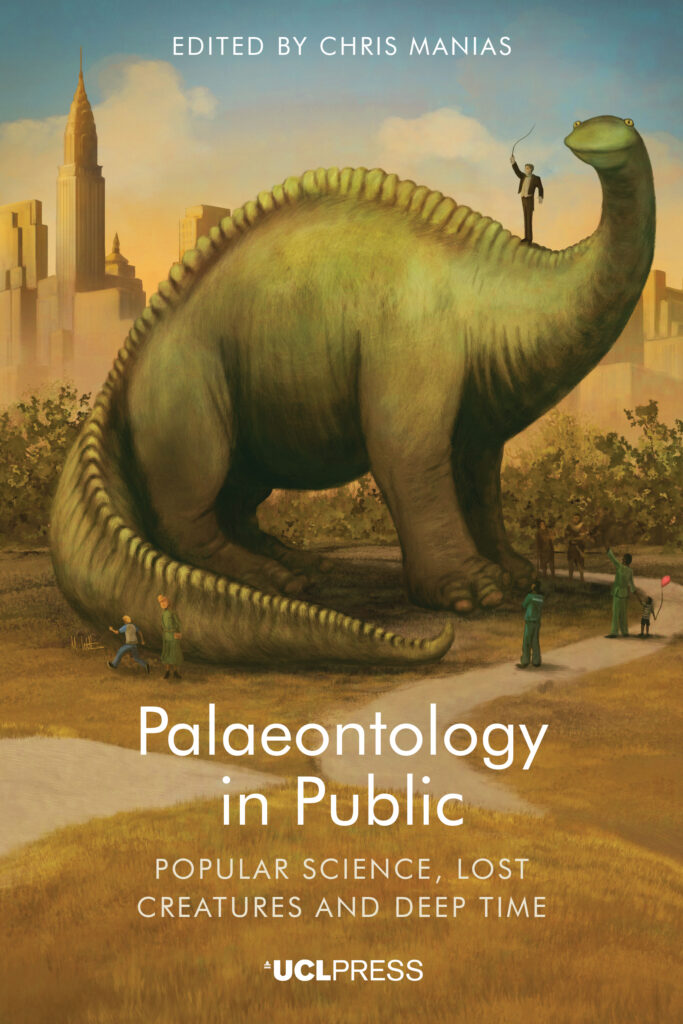
Palaeontology in Public considers the connections between palaeontology and public culture across the past two centuries. In so doing, it explores how these public dimensions have been crucial to the development of palaeontology, and indeed how they conditioned wider views of science, nature, the environment, time and the world. The book provides a history of vertebrate palaeontology through a series of compelling case studies. Dinosaurs feature, of course, including Spinosaurus, Winsor McCay’s ‘Gertie the Dinosaur’ and the creatures of Jurassic Park and The Lost World. But there are also the small mammals of the Mesozoic, South American Glyptodons, and human ancestors like Neanderthals and Australopithecines. This book shows how palaeontology is defined by its relationship with public audiences and how this connection is central to our vision of the past and future of the Earth and its inhabitants.

Eglė Rindzevičiūtė, Anna Storm, Linara Dovydaitytė, Karin Edberg, Rodney Harrison, Linda Ross,
01 April 2027
Second World War Archaeology at the Edge of Living Memory
Gabriel Moshenska, Jennifer McKinnon,
01 April 2027


How Alex Bloom Built Radical Democratic Secondary Education in Post-war London
Michael Fielding, Mark Erickson,
15 September 2026
Creating a Framework for Developing Sessional Teachers in Higher Education
Neil Sutherland, Alex Standen,
24 August 2026
Bringing Powerful Knowledge into Classrooms
Mark Hardman, Marie Nilsberth, Mikko Puustinen,
02 July 2026



Clive Young, Nataša Perović, Leo Havemann, Karen Shackleford-Cesare,
14 April 2026

Imperial Science, the Organic Movement and the Path to Shangri-La, 1900-1969
Ashok Malhotra,
23 March 2026


Palaeontology in Public
Popular science, lost creatures and deep time
Publication date: January 21, 2025
Open Access PDF ISBN: 9781800085824
Paperback ISBN: 9781800085831
Hardback ISBN: 9781800085848
Trim size (hardback): 23.4cm x 15.6cm
Trim size (paperback): 23.4cm x 15.6cm
Since the establishment of concepts of deep time in the late eighteenth and early nineteenth centuries, palaeontology has been one of the most high-profile sciences. Dinosaurs, mammoths, human ancestors and other lost creatures from Earth’s history are some of the most prominent icons of science, and are essential for our understanding of nature and time. Palaeontology and its practitioners have had a huge impact on public understandings of science, despite their often precarious and unsteady position within scientific institutions and networks.
Palaeontology in Public considers the connections between palaeontology and public culture across the past two centuries. In so doing, it explores how these public dimensions have been crucial to the development of palaeontology, and indeed how they conditioned wider views of science, nature, the environment, time and the world. The book provides a history of vertebrate palaeontology through a series of compelling case studies. Dinosaurs feature, of course, including Spinosaurus, Winsor McCay’s ‘Gertie the Dinosaur’ and the creatures of Jurassic Park and The Lost World. But there are also the small mammals of the Mesozoic, South American Glyptodons, and human ancestors like Neanderthals and Australopithecines. This book shows how palaeontology is defined by its relationship with public audiences and how this connection is central to our vision of the past and future of the Earth and its inhabitants.
‘…if this is a subject in which you are even casually interested, and certainly if strongly, it’s well worth making note of the book now.’
The Well-Read Naturalist
‘A must-read for anyone with an interest in paleontology and it’s interactions with the public.’
Paleontological Society
‘Palaeontology in Public is an excellent, well-illustrated, and highly entertaining contribution to a large and growing literature on the history of palaeontology and the public fascination for dinosaurs and other prehistoric creatures. It should be considered essential reading for historians of science, for vertebrate palaeontologists and for their graduate students. Yet, as an eminently readable open-access book, it will also be of interest to anyone with a passion for fossils.’
British Journal for the History of Science
‘This collection uses case studies to illuminate the complexity of the interplay between professional activities and public reactions, focusing on the ways in which those directly involved were attuned to the effects their work would have on the wider imagination of the past.’
Metascience
‘Surely there is a one-way traffic from science to the media? In this remarkable collection of papers, Chris Manias and the authors explore palaeontological themes from the origin of life to interpretations of human culture, through dinosaurs (of course) and many other fossil taxa.’
Michael J. Benton OBE, FRS, FRSE, University of Bristol
‘Palaeontology is a strange science, at times arcane yet so accessible that many children dream of hunting for dinosaurs among sun-beaten badlands. Palaeontology in Public digs into the overlap of these two realms, and offers a much-needed exploration of how prehistoric beings emerge from stone and enter our collective imagination.’
Riley Black, author of Last Days of the Dinosaurs and When the Earth Was Green
‘In this sweeping multi-authored compilation, reviews consider how ancient animals have been presented to the public, for good or for ill. From Lucy the australopithecine to Gertie the dinosaur and Jurassic Park, never before has so much scholarly content on palaeontology’s popularisation been amassed in a single volume.’
Darren Naish, vertebrate palaeontologist and author