
Publication date: 24 September 2026
DOI: https://doi.org/10.14324/111.9781800087484
Number of illustrations: 82

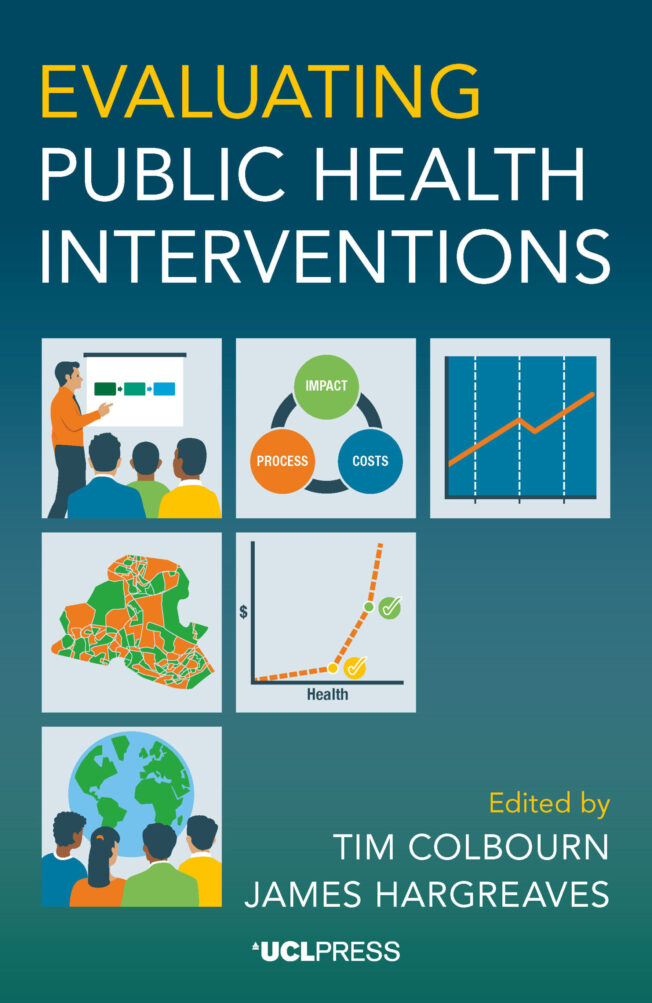
Evaluating Public Health Interventions
Tim Colbourn (Editor), James Hargreaves (Editor)
Public health interventions include any effort or policy that attempts to improve the health among individuals or an entire population. They can be run by governmental health departments or non-governmental organisations and can include educational programmes, screening programmes, vaccination programmes, environmental improvements and health promotion campaigns. Evaluating and predicting the efficacy of any public health intervention, as well as calculating the cost effectiveness is essential.
Using examples from multiple published studies conducted around the world, this textbook shows readers how to evaluate public health interventions in real world settings. It enables readers to understand how to investigate whether a public health intervention works, for whom, when, where, how and why. It provides a comprehensive introduction to key areas of evaluation including understanding complex interventions, developing programme theories, community engagement in evaluation and the main methods used in process, impact and economic evaluation. It explains how methods can be used individually and in combination to answer different kinds of evaluation question at various phases in an evaluation cycle and considers how the results of evaluations can be brought together to inform action.
Designed to support both classroom and independent learning, this textbook is the ideal guide for students, practitioners and policymakers in the field of health policy and evaluation.
Related titles
Epidemiological Change and Chronic Disease in Sub-Saharan Africa
Megan Vaughan, Kafui Adjaye-Gbewonyo, Marissa Mika,
27 January 2021

Textbook of Plastic and Reconstructive Surgery
Deepak K. Kalaskar B.Tech PhD, Professor Peter E. Butler MD, FRCSI, FRCS, FRCS (Plast), Shadi Ghali,
02 August 2016
Evaluating Public Health Interventions
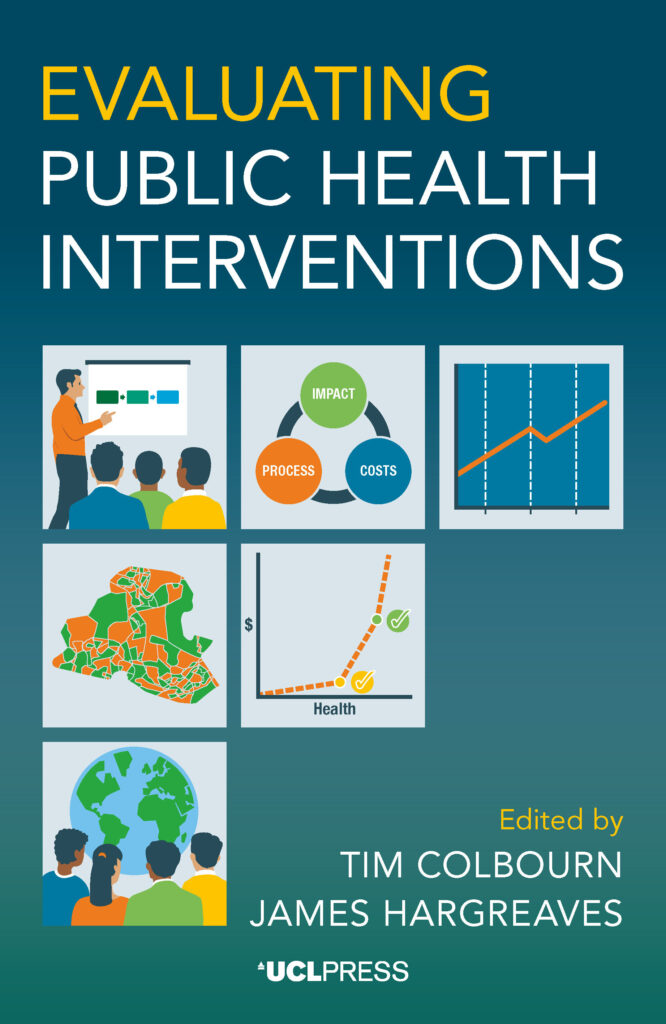
Publication date: September 24, 2026
Open Access PDF ISBN: 9781800087484
Paperback ISBN: 9781800087477
Hardback ISBN: 9781800089846
Trim size (hardback): 24.6cm x 18.9cm
Trim size (paperback): 24.6cm x 18.9cm
Public health interventions include any effort or policy that attempts to improve the health among individuals or an entire population. They can be run by governmental health departments or non-governmental organisations and can include educational programmes, screening programmes, vaccination programmes, environmental improvements and health promotion campaigns. Evaluating and predicting the efficacy of any public health intervention, as well as calculating the cost effectiveness is essential.
Using examples from multiple published studies conducted around the world, this textbook shows readers how to evaluate public health interventions in real world settings. It enables readers to understand how to investigate whether a public health intervention works, for whom, when, where, how and why. It provides a comprehensive introduction to key areas of evaluation including understanding complex interventions, developing programme theories, community engagement in evaluation and the main methods used in process, impact and economic evaluation. It explains how methods can be used individually and in combination to answer different kinds of evaluation question at various phases in an evaluation cycle and considers how the results of evaluations can be brought together to inform action.
Designed to support both classroom and independent learning, this textbook is the ideal guide for students, practitioners and policymakers in the field of health policy and evaluation.
‘Public health evaluation has long lacked a scholarly text equal to its scope and ambition. Edited by Colbourn and Hargreaves, and bringing together contributions from leading researchers, this volume advances a clear and compelling argument: that evaluating complex public health interventions in real-world settings demands rigorous scientific reasoning, a principled integration of methods, and an expansive view of what counts as evidence. It moves beyond the narrow question of whether interventions work to examine how they are implemented, through what mechanisms, at what cost, with what unintended consequences, and with what prospects for transfer across contexts.
Throughout, theoretical rigour is matched by practical orientation. Community engagement, contextual complexity, and the challenges of applying evidence in new settings are treated not as secondary considerations but as foundational to good evaluation. Global in perspective and diverse in authorship, this volume offers both a conceptual framework and a methodological toolkit for those seeking to understand and evaluate public health interventions in all their complexity.’
Mira Johri, University of Montreal, Canada
‘Evaluating Public Health Interventions provides a comprehensive overview of purposes, challenges and solutions in evaluating public health interventions, which are often highly complex in their design, and in how they interact with real-world contexts. It will act as a useful go-to resource for any newcomer to evaluation in public health. More seasoned evaluators will find chapters which provide useful introductions to areas beyond their immediate expertise within the broad field of public health evaluation.’
Graham Moore, Cardiff University, UK
‘This book is a remarkably complete and up-to-date reference on evaluating public health interventions, from process to outcomes to impacts and from community engagement to economics. It is cogent, clearly written and helpfully illustrated with tables and figures that illuminate the topic under discussion. The case studies, self-directed learning exercises and R code are very, very helpful. This comprehensive text should be a standard for public health evaluation for years to come and should be on the ‘shelf’ of epidemiologists, public health scientists, public health practitioners and funders seeking to understand what their investments are buying.’
George W. Rutherford, University of California, USA
‘This textbook fills a real gap. It will become a go-to resource for public health professionals and students for years to come, in the UK and globally.’
Liam Smeeth, London School of Hygiene and Tropical Medicine, UK
‘In public health evaluation, there has long been a need for a comprehensive guide to assessing complex interventions in real-world settings. Evaluating Public Health Interventions excels at covering process, economic and outcome evaluation. It also showcases essential concepts such as complex interventions, program theory and community engagement. It offers a broad range of methodologies, from theory-based evaluation to synthetic control and realist trials, making it an ideal guide for students, practitioners and policymakers. The book clarifies FURRIE challenges through case studies and exercises. This book is an invaluable resource, and I plan to recommend it for my evaluation course.’
Malabika Sarker, Brown University, USA
‘This is a timely and important contribution to public health from a formidable group of leading experts. With ever increasing options to optimise health, rigorous evaluation will determine whether we improve outcomes or not. Evaluating Public Health Interventions addresses practical and methodological challenges of assessing complex interventions in real-world settings. The breadth and clarity of this book make it a valuable resource for researchers, practitioners and policymakers working to strengthen evidence for better health outcomes.’
Ibrahim Abubakar, UCL, UK
‘Acute and chronic public health issues have the potential to affect everyone. Consequently, the response to these interventions is increasingly politicized. To protect evidence being the primary driver of intervention strategies, public health practitioners need to leverage empirically sound methods generating broadly applicable results. This textbook represents the state of the art of these methods presenting the reader with a broad introduction into the major categories of interventions used in public health with sufficient detail to guide the development of an intervention and the basis for those that want to learn more. It represents a unique and important contribution to the literature.’
Stefan Baral, John Hopkins Bloomberg School of Public Health, USA
‘This book offers real breadth, across methods and approaches, offering a truly multidisciplinary guide to the complexities of public health evaluation, from some of the leaders in the field.’
Mark Petticrew, London School of Hygiene and Tropical Medicine, UK
Evaluating Public Health Interventions is a timely new open-access textbook edited by two renowned public health researchers. Profs James Hargreaves and Tim Colbourn are to be congratulated on producing such a high-quality output that meets a critical gap in this dynamic and important field, and will likely contribute to strengthening evidence-based public health practice globally. The book builds on highly regarded Master’s modules taught for many years at London School of Hygiene and Tropical Medicine, UCL, and key Global South Institutes. The author list is highly distinguished. It is clear that that the chapter authors have had first-hand experience in design, implementation and evaluation of multiple interventions, with examples mainly drawn from Africa and Asia, and some are global leaders in their field. This deep expertise shines through, with numerous helpful conceptual Figures and Tables. I particularly enjoyed Part 3 (Evaluating Outcomes), which goes through the most common analytical approaches in a very readable way, and Part 5 (Evaluation Integration, Synthesis and Transferability) – which introduced me to some altogether new topics. There is something in here for everyone – from novices to Professors wanting to update their thinking and methods.
Liz Corbett, London School of Hygiene and Tropical Medicine, UK