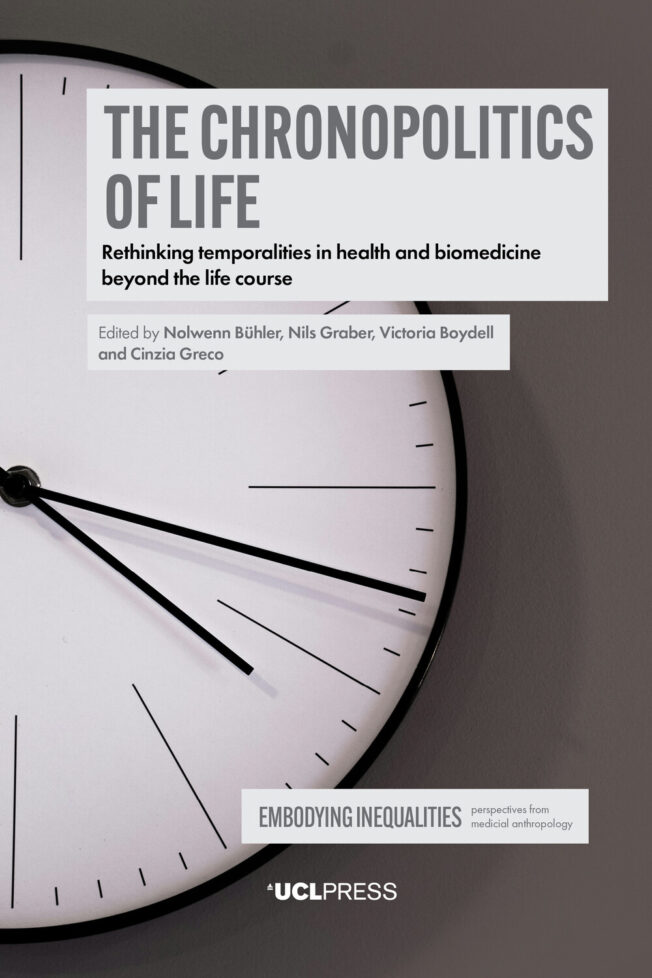

The Chronopolitics of Life
Rethinking temporalities in health and biomedicine beyond the life course
Nolwenn Bühler (Editor), Nils Graber (Editor), Victoria Boydell (Editor), Cinzia Greco (Editor)
The Chronopolitics of Life represents an important, timely and novel contribution in the fields of anthropology, social sciences of medicine, science and technology studies and cognate disciplines. By examining the concept of chronopolitics, this interdisciplinary collection explores the coproduction of temporalities, bodies and power relations in health contexts.
The book offers an original perspective on how temporalities shape the embodiment of health-related inequalities, across the beginning and the end of life. It provides empirical examples, from different places in Europe and Africa, of how technoscientific and biomedical endeavours reconfigure the temporalities of life. It also describes how time becomes a resource that is unequally distributed. By investigating health practices and lived experiences in science, institutions and governance, the authors reveal how specific temporal regimes can lead to discrimination on the basis of age, race, gender, (dis)ability and sexual orientation. This differentially shapes the experiences of ill-health, biomedical practices, the governing of bodies, biographies and the life course.

Comics and Race in Latin America
James Scorer, María Elena Bedoya, Abeyamí Ortega Domínguez, Peter Wade,
01 December 2026
Samuel Lunn-Rockliffe, Joseph Kimutai Cheptorus, Timothy Kipkeu Kiprutto,
01 December 2026



Poetics and Politics of Islamic Imaginaries
Sertaç Sehlikoglu, Fatemeh Sadeghi, Sumrin Kalia, Erol Saglam, Alexander Pymm,
01 October 2026






Alex Ungprateeb Flynn, María Iñigo Clavo, Beatriz Lemos, Florencia Portocarrero,
20 May 2026


Adrienne Evans, Jamie Hakim, Jessica Ringrose, Amy Shields Dobson, Shaka McGlotten,
16 March 2026
The Chronopolitics of Life
Rethinking temporalities in health and biomedicine beyond the life course
Series: Embodying Inequalities: Perspectives from Medical Anthropology
Publication date: December 4, 2025
Open Access PDF ISBN: 9781800089747
Paperback ISBN: 9781800089730
Hardback ISBN: 9781800089723
Trim size (hardback): 23.4cm x 15.6cm
Trim size (paperback): 23.4cm x 15.6cm

The Chronopolitics of Life represents an important, timely and novel contribution in the fields of anthropology, social sciences of medicine, science and technology studies and cognate disciplines. By examining the concept of chronopolitics, this interdisciplinary collection explores the coproduction of temporalities, bodies and power relations in health contexts.
The book offers an original perspective on how temporalities shape the embodiment of health-related inequalities, across the beginning and the end of life. It provides empirical examples, from different places in Europe and Africa, of how technoscientific and biomedical endeavours reconfigure the temporalities of life. It also describes how time becomes a resource that is unequally distributed. By investigating health practices and lived experiences in science, institutions and governance, the authors reveal how specific temporal regimes can lead to discrimination on the basis of age, race, gender, (dis)ability and sexual orientation. This differentially shapes the experiences of ill-health, biomedical practices, the governing of bodies, biographies and the life course.