We are currently upgrading our shopping cart; in the interim all orders are being diverted to Waterstones. If you would like to redeem a promotional code, or are an author wanting to place an order, please email us.
As COP30 comes to an end, we’ve pulled together a selection of open access books and journals tackling the big questions on climate change, environmental justice and sustainable futures. From practical solutions for greener cities to global perspectives on policy and activism, these titles bring fresh thinking to urgent challenges.
To mark the ICCEES 2025 World Congress at UCL in London this week, we’ve put together a reading list of essential open access books from UCL Press.
If you’re attending, Dr Chris Penfold, our commissioning editor, will be there to talk you through our extensive list of titles, and answer questions about how to publish your next open access book with UCL Press.
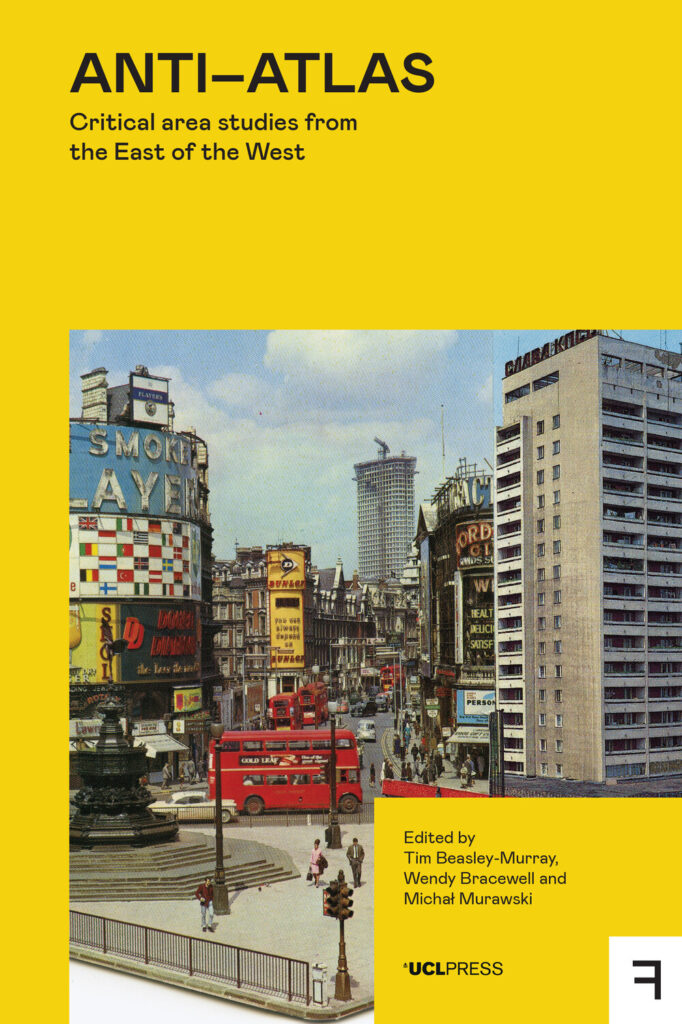
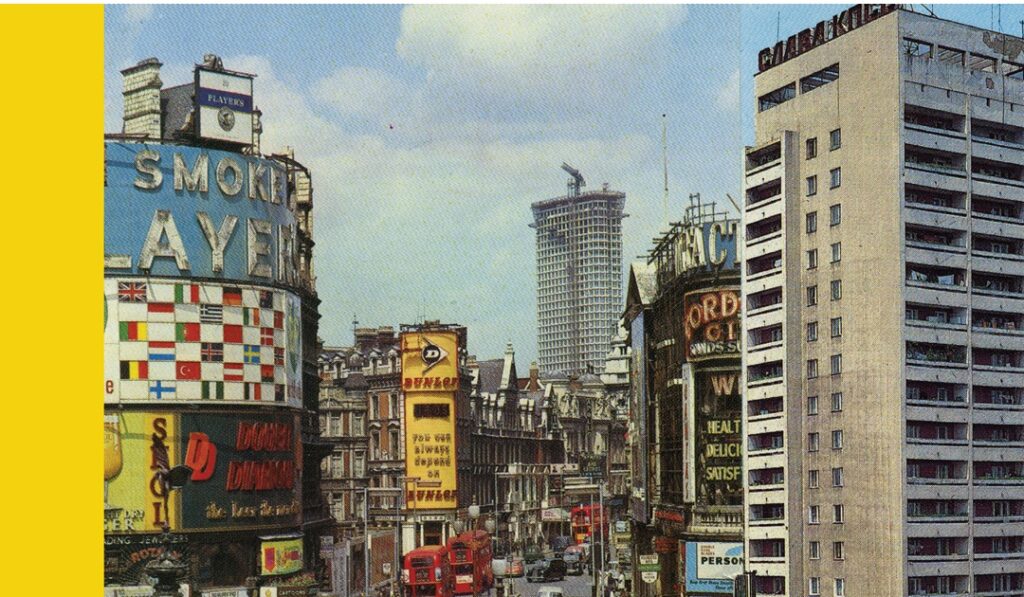
The full-scale Russian invasion of Ukraine has brought renewed urgency to questions about how we understand and study regions of the world. Anti-Atlas responds to this moment by challenging the conventions of the traditional atlas, including its assumptions about knowledge, power and spatial hierarchy.
Bringing together an eclectic mix of authors from Eastern and Western Europe, the UK and North America, the volume explores how Area Studies can be reimagined through heterodox, vernacular, undisciplined and collaborative approaches. The book includes a wide range of genres, from scholarly essays and travel guides to autobiographical reflections and data visualisations, each offering a different lens on what it means to think critically about place.
“Anti-Atlas is an imaginative, brave attempt to reframe area studies, simultaneously rebuilding ‘our images and cartographies of the world’… an essential antidote to knowledge produced in the service of empires, past or present.” — Aida A. Hozić, University of Florida
Event details
This event is open to all and will be of particular interest to those working in Area Studies, critical geography, postcolonial theory and interdisciplinary research. It will take place in person at UCL Bentham House.
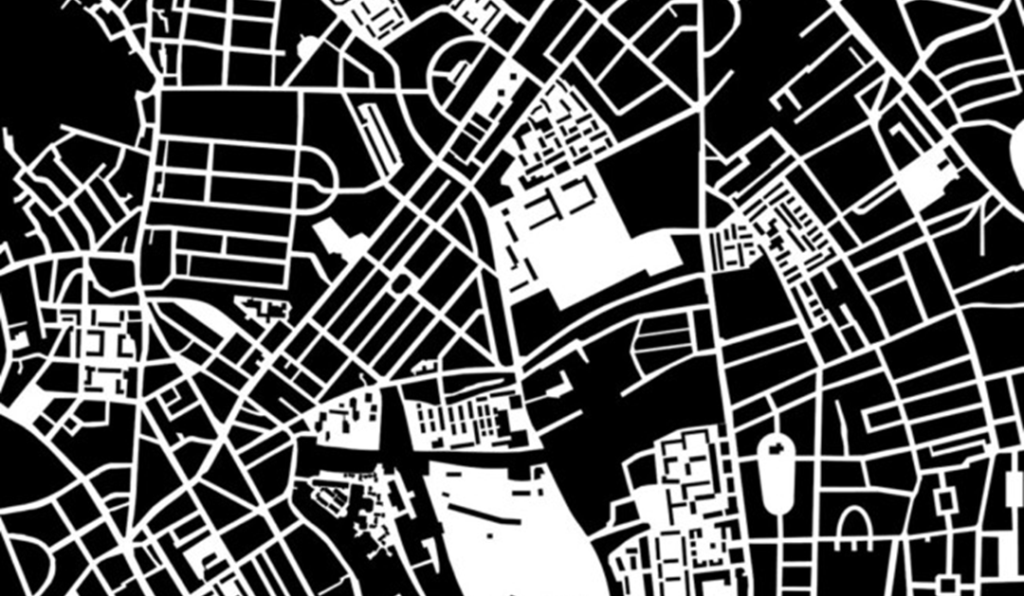
Space Syntax, a collection of the late Bill Hillier’s work that reflects the progression of his influential ideas across his career, published in April. In a post that originally appeared on Mapping Urban Form and Society, Professor Laura Vaughan reflects on Bill Hiller’s legacy, the future of Space Syntax, and a launch event that took place in May.
It’s hard to believe that it’s three years since I first wrote to leading space syntax scholars John Peponis (Georgia Tech) and Ruth Conroy Dalton (Northumbria) with the idea for an edited volume of Bill’s key papers. We had the mad notion that it would be quite a simple process. In some ways it was: we selected papers that weren’t available elsewhere for which Hillier was first author, choosing pieces that entailed significant theoretical and methodological insights, with a bias to the earlier articles and book chapters that established the foundations of the discipline of space syntax.
Edited by me, Laura Vaughan, John Peponis, and Ruth Conroy Dalton, the book offers access to essential papers on the origins and development of the discipline of space syntax, ranging from pieces on architecture as a professional and research discipline, through to later articles that present a theory of the spatial structure of the city and its social functions. By bringing together writing from across Bill Hillier’s career span of half a century, with specially commissioned introductions by a wide range of international experts in the field, we aimed to contextualise his key ideas.
The selection of contributors was relatively straightforward, as we did so on the basis that they had written something relevant about the piece in the past and/or were from adjacent fields that we felt that could add an interesting angle to Bill’s ideas. Inevitably, this consequently led to many space syntax theorists not being included.
The main themes in Bill’s work were summarised for the book’s introductory chapter, recontextualising their historical development in an extended piece written by the three editors led by John Peponis. Both he and Ruth checked, and revised where necessary, formulae and graphs that had been corrupted in earlier publications.
Page from one of Bill Hillier’s numerous notebooks, courtesy of Sheila Hillier
All the pieces were reformatted from the original, frequently poor quality photocopied papers. This involved, as well as rekeying the text of many of the earlier pieces, checking and revision of references, with additional editorial endnotes. The book also includes a list of published works by Bill Hillier. The illustrations were redrawn by a team led by Ruth Conroy Dalton, working with Emad Alyedreessy, while Nick (Sheep) Dalton, author of the original space syntax suite of software, wrote the code to generate new syntax graphs in several instances. An essential index to the book was prepared by Garyfalia (Falli) Palaiologou.
Photos from the launch courtesy of Jonathan Rock Rokem. Left-hand image shows John Peponis, Laura Vaughan, and Ruth Conroy Dalton; Right-hand image shows Ricky Burdett, Kerstin Sailer, Michal Gath-Morad, and Vinicius (Vini) Netto
The launch held a panel discussion to reflect on Hillier’s legacy and explore future directions for the field of space syntax, with prompting questions from the event’s chair, Kimon Krenz. Linked to below are the brief papers prepared by John Peponis and Ruth Conroy Dalton, as well as those of several of the panellists.
Professor Laura Vaughan is Director of the Space Syntax Laboratory at the Bartlett School of Architecture, University College London, where she is Professor of Urban Form and Society. Following an architectural design degree at the Bezalel Academy of Art and Design, Jerusalem, Israel, she studied for an MSc and PhD at the Lab. After several years working with Bill Hillier at Space Syntax Limited, she returned to UCL in 2001 as lecturer and Programme Director, MSc Advanced Architectural Studies (now MSc/MRes Space Syntax). She has been the Lab’s Director since 2014. In addition to co-editing Space Syntax, she also edited Suburban Urbanities (UCL Press, 2016) and is author of Mapping Society (UCL Press, 2018).
It’s been another grey, dark, wet month, but we’ve almost been too busy to notice. With six more exciting open access books to read, who can blame us?
The final volume of David Scott’s extraordinary On Learning trilogy (v1, v2) , On Learning, Volume 3: Knowledge, curriculum and ethics published at the start of the month. Like the first two volumes, the book is a response to empiricist and positivist conceptions of knowledge. in which the author challenges detheorised and reductionist ideas of learning that have filtered through to the management of our schools, colleges and universities, over-simplified messages about learning, knowledge, curriculum and assessment, and the denial that values are central to understanding how we live and how we should live.
Lahore in Motion: Infrastructure, history and belonging in urban Pakistan provides a vivid portrait of the Pakistani metropolis by tracing the path of the city’s first metro rail corridor. The volume collects stories from a series of walks along the metro’s 27-kilometre path, bringing together a wide variety of authors to reflect on the relationship between urban change and belonging in a historic city. Interested to find out more? We have an excusive excerpt on the blog.
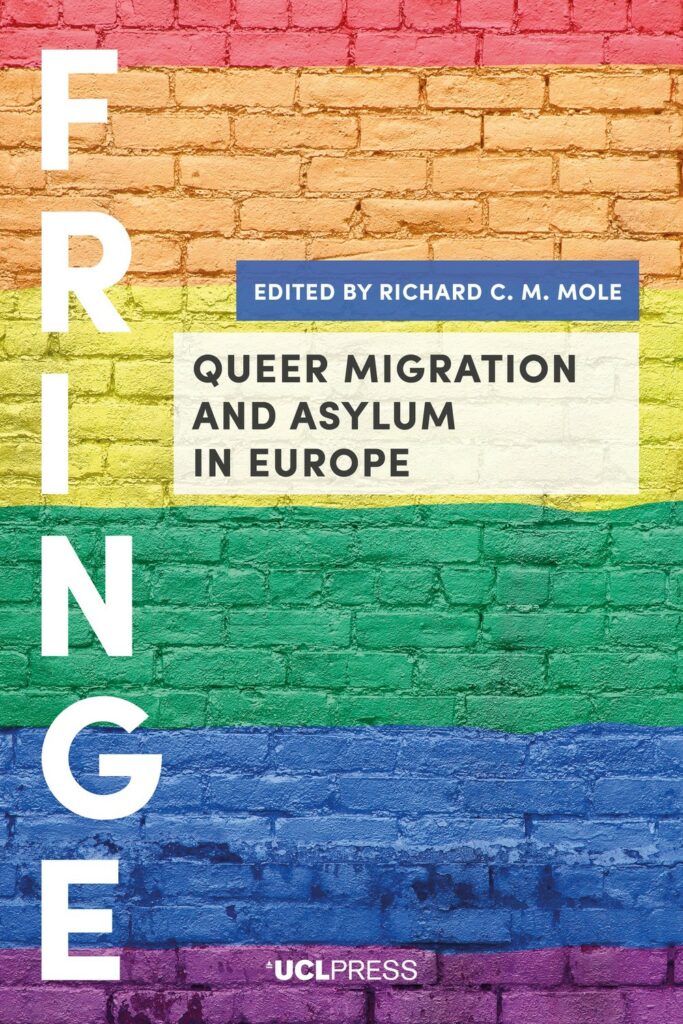
The latest book in the FRINGE series,Anti-Atlas: Critical Area Studies from the East of the Westplays with the politics of the conventional atlas, with its assumptions about knowledge and power, its hierarchies of value, and its simplifications. It provides readers with a diverse series of intellectual resources, asking them to think critically about the ways in which we construct the world by dividing it into pieces.
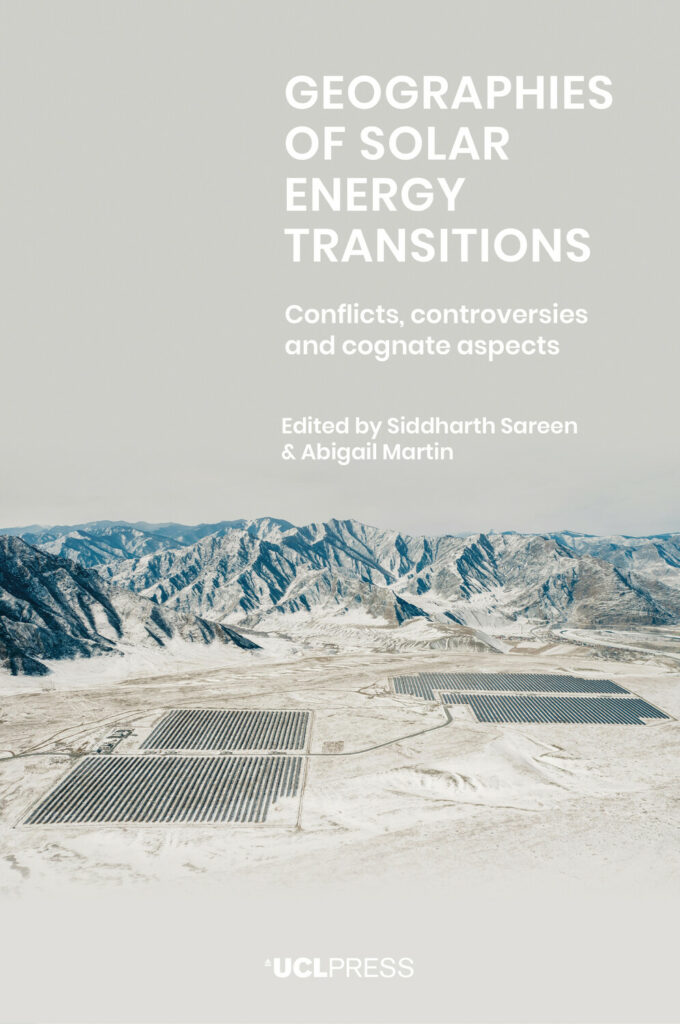
We are delighted to announce that Geographies of Solar Energy Transitions has been awarded the American Energy Society’s best edited book award for 2024!
Edited by Siddharth Sareen and Abigail Martin, with a host of outstanding contributors, Geographies of Solar Energy Transitions focuses on how solar energy governance (both state-based regulations and more market driven modes of governance) is evolving to address a diverse range of conflicts and challenges.
Each year, the American Energy Society surveys the energy landscape and spotlights the most extraordinary contributions to energy and sustainability. Categories include books, media, people and STEM.
The announcement said that ‘Geographies of Solar Energy Transitions (UCL Press) focuses on how solar energy governance (both state-based regulations and more market-driven modes of governance) is evolving to address these conflicts in diverse settings. Each chapter is well written (especially chapter 4 “Beyond Power” by Karla Cedeño and Ana G. Rincon-Rubio; and also chapter 10 “Governing solar supply chains,” by Dustin Mulvaney.’
Congratulations to the volume’s editors and contributors!
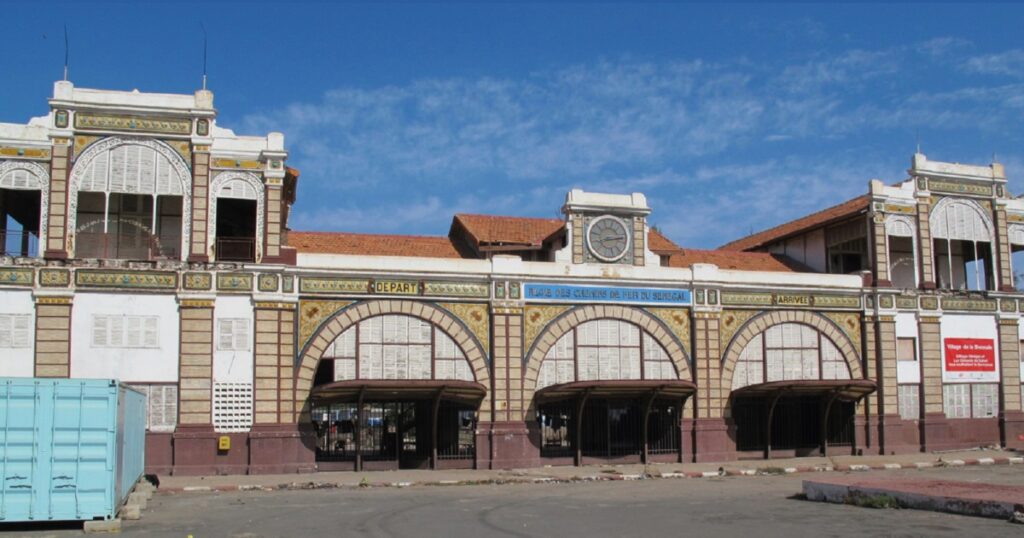
To celebrate World Urbanism Day, the editors of the open access Urban Africa series, co-published with the International African Institute, have opened a new call for proposals for new books. The series provides a platform for critical, in-depth analysis of key contemporary issues affecting urban environments across the African continent.
The editors aim to work in close collaboration with African based networks and centres of urban scholarship to publish the best of urban research on Africa, prioritising the publication of work by scholars based in African contexts as well as leading African scholars globally. Their goals are to publish an urban studies series with a distinctive African-centred approach; to provide a high-profile platform to urban scholars from the African continent; to bring the best work in African urban studies globally to African studies audiences; and to make publications widely accessible to African based scholars.
The series tackles the most important issues of the day, such as demographic change; climate change; increasing mobility; major infrastructure investments. It fosters transdisciplinary perspectives, with strong links to all areas of research prominent in urban studies, notably human geography, architecture, ethnography, anthropology, sociology, environmental studies, urban planning, politics and development. It seeks to establish insights from African urbanisms as fundamental to theory development in urban studies and place African cities in conversation with other urban contexts. The series also seeks to showcase the best of urban scholarship emanating from the African continent, and to amplify the voices of scholars who are immersed in the day-to-day realities of African urban life. The series is open to both conventional and innovative formats.
UCL Press books are open access, and manuscripts accepted for this series will incur no book publishing charge.
All proposals and further queries can be directed to Stephanie Kitchen, sk111@soas.ac.uk, or to one of the lead editors, Jennifer Robinson (Jennifer.Robinson@ucl.ac.uk) and Jeffrey Paller (jpaller@usfca.edu).
September has provided us with a bumper harvest of five new titles covering everything from solar energy transitions to smuggling via a fascinating account of the fight against gentrification in a London suburb.
Modern Americas gave us another absorbing volume: Contraband Cultures: Reframing smuggling across Latin America and the Caribbean. presents narratives, representations, practices and imaginaries of smuggling and extra-legal or informal circulation practices, across and between the Latin American region (including the Caribbean) and its diasporas. If you’re interested in finding out how smuggling and the informal economy and
With government ever more dependent on speculative property developments that come at the expense of diverse working-class communities, Disrupting the Speculative City: Property, power and community resistance in London tells the fascinating story of successful community resistance in Tottenham, a suburb of London, to inspire urban movements and researchers.
We ended the month with a new volume of the Grammars of World and Minority Languages series: A Grammar of Elfdalian. Elfdalian is a unique language raditionally spoken in Övdaln (Älvdalen), central Sweden; this open access book provides a full account of Late Classical Elfdalian from linguistic, historical and sociolinguistic angles.
We’ll be back again next month with a round up of the very best open access books. As always, stay safe!
Sign up to our newsletter
Don't miss out! Subscribe to the UCL Press newsletter for the latest open access books, journal CfPs, news and views from our authors and much more!