How to know something improves public health
Posted on 25th September, 2026
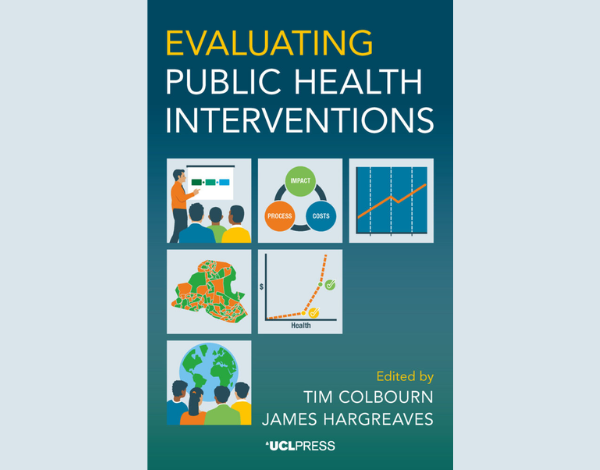
Improving public health prevents early deaths and improves our lives. But how do we know what improves public health and what doesn’t? how and why something improves public health for some people and not for others? and whether something is worth spending scarce time and money on instead of something else to improve public health? Our new book, Evaluating Public Health Interventions, provides answers to all of these questions and more, and is freely available open access online from UCL Press.
All the book’s authors have been evaluating interventions for years, and this book came out of our teaching over the past dozen years at UCL and LSHTM. So this book is for Masters and PhD students, but also for people working in public health, and policy makers who want to understand how to know they are improving public health. We cover impact, process and economic evaluation of public health interventions all in one 20-chapter book. Over four years in the making and with 60 expert authors, many of them leaders in the fields covered in their chapters, this is a book not to be missed. One to be downloaded, saved on all your devices, read, and searched (we also have a useful glossary at the end of the book), for public health people worldwide. Print copies are available to buy if you prefer to have it on your shelf.
We use examples from all over the world and cover the evaluation of diverse public health interventions ranging from vaccination accessibility and promotion, to stopping smoking, nutrition, sexual health behaviour change interventions, maternal and child health, substance use, non-communicable diseases, and more. The book starts with key fundamentals including the history of the field, the disciplines feeding into it, how it all fits together, what the challenges of evaluation of public health interventions are, how to ensure communities are involved, and the importance of underlying theory. We cover cluster randomised controlled trials and five quasi-experimental methods for determining whether and how much a public health intervention improves an outcome. We cover implementation and programme theory, process evaluation, qualitative and quantitative methods, and realist evaluation to explain how and why an intervention does or doesn’t improve an outcome. We cover economic evaluation to determine costs and cost-effectiveness of interventions. We cover realist trials, evidence synthesis, and how to use evaluation to inform decisions on public health interventions in new settings.
We hope you find it useful – please do let us know if you use it in your teaching or practice!
Blog post written by Tim Colbourn and James Hargreaves, on behalf of all authors of Evaluating Public Health Interventions.
UCL is ranked third in the world for public health and delivers outstanding research and teaching for improved human health and wellbeing worldwide. UCL Institute for Global Health has just launched a new DrPH (Doctor of Public Health) programme.
At LSHTM, the Centre for Evaluation (CfE) brings students, staff and partners together to share learning and strengthen knowledge on how to evaluate public heath interventions. With contributions from members of the CfE management committee and wider network, this book is a valuable resource for everyone interested in evaluation and public health.