Get to know the editors behind Rethinking Urban Entrepreneurialism
Posted on 5th November, 2026
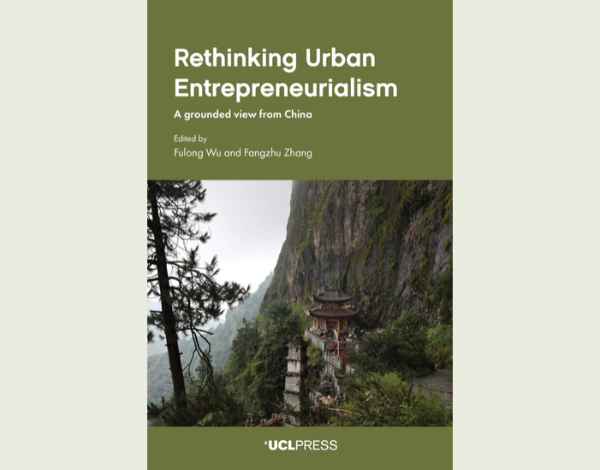
Rethinking Urban Entrepreneurialism is a new edited collection from UCL Press, edited by Fulong Wu and Fangzhu Zhang. Interested to learn more? Keep reading to find out some key information from the editors themselves.
Can you introduce yourselves to our readers?
Fulong Wu: I am a Bartlett Professor of Planning at UCL. My research interests include China’s development and governance, and I lead a European Research Council (ERC) advanced grant on China’s urban governance. I am the author and co-author of several books, including Creating Chinese Urbanism: Urban Revolution and Governance Change with UCL Press.
Fangzhu Zhang: I am a Professor of China Planning at The Bartlett School of Planning, UCL. My main research interest is on China’s innovation and environmental governance, and I am working alongside Fulong on the ERC advanced grant. I am founding editor-in-chief of Transactions in Planning and Urban Research, and co-author of Governing Urban Development in China: Critical Urban Studies.
Can you tell us a little more about your edited collection, Rethinking Urban Entrepreneurialism?
Absolutely. This book provides a grounded view from China to rethink a now classic theory of urban entrepreneurialism in critical Urban Studies and Geography. It challenges the conventional understanding of urban entrepreneurialism as capital-driven governance and argues that Chinese urban governance comprises two interrelated aspects: entrepreneurial governance and innovative statecraft.
Rethinking Urban Entrepreneurialism extends the specific form of public-private partnerships of urban entrepreneurialism into a broader form of statecraft known as ‘state entrepreneurialism’ and demonstrates a strong state intentionality. It also reveals the limits of entrepreneurial governance and multiple managerial practices in China. It transcends the binary view of authoritarianism versus entrepreneurialism, showcasing a wide spectrum of entrepreneurial and managerial governance features.
What makes your edited collection unique?
Our book breaks out of the ‘urban entrepreneurialism’ mode of thinking by arguing against a definitive ‘model’, or describing a fluid reality with a fixed and stable ‘concept’. Instead, it looks into perceived ‘entrepreneurial practices’ from a different angle: the statecraft of managing a changing economy and society.
It engages with the debates on entrepreneurialism vs authoritarianism; enriching the concept of ‘urban entrepreneurialism’ derived from western post-industrial economic restructuring and governance change to offer a new concept of ‘state entrepreneurialism’.
The book provides a historical and material understanding of a wide range of current planning and development practices; from large infrastructure projects to neighbourhood regeneration and social management. The book also extends to social governance.
Finally, the contributors are all active researchers on China planning and developments.
Who is your edited collection for?
The book provides an introduction to basic concepts and concrete examples, making it very accessible for readers. As ‘urban entrepreneurialism’ is a key topic in most undergraduate and postgraduate courses on cities, planning and governance, and geography, the book will be attractive to studies in geography, planning, urban studies, and also political and social studies. It will also be useful to those in area studies such as China Studies.
Thank you both for your time.
Rethinking Urban Entrepreneurialism is available to read now as an Open Access PDF. Click the button below to learn more.