Twice invisible: Sessional teachers and the educational leaders who support them
Posted on 11th November, 2026
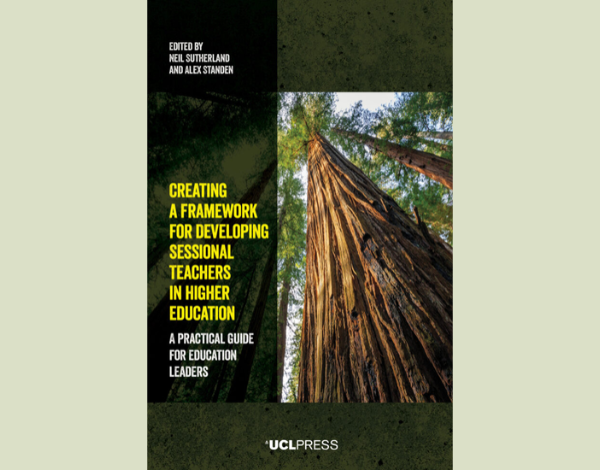
Article written by Alex Standen (LSE) and Neil Sutherland (UCL), editors of Creating a Framework for Developing Sessional Teachers in Higher Education
According to the Higher Education Statistics Agency, 28% of academic staff in UK universities were employed on fixed-term contracts in 2024/25 (HESA, 2026). When Neil and I worked together at UCL a few years ago, we wanted to build a community of colleagues from across disciplines who were committed to supporting and developing the teachers on these ‘atypical’ contracts in their departments and programmes. By providing a platform for this community, we hoped they could learn from each other, surface shared concerns, and support the enhancement of teaching practices across the institution.
At a Symposium in Spring 2023, we brought together a group of colleagues to share their excellent practice. The examples they shared were compelling. For some, this was running induction programmes for Graduate Teaching Assistants, for others it was coordinating marking across large modules taught by practitioners, for others it was leading modules where the teachers all held fractional UCL posts. But all expressed that, having made this commitment to their teachers, the benefits to students were clear. In fact, one case study from Speech and Language Sciences even observed an increase in PTES scores: ‘these changes have been recognised by our students in their feedback to us, as five years after commencing this process, our overall PTES scores for Assessment and Feedback increased to 83.2%’ (Pepper & Shobbrook, p. 253).
The advantages of course extended to the teachers themselves as well. Their temporary positions in HE are, for many, characterised by uncertainty, marginalisation and dissatisfaction. By contrast, what we observed in our colleagues’ case studies were practices that centred, supported and rewarded their contributions, including through mentorship, professional recognition and collaboration.
We had expected to see these benefits to students and teachers, but we also noticed an additional benefit. Many of the colleagues who were presenting did not themselves hold formal leadership roles, but were clearly taking leadership in this space: a space that can be additionally challenging to navigate in a research-intensive environment. By sharing their approaches and initiatives with others at the Symposium, we saw how this was also making their leadership visible.
With these benefits in mind, we felt strongly that the Symposium provided the makings of a book project. We reached out to contacts and collaborators in a range of institutional settings to gather further examples and case studies. We grappled with the nature of the HESA-defined ‘atypical’ and sought a term that was more inclusive and positive. We mentored authors who had little experience of writing about their education work with a scholarly lens. We brought chapter authors together to engage in cross-institutional dialogue. We provided a structured framework for contributions which included drawing out tangible take-home lessons and making connections across chapters. We celebrated together the richness of practice that is in evidence across the sector. All of this work came together to become our book: Creating a Framework for Developing Sessional Teachers in Higher Education.
In our conclusion, we write that our sessional teachers ‘occupy positions marked by precarity, liminality and structural invisibility, their labour both essential but often experienced or perceived as undervalued. Supporting them is not simply an act of pastoral goodwill, it is an institutional imperative that underpins teaching quality, student experience and the cultivation of positive, sustainable academic communities.’ Reflecting on editing this volume, we can’t help but feel that the same could be said for our authors and contributors: in many institutional settings, educational development work can be invisible, misunderstood and undervalued.
If institutions are to thrive in these increasingly complex circumstances, recognising, valuing and rewarding compassionate, positive and transformational educational leadership should be an institutional imperative.
Interested to learn more? Click the button below to find out more about Creating a Framework for Developing Sessional Teachers in Higher Education.