Get to know the editor behind Critical Thinking for the Arts and Humanities
Posted on 29th October, 2026
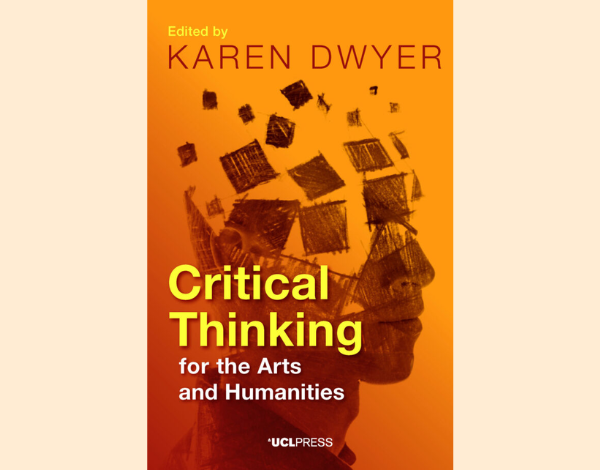
Critical Thinking for the Arts and Humanities is a new textbook from UCL Press, edited by Karen Dwyer. This brand-new title utilises research conducted at UCL to illustrate critical thinking skills and guide students through the research process. Interested to learn more? Keep reading to find out some key information from Karen herself.
Can you introduce yourself to our readers?
I am a linguist with research interests in psycholinguistics; particularly in how language is processed and experienced. My research has explored language and communication disorders in relation to mental health, as well as how people articulate and develop understandings of experiences of spiritual phenomena.
More recently, I have become interested in less familiar aspects of language experience, including phenomena such as involuntary auditory imagery, and verbal earworms in particular. Across these areas, I am interested in the relationship between language, experience, and the ways people make sense of what happens to them. I investigate these questions using a combination of experimental methods and discourse analytic approaches.
Alongside my research, I am a Lecturer in English Linguistics at UCL. My teaching covers areas including English in Use, which explores how people use language to achieve communicative goals, as well as English grammar, research methodology, and academic skills. I also run workshops on critical thinking, helping students to engage with academic research and ideas more confidently and critically. An important part of this is helping students recognise that disciplines can have their own ideas about what counts as knowledge, evidence, and a reasoned argument. I support students in navigating these disciplinary differences and communicating their ideas clearly across a range of academic contexts.
Can you tell us a little more about your textbook, Critical Thinking for the Arts and Humanities?
Absolutely. This textbook introduces critical thinking across the arts and humanities, exploring how different disciplines approach questions of knowledge, evidence, and argument.
The book uses real research case studies to show how critical thinking is applied in different disciplines. It aims to help students understand where their own discipline sits within the broader landscape of the arts and humanities, how these fields share common goals, core questions and critical values, and the range of methods and approaches they encompass. I hope this broader perspective encourages students to look beyond their own disciplinary boundaries and explore more interdisciplinary ways of thinking. The accompanying exercises give students opportunities to develop these skills further by working with ideas from the case studies and applying them to their own work and real-world contexts.
What makes your textbook unique?
The most distinctive feature of the textbook is that it uses authentic, published research by UCL scholars in the Arts and Humanities as case studies to show how critical thinking is applied in research. Rather than presenting critical thinking as a set of abstract skills, the book allows students to see how these skills operate within particular disciplinary contexts.
Each case study is accompanied by annotations, pre- and post-study activities, and glossaries that help students identify and practise specific critical-thinking and research skills. They also encourage students to engage with research beyond their own discipline and to explore a range of methodological, analytical, and theoretical perspectives. In this way, the book makes critical thinking concrete and transferable, while showing students how these skills can be applied both within and beyond academia.
Who is your textbook for?
The textbook is a broad, accessible resource that can support teaching and learning across a range of courses and modules, as well as independent study. It is not tied to any one particular course, so it can be used in different teaching contexts.
It will be useful for undergraduate and postgraduate students across the Arts and Humanities, as well as lecturers looking for a resource to support research methodology, study skills and critical thinking teaching. It may be particularly useful to students and researchers working across disciplinary boundaries.
How might your textbook be used?
There are lots of ways the textbook could be used. It could work as a core or supplementary resource for research methodology, study skills, and critical thinking modules and workshops across the Arts and Humanities. The case studies can provide a starting point for seminar and workshop discussion, while the accompanying activities give students the chance to analyse research, develop their own arguments, and apply critical-thinking skills to their academic work.
As the book brings together research from across the Arts and Humanities, it can also be used in a wide range of courses, particularly those that focus on critical reading, analysis, and interpretation. I can also see it being useful in interdisciplinary and preparatory or pre-sessional teaching, including courses such as those offered by UCL’s Centre for Languages & International Education (CLIE).
Thank you for your time, Dr Dwyer.
Critical Thinking for the Arts and Humanities is available to read now as an Open Access PDF. Click the button below to learn more.