How does open knowledge contribute to society?
Posted on 27th October, 2026
OASPA’s annual conference brings together publishers, librarians, researchers and other stakeholders from across the scholarly communications community to discuss the future of open access and research dissemination. In this blog post, Sunbul Akhtar, Journals Development Editor at UCL Press, reflects on key themes from OASPA 2026, including the role of open knowledge in society, the importance of reaching audiences beyond academia, and the challenges and opportunities that generative AI presents for open access publishing.
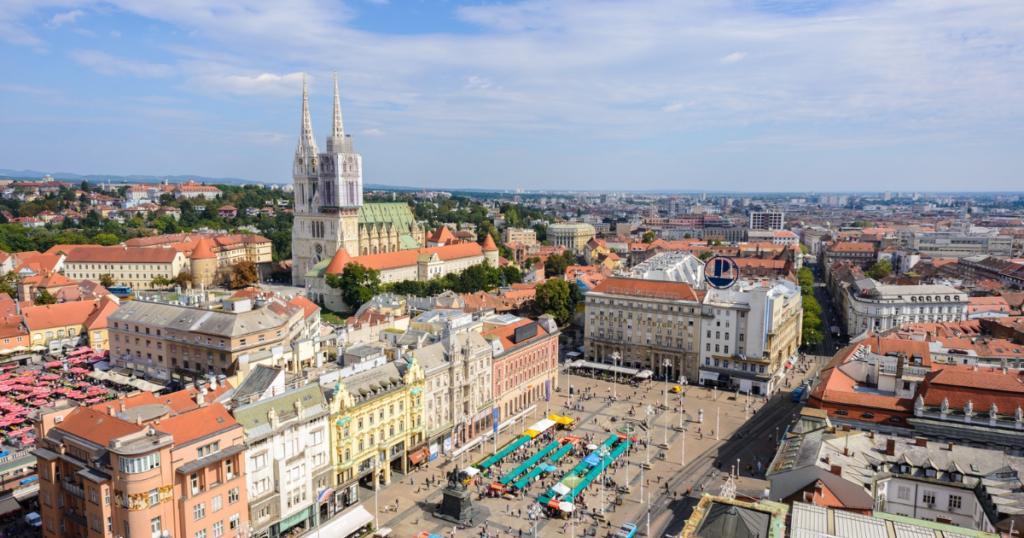
Once a year, a community of publishing representatives come together to discuss the most pressing issues in scholarly communication. The keynote speech, panel discussions and open forums offer a glimpse into the trends affecting an industry that bears on those of us working in universities. At first glance, the business of scholarly publishing can seem distant from the day-to-day work of most university staff. Yet the issues discussed at OASPA, from research dissemination to AI and copyright, increasingly affect researchers, librarians, communications teams and institutional leaders alike. The Open Access Scholarly Publishing Association (OASPA) 2026 conference took place in Zagreb this year, attended by over 150 people from 119 organisations, including UCL Press.
OASPA’s mission is to advance open access publishing and, as the world’s first fully open access university publisher, UCL Press is a member. Over the course of three days, the community came together to discuss hot topics in open access scholarly communication in 2026 against the backdrop of 18th century Austro-Hungarian architecture in the heart of Zagreb. While each of the panels at OASPA 2026 discussed a broad spectrum of issues, the overriding message to me was how making research free (or, open) at the point of access contributes to society.
Diversifying the dissemination of scholarly communication
It is through research and knowledge that we can tackle the challenges of the modern world, from armed conflicts to environmental disasters. Open access publication helps to facilitate this by allowing published, peer reviewed research to be accessed by anyone anywhere in the world. But in the publishing community there is a level of complacency in tackling dissenting voices to scientific knowledge in that we, collectively, are producing and platforming knowledge without diversifying the dissemination to ensure it reaches everyone, not just those within the academic community. Diversifying the dissemination of scholarly communication was addressed by making research free at the point of access with the idea that if you remove the paywall, knowledge will flow. But open access publication alone cannot bridge the gap between knowledge producers and the general public. It is not enough to share knowledge if it isn’t effecting change in society and amongst policy makers. One of the pressing issues discussed at OASPA 2026 was bridging this gap but also the need for knowledge producers to collaborate, from publishers to researchers, practitioners and policy professionals.
So, what responsibility do we all have to push past conventional methods of research production and meet some of these challenges we’re witnessing in the societies we live in? At UCL Press, the author blog accommodates alternative research presentation by providing authors with a platform to discuss their research in a conversational tone to make scholarly research accessible to a wider audience. This one step is making leaps in the dissemination of research. History Education Research Journal alone has more than 10,000 hits to the author blog over the past 12 months.
Elsewhere, the scholarly community has addressed this gap by providing their own platforms for academic discussions. The LSE blog functions as a digital knowledge exchange platform for accessible summaries of academic research that address social science challenges. The Conversation, which publishes accessible and topical articles by academics, offers a similar platform.
Ultimately, what this means is that scholarly research doesn’t just circulate within the scholarly community, but can be accessed, and is accessible to, a wider audience allowing this research to permeate through society and act as quality markers against dissenting voices to scientific knowledge. I was proud to be in a room where questions were being asked of diversifying dissemination and having a proven record from UCL Press to respond with.
Open Access in a GenAI world
Carrying on from the discussion to diversify dissemination of scholarly research, I find that there is more effort being taken to accommodate LLM platforms trawling Open Access scholarly outputs than there has been in bridging the gap between scholarly output and the general public. In 2025 servers were taking unprecedented lengths of time to load pages across open access publication sites due to trawling from AI platforms. It was difficult to know whether this took place in response to human driven prompts or if AI platforms were initiating this action to feed their platform. With no real agency in this exchange, the response from the publishing community was to continue to allow LLMs to trawl open access publication sites for content to ethically contribute to prompts by producing verified, peer reviewed sources.
Summarising research outputs in a prompt also goes to some length to make accessible academic content and so contributes to the dissemination of scholarly research. At OASPA 2026 we were asked what role open access publishers have to play in ensuring that trustworthy information is being included in search results. Most academic publisher sites you visit today will have a firewall to prevent trawling from LLMs and the impression this question gave me was that we in the publishing community should remove firewalls and allow full access to our content, whether to humans or machines.
Missing from the room are the LLM platforms that have come to dominate these discussions and we can equally ask of them what role do they play in ensuring trustworthy information is included in the search results their platforms provide. Some panellists argued for making efforts to work with AI firms on the question of provenance, attribution and trust, again placing the responsibility on publishers to reach out to and accommodate these platforms.
A poll taken by a US based scientific society presenting at OASPA 2026 showed that over 70% of researchers and editors responding to the poll admitted to using AI to conduct literature reviews. What does this mean in the context of open access research? Considering the growth in publication output across scholarly publishing, one speaker argued that there may come a point where the volume of scholarly publishing exceeds the capacity of human readers alone.
Can the Open Access CCBY license survive the advent of GenAI?
One point that came out from a lively discussion at OASPA 2026 was to recognise that Open Access licensing came into existence in a world where agreements are made between humans and not machines. While no clear path to addressing this was presented, issues of provenance, credibility, copyright, attribution and ownership remain a focus for Open Access publishers in a post GenAI world. These are conversations that universities, libraries and other knowledge producers are having concurrently and my main takeaway from the conference was the need to come together to address our concerns and work to find solutions collectively.
In this sense, the open access university press is on the frontlines of the most pressing issues of scholarly communication. Our experience disseminating scholarly communication, handling manuscripts where AI tools have been used, all the way to copyright and licensing agreements for accepted manuscripts places us in the best position to collaborate with other departments in the university to find solutions to the issues that affect us all.
If open knowledge is to contribute meaningfully to society, the challenge is no longer simply making research available. It is ensuring that research remains discoverable, trustworthy and understandable in an increasingly complex information landscape. OASPA 2026 reinforced that this responsibility cannot sit with publishers alone. It requires collaboration across the entire research ecosystem.