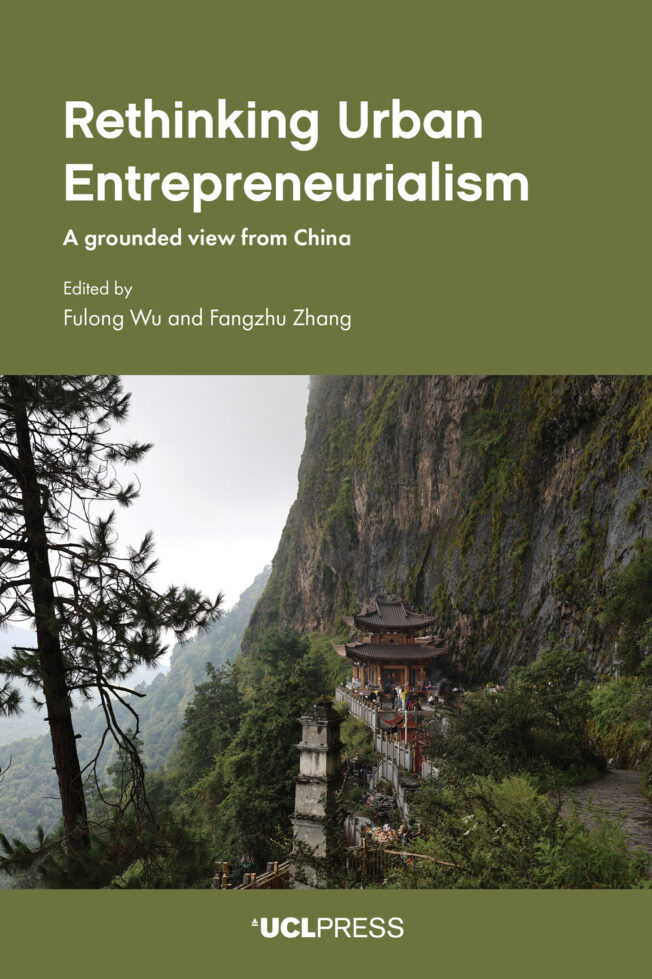

Rethinking Urban Entrepreneurialism
A grounded view from China
Fulong Wu (Editor), Fangzhu Zhang (Editor)
China’s urban governance demonstrates perplexing and contradictory features. Despite market-oriented reform, the role of the state remains salient. What is the logic behind governing urban China? Chinese scholars provide a grounded view.
Rethinking Urban Entrepreneurialism challenges the conventional understanding of urban entrepreneurialism and argues that Chinese urban governance comprises two interrelated aspects: entrepreneurial governance and innovative statecraft. The first refers to the deployment of market-based approaches to urban development, and the second refers to versatile techniques. Urban entrepreneurialism encompasses both market-oriented approaches and administrative innovations. The state upholds its strategic and extra-economic objectives by deploying and mobilising the market and society. Urban entrepreneurialism also demonstrates a strong state intentionality rather than following the market logic. The book reveals the challenges to urban entrepreneurialism, the limits of entrepreneurial governance, and multiple managerial practices in China.
By examining entrepreneurial urban development and governance experiments, it paints a comprehensive picture of contemporary urban governance in China. It transcends the binary view of authoritarianism versus urban entrepreneurialism, showcasing a wide spectrum of entrepreneurial and managerial governance features. To rethink urban entrepreneurialism, the book suggests that it extends public-private partnerships into a broader form of statecraft known as ‘state entrepreneurialism’.
List of figures
List of tables
List of contributors
Acknowledgement
Introduction: rethinking urban entrepreneurialism as a form of statecraft
Fulong Wu and Fangzhu Zhang
Part I: Critical perspectives
1 The challenges to urban governance in China: economic transition, scale, and smart technology
Anthony G.O. Yeh
2 Between state entrepreneurialism and authoritarian environmentalism
Calvin King Lam Chung
3 When market instruments fail: limits to state entrepreneurialism
Zheng Wang
Part II: Entrepreneurial Governance
4 State entrepreneurialism revisited: towards a dynamic state-firm nexus approach in urban governance
Jiang Xu
5 The making of a twin-megacity: the co-evolution of Hong Kong and Shenzhen in the Greater Bay Area
James J Wang
6 Governing greenway development in Chengdu
Handuo Deng
7 Governing China’s innovation-driven development: revisiting state-market relations
Kan Zhu and Yi Feng
8 Financing urban development through chengtou: unpacking the governing logic of the state
Yi Feng
Part III: Polanyian experiments
9 The Polanyian turn: governing experiments in dilapidated neighbourhoods of Chinese cities
Zhigang Li and Qing Liu
10 Urban regeneration and neighbourhood governance in Shanghai
Yang Xiao and Yihui Huang
11 Creating new commons: three models of governance in neighbourhood regeneration in Guangzhou
Yuting Liu and Nannan Zhao
Part IV: Governing a changing society
12 Unpacking the pathways to an age-friendly city: community building under state entrepreneurialism
Yuqi Liu, Tianke Zhu, Ye Liu, and Zhan Huang
13 Governing international communities amidst the global geopolitical shift: insights from Shanghai
Jie Shen and Xiang Luo
14 State territoriality, local entrepreneurialism, and social agencies: migrant integration in urban China
Siyao Liu and Mengran Xu
DOI: 10.14324/111.9781800081307
Number of illustrations: 58
Publication date: 01 September 2026
EPUB ISBN: 9781800081314
Fulong Wu (Editor) 
Fulong Wu is Bartlett Professor of Planning at UCL. His research interests include China’s development and governance. He is the author of Planning for Growth: Urban and Regional Planning in China (Routledge, 2015), Creating Chinese Urbanism: Urban Revolution and Governance Change (UCL Press, 2022), co-editor (with Fangzhu Zhang) of Handbook on China’s Urban Environmental Governance (Edward Elgar 2023). His recent co-authored book is Governing Urban Development in China: Critical Urban Studies (with Fangzhu Zhang, Routledge, 2024). He leads a European Research Council (ERC) advanced grant on China’s urban governance.
Fangzhu Zhang (Editor)
Fangzhu Zhang is Professor of China Planning at The Bartlett School of Planning, UCL. Her main research interests focus on China’s innovation and environmental governance. She is currently working on an ERC advanced grant, Rethinking China’s Urban Governance, and is co-editor of the Handbook on China’s Urban Environmental Governance (Edward Elgar, 2023) and co-author of Governing Urban Development in China: Critical Urban Studies (Routledge, 2024). She is a founding editor-in-chief of Transactions in Planning and Urban Research.
Urban Violence and Marginalised Communities
Ashvin Devasundaram, Stamatis Zografos, Márcio Mattos, Zoe Holman,
25 March 2026


Co-production of Knowledge in Action
Cassidy Johnson, Vanesa Castán Broto, Wilbard Kombe, Catalina Ortiz, Barbara Lipietz, Emmanuel Osuteye, Caren Levy,
15 September 2025
Urban Informality and the Built Environment
Nerea Amorós Elorduy, Nikhilesh Sinha, Colin Marx,
12 March 2024
Co-designing Infrastructures
Sarah Bell, Charlotte Johnson, Kat Austen, Gemma Moore, Tse-Hui Teh,
27 April 2023
Co-curating the City
Clare Melhuish, Henric Benesch, Dean Sully, Ingrid Martins Holmberg,
24 May 2022
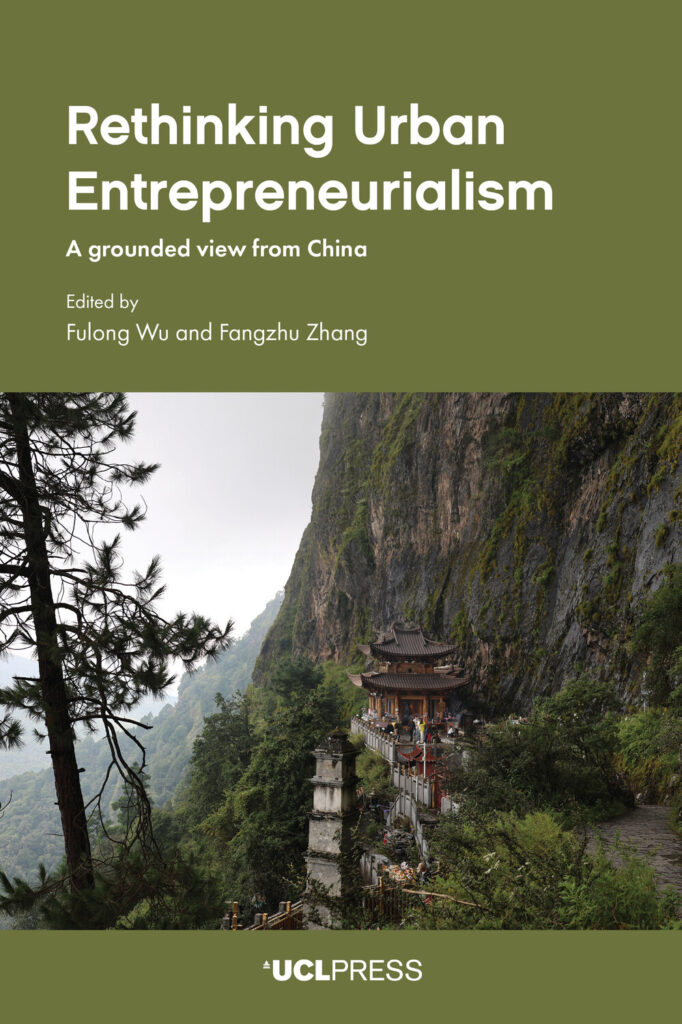
Rethinking Urban Entrepreneurialism
A grounded view from China
China’s urban governance demonstrates perplexing and contradictory features. Despite market-oriented reform, the role of the state remains salient. What is the logic behind governing urban China? Chinese scholars provide a grounded view.
Rethinking Urban Entrepreneurialism challenges the conventional understanding of urban entrepreneurialism and argues that Chinese urban governance comprises two interrelated aspects: entrepreneurial governance and innovative statecraft. The first refers to the deployment of market-based approaches to urban development, and the second refers to versatile techniques. Urban entrepreneurialism encompasses both market-oriented approaches and administrative innovations. The state upholds its strategic and extra-economic objectives by deploying and mobilising the market and society. Urban entrepreneurialism also demonstrates a strong state intentionality rather than following the market logic. The book reveals the challenges to urban entrepreneurialism, the limits of entrepreneurial governance, and multiple managerial practices in China.
By examining entrepreneurial urban development and governance experiments, it paints a comprehensive picture of contemporary urban governance in China. It transcends the binary view of authoritarianism versus urban entrepreneurialism, showcasing a wide spectrum of entrepreneurial and managerial governance features. To rethink urban entrepreneurialism, the book suggests that it extends public-private partnerships into a broader form of statecraft known as ‘state entrepreneurialism’.