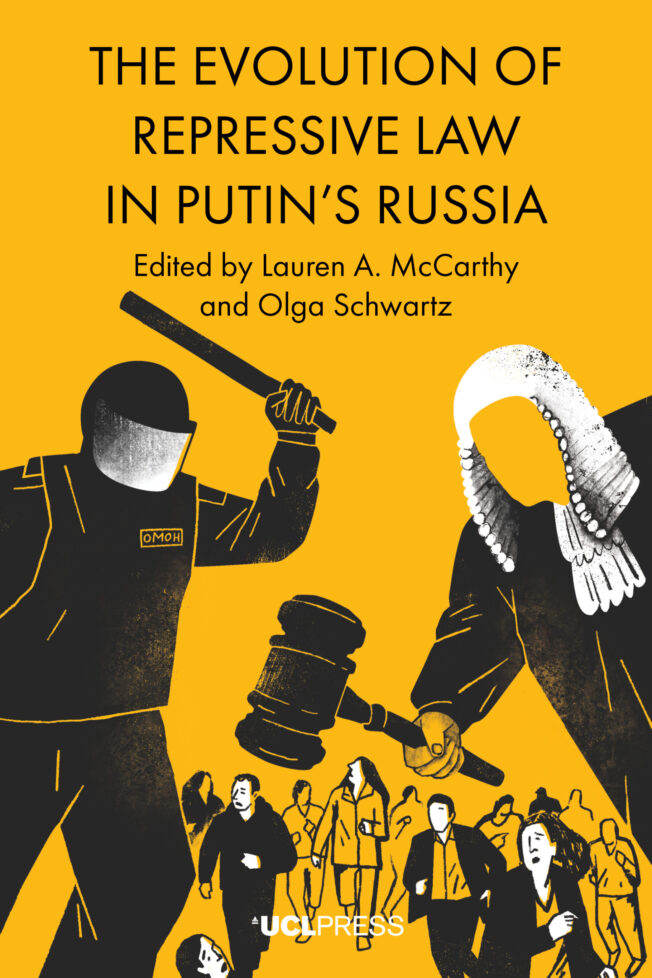

Publication date: 1 April 2027
DOI: https://doi.org/10.14324/111.9781806552801
Number of illustrations: 30

The Evolution of Repressive Law in Putin’s Russia
Lauren A. McCarthy (Editor), Olga Schwartz (Editor)
Since 2012, the Russian state has relied increasingly on the law as a tool of repressive governance, using it to consolidate its power, dissuade opposition and punish its enemies. New laws have been passed to suppress particular forms of activity while other laws passed for ostensibly reasonable purposes have been used in ways that stretch their meaning and application.
The Evolution of Repressive Law in Putin’s Russia takes a socio-legal perspective to trace the development of this regime of legalized repression, by looking at both the laws on the books and the law in action. Each chapter is a case study of a single repressive law regime, containing the context and a short legal history followed by analysis of its implementation. The authors cover terrorism, extremism, treason and espionage laws. They also trace restrictions on freedom of assembly, traditional and online media, and speech in multiple contexts, including the COVID era and the 2022 war in Ukraine. Importantly, this book takes a ground-up perspective, centering the voices of those who have engaged with these laws in practice. The contributors have been on the front lines of documenting and resisting the evolution of Russia’s repressive legal system that we document in this book and, as such, have also been caught in its crosshairs.
Related titles
The Ambivalence of Power in the Twenty-First Century Economy
Vadim Radaev, Zoya Kotelnikova,
07 July 2022
Who are the Humans behind Human Rights?
Agnieszka Kubal, Beáta Huszka, Hanna Oliinyk, Denis Shedov,
01 February 2027
The Evolution of Repressive Law in Putin’s Russia
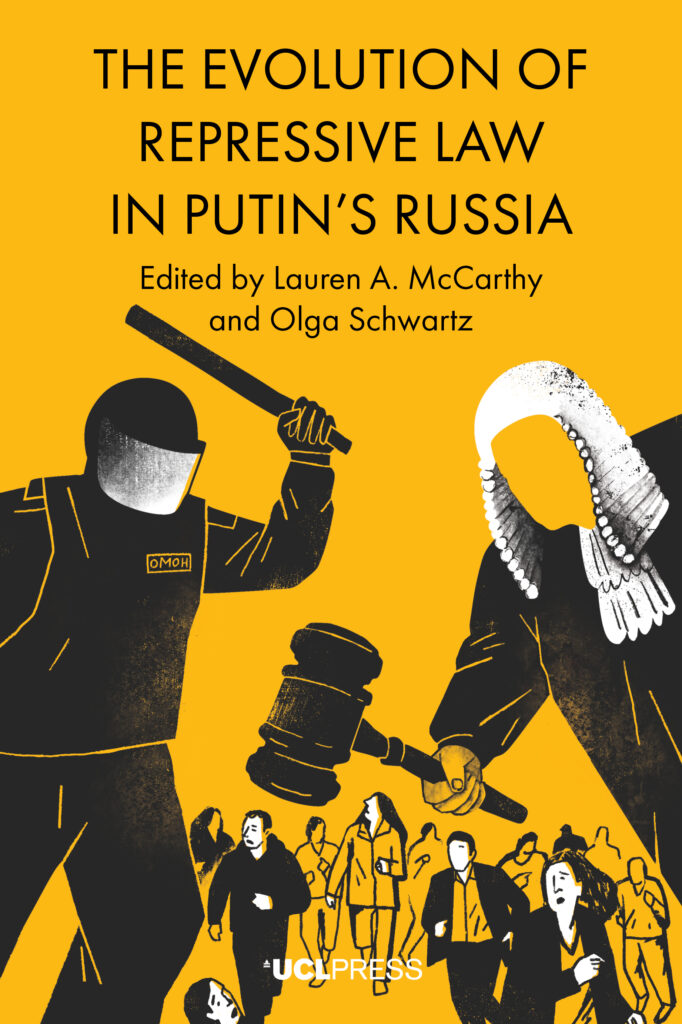
Publication date: April 1, 2027
Open Access PDF ISBN: 9781806552801
Paperback ISBN: 9781806552795
Hardback ISBN: 9781806552788
Trim size (hardback): 23.4cm x 15.6cm
Trim size (paperback): 23.4cm x 15.6cm
Since 2012, the Russian state has relied increasingly on the law as a tool of repressive governance, using it to consolidate its power, dissuade opposition and punish its enemies. New laws have been passed to suppress particular forms of activity while other laws passed for ostensibly reasonable purposes have been used in ways that stretch their meaning and application.
The Evolution of Repressive Law in Putin’s Russia takes a socio-legal perspective to trace the development of this regime of legalized repression, by looking at both the laws on the books and the law in action. Each chapter is a case study of a single repressive law regime, containing the context and a short legal history followed by analysis of its implementation. The authors cover terrorism, extremism, treason and espionage laws. They also trace restrictions on freedom of assembly, traditional and online media, and speech in multiple contexts, including the COVID era and the 2022 war in Ukraine. Importantly, this book takes a ground-up perspective, centering the voices of those who have engaged with these laws in practice. The contributors have been on the front lines of documenting and resisting the evolution of Russia’s repressive legal system that we document in this book and, as such, have also been caught in its crosshairs.