The cost of knowledge – funding open access books
Posted on 22nd October, 2026
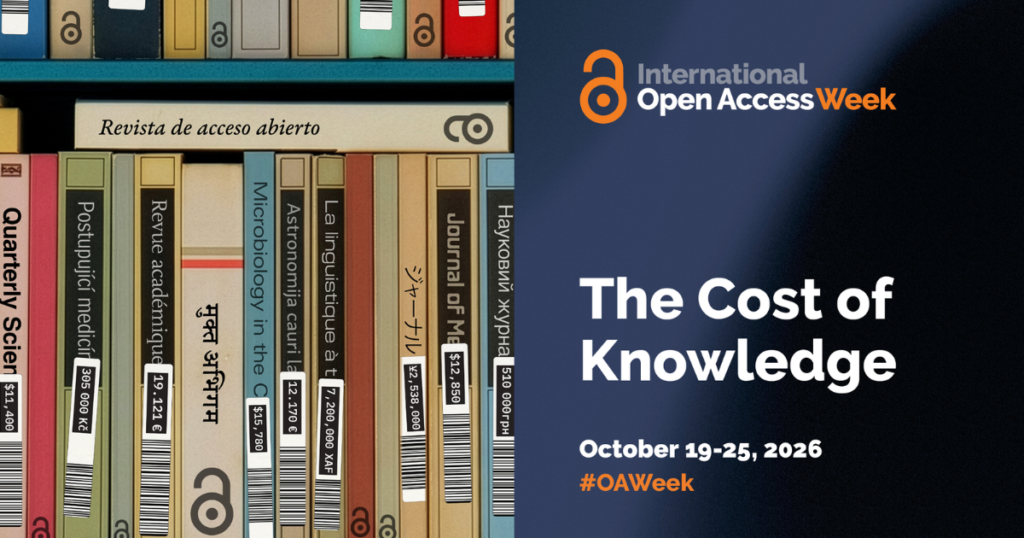
Originally published on the Open@UCL Blog, this article by Lara Speicher, Head of UCL Press, explores the evolving landscape of funding for open access books. From book processing charges (BPCs) and institutional support to collective funding initiatives such as Open Book Collective, Speicher examines the opportunities and challenges of creating a more equitable and sustainable future for open access publishing, and reflects on the role of university presses, libraries and publishers in supporting the transition.
While open access makes content free at the point of access for readers, the cost to the publisher of producing and publishing that content remains, while the usual means of covering the costs, through subscriptions and sales in commercial publishing, is removed or diminished. Since the open access movement started, how to pay for open access publication has been a constant theme, with various models for open access journals and books publication emerging regularly, including APCs (article processing charges), transformative agreements, BPCs (book processing charges), institutional subsidy for university presses and library publishing, and collective funding schemes.
Initially, the main model that emerged for funding open access books was the BPC, the book equivalent of the APC for journal articles. The BPC covers the cost of publishing a book including the submissions process and peer review, copy-editing, typesetting, proofreading and dissemination. The BPC is tied to a particular book and the funding can come from a range of sources including funders (national and international funders or specialist funders for the area of study), grants and the author’s institution.
However, BPCs are generally seen as problematic for various reasons including the high cost and very variable charges seen across the industry, the lack of transparency around what the BPC covers, the difficulty of funding BPCs at scale, and the issue of unequal access for authors for open access publishing since the model favours scholars who have access to funding.
In 2012, Knowledge Unlatched launched as the first collective funding scheme for open access books. The scheme raises contributions from libraries worldwide to enable a select range of monographs to be made available open access from a range of publishers. Since then, a number of other open access funding schemes have emerged run by both individual publishers to support the expansion of their open access book publishing and collective schemes that support a wider range of publishers.
Collective schemes that support smaller, non-profit publishers and infrastructure providers are particularly welcome as a way for libraries to support a more equitable and sustainable open access publishing ecosystem. Open Book Collective is one of the key schemes to emerge in recent years that follows this model. Launched in 2022 as a charity and community-governed platform, OBC was developed as an output of COPIM (Community-led Open Publication Infrastructures for monographs), a project funded by UKRI and Arcadia.
OBC supports open access university presses from around the world, as well as independent open access publishers, scholar-led publishers and publishing service providers including Open Book Publishers, LSE Press, University of London Press, Leuven University Press, Edizioni ca’Foscari, University of Capetown Press, the Directory of Open Access Books, OAPEN and PKP (Public Knowledge Project), among others.
Using OBC’s platform, libraries and other funders can find out about members of OBC and the books they publish and can then choose to fund these initiatives by subscribing to individual Supporter Programmes and collective packages. Increasingly, libraries are keen to contribute to open access publishing initiatives such as this as a way of supporting alternative, not-for-profit models that can help to build a more fair and transparent scholarly publishing ecosystem.
OBC now has over 100 supporting institutions and represents 24 publishers and publishing infrastructure providers. The funding it distributes to its member publishers is not tied to particular books, rather it can be used to support the publishers’ general activity and infrastructure, thus enabling publishers to grow and develop in the ways they need to in order to support a broad publishing programme.
UCL Press joined OBC in July 2026 and by participating in this scheme and others such as the Open Journals Collective, UCL Press is supporting the development of collective schemes as well as diversifying its range of funding sources and income streams to enable further investment in its open access publishing programmes.
The work of UCL Press, and programmes like Knowledge Unlatched and OBC are only part of a much wider conversation about the mounting costs of open access, the sustainability of more traditional publishing models in a world striving for equity of access to research, and how we choose the best path forward. There are many schemes out there trying new mechanisms and models, seeking to shift the cost of sharing academic knowledge towards a more open, equitable and sustainable model and these are just the start of what will hopefully be a more sustainable and cost-effective open future.