We are currently upgrading our shopping cart; in the interim all orders are being diverted to Waterstones. If you would like to redeem a promotional code, or are an author wanting to place an order, please email us.
Stone, the most prized building material of the early-modern period, is not only a material substance shaped by natural forces, but also a commodity embedded in logistical and economic circuits, aesthetic cultures and scientific discourse. Foregrounding both the tangible qualities of stone and the intangible human systems through which it circulated, Enabling Architecture explores how geological properties, aesthetic choices, trade relationships and labour networks intersected in shaping architectural outcomes.
Combining expertise from geology, craft history and architectural history, this interdisciplinary volume seeks to expand the panorama of stone sourcing and supply in the seventeenth and eighteenth centuries as an area of enquiry vital for an understanding of building activity. Bringing together scholars from Ireland, Britain, Italy, Germany and the Netherlands, it proposes a reframing of stone production as a constellation of interdependent material microhistories rather than an overview of a specific region. Its aim is neither to create a definitive inventory of British or Irish stone usage in the long eighteenth century, nor an exhaustive catalogue of geological sources. Instead, it draws attention to specific case studies – regional and transnational – that illuminate the dynamic infrastructures, decisions and relationships behind stone procurement and use.
Melanie Hayes (Editor)
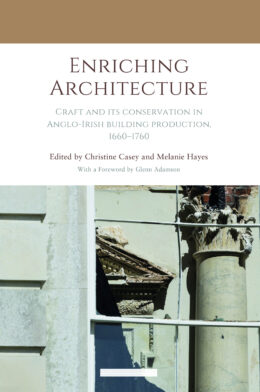
Melanie Hayes is an architectural historian and senior research fellow on the ERC Advanced Grant project STONE-WORK at Trinity College Dublin. Her work focuses on collaborative practices within the eighteenth-century building industry, contributing to new approaches to architectural labour and agency. She is the author of The Best Address in Town: Henrietta Street Dublin and its First Residents, 1726–1861 (Four Courts Press, 2021) and co-editor of Enriching Architecture: Craft and its Conservation in Anglo-Irish Building Production, 1660–1760 (UCL Press, 2023) and Between Design and Making: Architecture and Craftsmanship, 1630–1760 (UCL Press, 2024).
Nele Lüttmann (Editor)
Nele Lüttmann is an architectural historian and research assistant at Trinity College Dublin, where she recently completed her PhD on German draughtsmen in early eighteenth-century Britain and Ireland. She is currently a member of the ERC Advanced Grant project STONE-WORK, researching stone sourcing, trade networks, and craftsmanship. Her recent work includes a chapter in Between Design and Making: Architecture and Craftsmanship 1636–1766 (UCL Press, 2024).
Ruth Siddall (Editor)
Ruth Siddall is a geologist with over 30 years of experience working on Earth materials in cultural heritage, focusing particularly on stone, pigments and ceramics. Her research encompasses characterisation and analysis of materials from Classical antiquity to the Victorian period, with a particular interest in marbles and stones used in the decorative arts, architecture, lapidary work and pietre dure.
Patrick Wyse Jackson (Editor)
Patrick Wyse Jackson is Professor Emeritus in Geology at Trinity College Dublin and a Member of the Royal Irish Academy. He researches decorative and dimension stones used in Ireland’s architectural heritage as part of the STONEBUILT Ireland and STONE-WORK projects. He has co-authored numerous publications, including The Decorative and Building Stones of Dublin, and is a member of the IUGS Heritage Stone Subcommission.
Sign up to our newsletter
Don't miss out! Subscribe to the UCL Press newsletter for the latest open access books, journal CfPs, news and views from our authors and much more!