Alex Bloom: an English giant of democratic education
Posted on 7th October, 2026
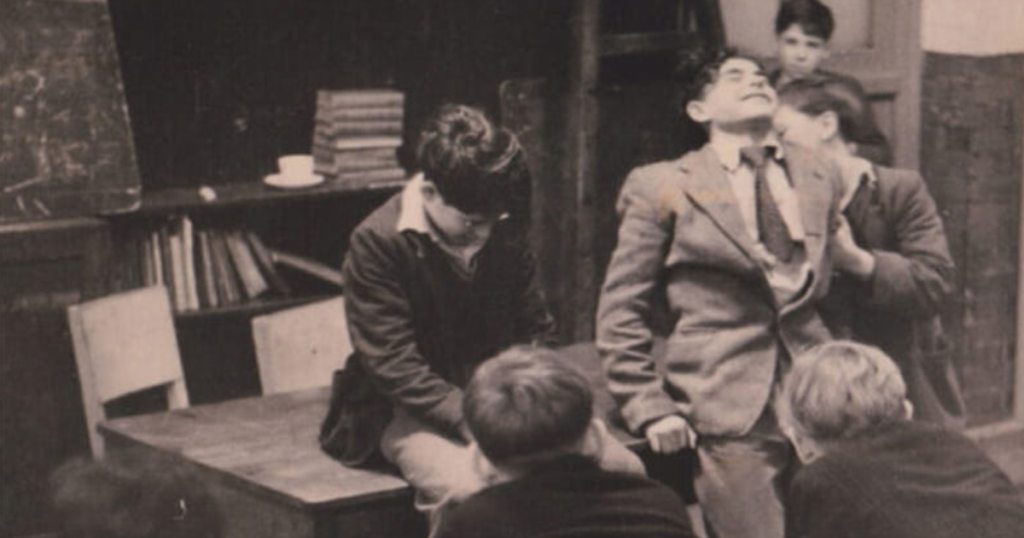
Originally published on the IOE Blog, this article by Michael Fielding and Peter Moss explores the legacy of Alex Bloom, the pioneering headteacher who built one of the UK’s most remarkable examples of radical democratic education. Drawing on Fielding’s new UCL Press book, it considers why Bloom’s ideas on democracy, creativity and inclusion remain relevant today.
Alex Bloom died prematurely in 1955. His passing was marked by obituaries in local and national newspapers, the left-wing and anarchist press and professional and international education journals. Weeping families lined the streets of East End London as his funeral procession passed, to pay their respects. Who was Alex Bloom? Should we still remember him?
Bloom was the headmaster, from 1945 to 1955, of St. George’s-in-the-East, a state secondary modern school serving around 280 boys and girls aged 11–15 years and situated in Stepney, one of London’s poorest districts, terribly scarred by war-time bombing. Yet in what to many might have seemed unpromising conditions, Bloom, an exceptional educator, headteacher and innovator, built a thriving example of radical democratic education – ‘the only state school run on progressive lines’ declared the Daily Herald just before his death.
He and his school attracted much attention and admiration, with many national and overseas visitors. One of these was Dr Gertrude Panzer, a key figure in the development of post-war secondary education in Berlin, and who later commented: ‘If I could have in Berlin three schools like St George’s in the East, Stepney, I could revolutionise the education of this city.’ St George’s was also the only state secondary school to be visited and admired by A. S. Neill.
So, yes, we should remember him, and a new book, How Alex Bloom built radical democratic secondary education in London, provides a perfect antidote to today’s historical amnesia about this remarkable English educator.
What he achieved in hard conditions and a short time is extraordinary. A flexible, negotiated timetable, which gave children maximum choice; it used, for instance, London as a major curriculum resource and encouraged young people themselves to plan, negotiate and lead journeys in search of learning they themselves had initiated. An emphasis on the creative arts, with its ‘Elective Activities’, part of the flexible timetable, offering children four times a week a choice of ‘Art, Bookbinding, Creative Writing, Debate, Drama, Dramatic Reading, Fabric Printing, French, Housecraft, Italic Writing, Literature, Music, Mythology, Needlecraft, Pottery, Puppetry, Recorder Playing, Weaving, What’s On?, Woodwork’. A refusal to label pupils, with no ability groups or other forms of streaming, an emphasis on project and group work, and a strong belief in the potential of all pupils. And a school that had no use for competition or prizes of any kind, nor for any punishments, ditching corporal punishment decades before the rest of the country – ‘there are no fears here’, Bloom told a visiting journalist.
Then there was democracy. Bloom was in a tradition that has regarded democracy as central to educational purpose. ‘We are convinced’, he wrote, ‘that not only must the overall school pattern – the democratic way of living – precede all planning, but that it proclaims the main purpose of education in a democracy. Our aim is that our children shall learn to live creatively, not for themselves alone, but also for their community’. Achieving this democratic purpose, he insisted, would be achieved not by formally teaching democracy, but by enabling children and adults to live democracy in the daily life of the school: ‘for a child to learn this art of living, he must actually live the implied experiences’.
The school, under Alex Bloom’s leadership, pioneered some of the most sophisticated democratic structures, practices and cultures ever seen in the state education sector in the UK. These included form meetings, staff and pupils’ panels, and a School Council consisting of ‘the staff panel which comprises all members of staff, and the pupils’ panel which is made up of the Head Girl, the Head Boy, their Deputies, the Secretary, (all of whom are elected by free vote of the children) and a Representative from each Form elected by the Form’. The pupils’ panel ‘may consider all school matters; it receives reports from the Form Representatives, discusses business sent to it by the staff panel, makes new suggestions for action and appoints committees responsible for the running of various activities’. Amongst the committees set up by the pupils’ panel was the Dance Committee, which took responsibility for the midday dancing that took place after the (excellent) school lunches: fun and joy were also part of the school ethos.
All this added up to, as Patrick Yarker writes in the book, Bloom leading:
an audaciously transgressive endeavour to build a consciously democratic community of teachers and students, grounded in principles which recognise every young person as worthy, responsible and capable, and dedicated to the idea that the education offered by the school must be meaningful and valuable in the eyes of that young person. As Bloom put it: ‘The child must feel that he does count and that the school community is worthwhile’.
The inspiring example of Alex Bloom and St. George’s-in-the-East generates a mix of feelings viewed from today’s education scene. Frustration at the ‘historical amnesia’ that denies so many a knowledge of such important past schools and educators, contributing to a pervasive sense that ‘there is no alternative’ – when there evidently is. Sadness at the impoverishment of today’s education, with its narrow fixation on economic purpose and managerial practice, stifling the ambition and beliefs that motivated teachers like Bloom. Pleasure at seeing the importance Bloom gave to democracy, creativity, inclusion and much else, not least the centrality of relationships and care in education: for is not education, Bloom asks, ‘fundamentally a matter of relationships? He is educated who is able to recognise relationships between things and to experience just relations between persons’.
Last but not least, perplexity that while so much was achieved in so short a time at St. George’s-in-the-East, it was dissipated so soon after Bloom’s untimely death. If radical democratic education is to take root, spread and survive, if it is to outlast the working lifetime of charismatic individuals, if it is to become systematised whilst retaining its dynamic – then we must do some hard thinking about what conditions are needed?
There is a long tradition of educators who have believed and argued for a democratic education: an education that offers a democratic way of living and an education whose purpose is to sustain democratic society – Dewey, Freinet, Korczak, Freire, Malaguzzi to name but a few. This new book shows that Alex Bloom belongs with this pantheon of past democratic giants. But also that he remains relevant and inspiring for education today and tomorrow.
Additional information
How Alex Bloom built radical democratic secondary education in London by Michael Fielding was published by UCL Press on 15 September. There will be a book launch at UCL on 8 October 2026: see further information and register to attend.