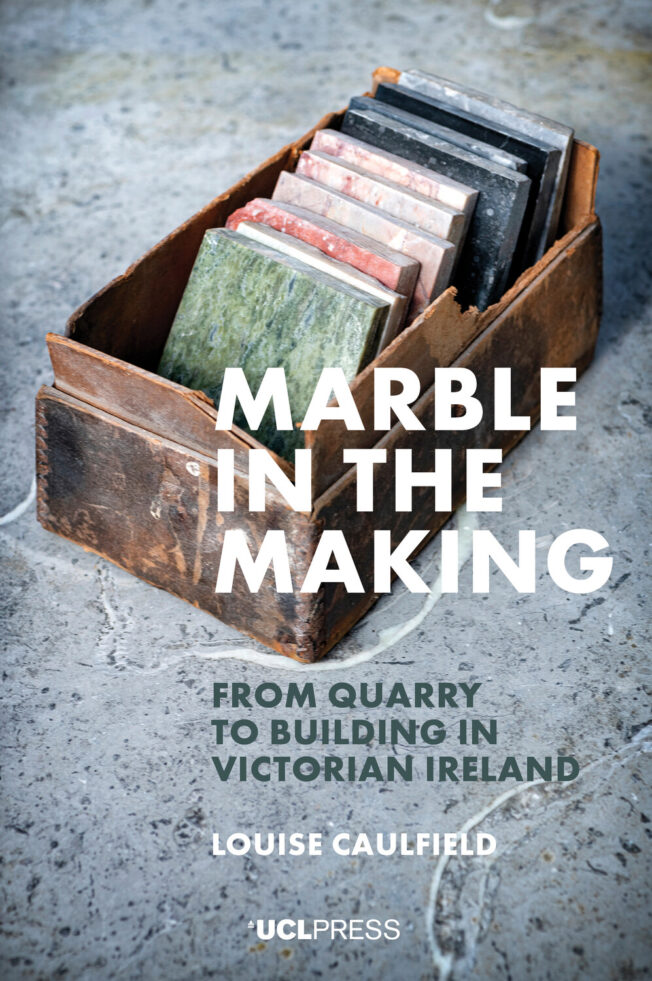

Marble in the Making
From quarry to building in Victorian Ireland
Louise Caulfield (Author)
Ireland’s geological bedrock, though often overlooked, contains an exceptional range of varicoloured marbles comparable to continental varieties and in some cases superior. Marble in the Making focuses on Victorian Ireland, an architectural landscape characterised by neo-Gothic design and the high point of indigenous marble production. It demonstrates that the architecture of this period is distinguished by native polychromy, a feature that was shaped by the resurgence of Gothic architecture and driven by post-Famine entrepreneurship and industrialisation.
This is the first major study of Irish marble. It uncovers the largely unheard-of marble industry by tracing stone from quarry source to marble works to building. The book’s interdisciplinary approach identifies key marble deposits and their distinctive characteristics, outlines workshop and quarry practices, reconstructs trade paths and reveals connections between communities. It enables a holistic and contextual attribution of architectural marble and broadens the understanding of nineteenth-century Irish Gothic Revival architecture. Moreover, this research repositions Irish marble within an international framework, highlighting its contribution to transnational material culture and geological heritage.
Contents
List of figures
List of tables
List of abbreviations
Foreword
Acknowledgements
Introduction
1 Irish marble’s industrial motivation
2 The genesis of marble quarrying
3 Breaking new ground: expansion and diversification
4 Beyond the block: the marble makers
Afterword
Appendix
References
Index
DOI: 10.14324/111.9781806551613
Number of illustrations: 141
Publication date: 01 January 2027
EPUB ISBN: 9781806551620
Louise Caulfield (Author)
Louise Caulfield is Research Fellow of the STONEBUILT Ireland project at Trinity College Dublin. She is a geologist with a special interest in the interplay between geology and architecture. She holds a BA in geology, an MSc in environmental sciences, and a PhD for her research on the exploitation and utilisation of Irish decorative stone in the nineteenth century. Her publications include chapters in The Museum Building of Trinity College Dublin: A Model of Victorian Craftsmanship (Four Courts Press, 2019) and Enriching Architecture: Craft and its Conservation in Anglo-Irish building production, 1660-1760 (UCL Press, 2023).

Voices for Change
Toby Butler, Felix Driver, Barbara Brayshay, Chris Church, Jeremy Iles, Oli Mould, Saskia Papadakis,
01 November 2026

Imperial Science, the Organic Movement and the Path to Shangri-La, 1900-1969
Ashok Malhotra,
23 March 2026


Women’s Labour Activism in Eastern Europe and Beyond
Selin Çağatay, Mátyás Erdélyi, Alexandra Ghiț, Olga Gnydiuk, Veronika Helfert, Ivelina Masheva, Zhanna Popova, Jelena Tešija, Eszter Varsa, Susan Zimmermann,
26 August 2025
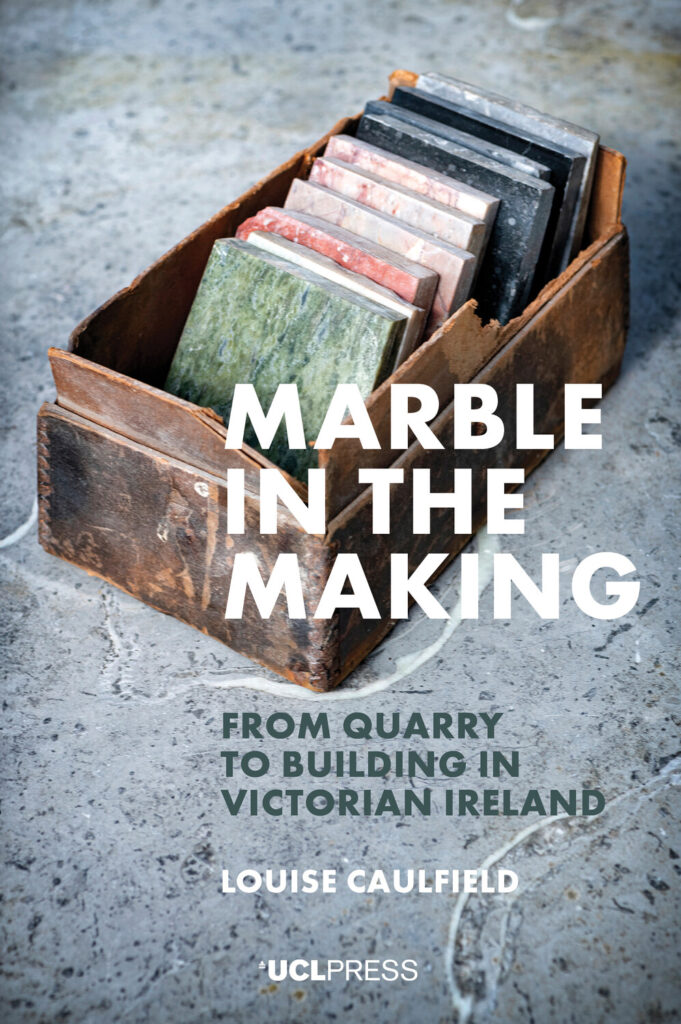
Marble in the Making
From quarry to building in Victorian Ireland
Ireland’s geological bedrock, though often overlooked, contains an exceptional range of varicoloured marbles comparable to continental varieties and in some cases superior. Marble in the Making focuses on Victorian Ireland, an architectural landscape characterised by neo-Gothic design and the high point of indigenous marble production. It demonstrates that the architecture of this period is distinguished by native polychromy, a feature that was shaped by the resurgence of Gothic architecture and driven by post-Famine entrepreneurship and industrialisation.
This is the first major study of Irish marble. It uncovers the largely unheard-of marble industry by tracing stone from quarry source to marble works to building. The book’s interdisciplinary approach identifies key marble deposits and their distinctive characteristics, outlines workshop and quarry practices, reconstructs trade paths and reveals connections between communities. It enables a holistic and contextual attribution of architectural marble and broadens the understanding of nineteenth-century Irish Gothic Revival architecture. Moreover, this research repositions Irish marble within an international framework, highlighting its contribution to transnational material culture and geological heritage.