Get to know the author behind An Introduction to Science, Technology, Warfare and Peace
Posted on 13th October, 2026
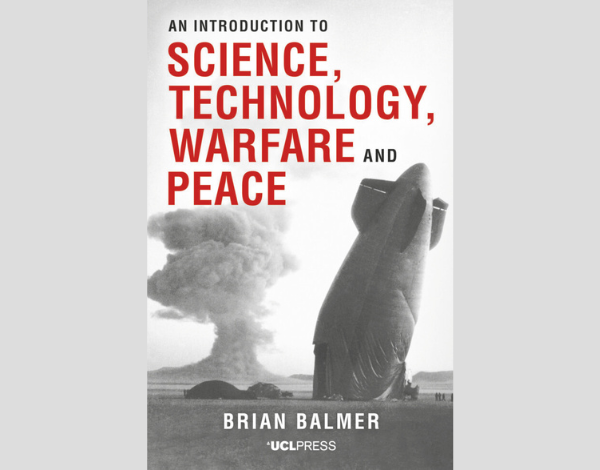
An Introduction to Science, Technology, Warfare and Peace is a brand-new textbook from UCL Press, written by Brian Balmer. Interested to learn more? Keep reading to find out some key information from Brian himself.
Can you introduce yourself to our readers?
I am a Professor in the Department of Science and Technology Studies at UCL where I teach on a variety of modules related to science, technology and society. I’ve taught there since 1994. In that time, I have taught, or co-taught, a module for final year undergraduates (and occasionally for Masters students) on the relationship between science, technology and war since 1996. As the module has evolved over the years, I’ve increasingly wanted to turn the module into a textbook, and so An Introduction to Science, Technology, Warfare and Peace is the realisation of that ambition.
Can you tell us a little more about Science and Technology Studies?
Few undergraduates directly encounter Science and Technology Studies, or STS, during their studies although they often do so indirectly. STS is a field that broadly encompasses the sociology, history and philosophy of science and technology. In other words, while scientists and engineers practice science and engineering from the ‘inside’, we analyse it from the ‘outside’. We ask questions like: where has any field of science and technology come from? How do scientists and engineers work? How does science and technology influence society, and, in turn, how does society influence science and technology? So, in the book I bring these broader STS theories, concepts and approaches to bear on the topic of war, peace and security. The book is written with the contribution of STS to arms control and disarmament very much in mind.
Can you tell us a little more about your textbook, Science, Technology, Warfare and Peace?
The book is divided into chapters that cover concepts, theories and approaches in STS, so readers will be introduced gently to key terms like technological determinism, actor-network theory and social constructivism. Then there are a series of chapters focussing on STS and particular weapons systems such as nuclear weapons or automated warfare. Because STS has a heavy focus on thinking about what knowledge is and what it does (epistemic questions, to use our jargon), I added two chapters on epistemic issues – tacit (hard to write down) knowledge and non-knowledge (secrecy and ignorance) – that have influenced STS studies of military and security technologies.
The final section of the book picks up two key themes or clusters where STS researchers have investigated what could be called everyday security such as CCTV cameras or facial recognition technology. This meshes with the broader sociological and political topic of surveillance. Then there is a closing chapter called ‘war at a distance’ which explores how war is mediated to its audiences. It focuses on the sociology of body counts; military technology and the mass media; and war, technology and popular culture.
By the end I hope readers will have been given a thorough grounding in this evolving and exciting field of study. Moreover, I hope that readers will be able to apply what they’ve learnt to make sense of, even maybe actively intervening in, these issues in an increasingly insecure world.
Who is your textbook for?
I’ve aimed the textbook at students even though I originally conceived it as an advanced introduction. Conversations with colleagues at UCL Press led me to take the book down the textbook route. As such, the book is aimed primarily at students with little or no background knowledge of STS. It could, however, serve as an introduction for more advanced researchers in other fields that study war and security, including politics and international relations, history, geography, sociology and anthropology.
How might your textbook be used?
An Introduction to Science, Technology, Warfare and Peace can be used in both independent and classroom learning environments. As the book developed, and again in conversation with my commissioning editor at UCL Press, at the beginning of each chapter I added ‘chapter maps’ outlining the structure of the chapter, also a list of its key features and concepts so that readers understand its focus at a glance. Then, at the end of each chapter, readers will find discussion questions and suggested further readings to encourage critical thinking. It doesn’t end there as readers can find additional online resources such as learning activities and answer prompts for the discussion questions to help both students and instructors.
Thank you for your time, Professor Balmer.
Introduction to Science, Technology, Warfare and Peace is available to read now as an Open Access PDF. Click the button below to learn more.