Preparing Generation Z students for a volatile world through language learning

To mark European Day of Languages, Kasia Łanucha and Alexander Bleistein consider the changing needs of ab initio language learners in UK universities in this excerpt from their chapter in Ab Initio Language Teaching in British Higher Education: The Case of German. They argue that teachers need to be aware of the implications of volatility, uncertainty, complexity and ambiguity (VUCA) for their students. As the first generation of digital natives are now at university, these students’ approach to learning is more focused on online materials, and teachers need to adapt in order to maintain the students’ interest. 

How can language teachers support Generation Z students in developing the skill set needed in the post-pandemic VUCA world? Here are six takeaway points based on teaching experiences during German language classes at the Centre for Languages and Inter-Communication (CLIC) within the Engineering Department of the University of Cambridge.

  1. Are the materials and course contents motivating and relevant to the students?

Considering the speed of societal and technological change, it is apparent that a lot of language material is outdated before it has even been published and therefore, it is not always useful for developing self-motivation, sense of purpose and ultimately self-discipline. Do Generation Z students in the 2020s still have to learn how to book a hotel room via phone? Is asking for directions an authentic scenario when navigation apps figure out the best route in seconds? To what extent are translation skills still necessary with the constantly improving accuracy of machine translation? For practical reasons, teachers must rely on existing material but should follow a learner-centred approach and amend exercises and scenarios to make them fit for the situation students currently find themselves in. Also, it is advisable to make resources available and easy to access online, not only to meet the learners’ technological preferences but also to reduce costs for students and universities. Still, considering the saturation with technology, the widespread ‘Zoom fatigue’ (Nadler, 2020: 1) and social media overload, teachers should limit the platforms used and make sure that all of them bring a significant benefit to the classroom. Involving students’ interests in the course design is a factor that increases motivation in the classroom. Various online polling tools are a workable solution to find out about the learners’ preferences during or before the first class. In order to develop a sense of purpose, the practical application of theoretical language and cultural knowledge is key for ab initio learners. For example, teachers are advised to facilitate situations allowing an authentic discourse with speakers of the target language. Online tandem projects with partner universities abroad have proven to be an effective way in language classes at CLIC to enable a meaningful exchange when restrictions make travel abroad unfeasible.

  1. Can students develop learning agility?

Teachers play an important role in developing agility among the learners and moving them out of their comfort zones: they encourage students to take new directions and to approach problems from a different perspective. In language learning, there is no problem that cannot be solved, as long as learners have access to a wide range of techniques, exercises and explanations to tackle them. Ab initio classes offer the opportunity to implement various learning strategies from the very beginning, and the omnipresent technology focus of Generation Z enlarges the pool of resources and platforms. Learning agility also refers to being open to new types of tasks. For example, recording oneself can feel uncomfortable for the first few times, but students get used to it over time and acknowledge the potential of practising speaking and being able to listen back to the audio file. Equally important is the ability to work with and learn from different people, so mixing groups during classes should be a matter of course in ab initio groups.

During the pandemic, being able to switch between different modalities and platforms of communication has become another crucial skill, and one that is likely to gain importance and require agility in the future: students are expected to be confident to converse and collaborate online and in person, adapting to the conventions associated with each medium as well as to different communication styles.

  1. Does the teaching foster learner autonomy and self-reflection?

From our experience, elements of autonomous learning, self-assessment and feedback seem to work particularity well when used with Generation Z students. To provide a comprehensive and personalised pathway, CLIC introduced a reflective portfolio as a new assessment element in language courses from 2020/1 onwards. This serves as a continuous log of the students’ work and gives evidence of all relevant language skills. A viva at the end of the course requires students to defend the portfolio work submitted and allows teachers to check whether the skills meet the corresponding CEFR level (Council of Europe, 2020). Students are also asked to reflect in writing on their learning experiences and to answer questions like the following: ‘Why did you choose this task?’, ‘How difficult was it to complete this task?’, ‘What would you like to work on in your next submissions?’. Answering questions of this sort not only activates a process of self-reflection within the students but also helps teachers develop a stronger connection with them and understand their learning styles and needs better.

While many students enjoy the high degree of flexibility and creativity allowed, a large proportion of learners, especially at beginners’ level, require clear guidance and regular feedback from teachers to shape the personalised learning pathway. It is therefore necessary to establish a lively feedback culture in the classroom and to address the importance of giving and receiving feedback which is different to the act of instant gratification that Generation Z is used to in many scenarios (Kalkhurst, 2018). Altogether, students must learn to take responsibility for their own learning and can be held accountable for their progress, provided that the support and guidance from the teacher’s side is sufficient and effective.

  1. How can teachers help students in becoming more resilient?

Making mistakes is part of every language learning journey and should be considered normal. However, it is much easier to accept in children than in adult learners who are often more reluctant to embrace the fact that they will be wrong in the language course, and in fact, they will be wrong a lot – an inevitable by-product of language acquisition. If a message does not have the expected outcome or the interlocutor cannot understand it, teachers must encourage their students to try again, paraphrasing, or using other means of communication such as body language. Communicating the fact that trial and error is how we learn and that striving for perfection every time can be counterproductive is critical. This kind of stance from a teacher can boost creativity and encourage risktaking (instead of always trying to play it safe) which should be reflected in the assessment and feedback where language accuracy is not the most important factor. In addition, non-native language teachers could also help learners by acknowledging their own vulnerability when they are not always sure of their language accuracy and yet constitute proficient language speakers which can be very empowering for the students. 

Secondly, managing expectations of the learners is key, especially for those who enrol on a language class in hope for an easy gain of a credit. Language classes are often advertised as fun, and anecdotally, students at CLIC would sometimes drop off after a week or two once they realised that language learning is hard work too, especially when grammar is covered, which tends to be harder to make engaging (and therefore sometimes leads teachers to almost being apologetic for even talking about grammar in the class!).

  1. What about critical thinking skills?

Critical thinking skills are particularly important when dealing with an overload of often conflicting and ambiguous information. Can teachers address this challenge in an ab initio language class? Shirkhani and Fahim argue that the best way of fostering critical thinking in the language teaching context is to include it in assignments by integrating language and critical thinking skills (Shirkhani and Fahim, 2011: 113). Although it might prove difficult to enhance critical thinking through engagement with sophisticated input at beginners’ level, meta-reflection on language and cultural conventions (even if partly not in the target language), can form a part of language classes to critically shed a light on the learning contents: ‘What is the benefit of having a system of cases in German?’, ‘Which function has the distinction between a formal and informal address (du/Sie)?’, ‘Do we need a gender-sensitive language?’, ‘Why are Germans considered as direct or even rude compared to the British?’. Cultural and linguistic questions like these could arise when dealing with language contents that touch on these topics explicitly or implicitly Another area to use critical skills is the choice of materials students engage with, such as online dictionaries, translation tools, YouTube videos or language programmes, perhaps by spending some time in the course on discussing the main features of reliable and credible (online) sources and by integrating traditional approaches like literature reviews or discourse analysis on a certain topic.

  1. How can language teaching improve collaboration and communication skills?

Collaboration underpins every interactive language class and is present in different forms: work in pairs, smaller or bigger groups, in person or remotely or by using technology. Teachers can support their students, depending on the task and its length, by helping them establish the ground rules to make sure teamwork goes smoothly. When it comes to communication, it is unlikely that, at beginners’ level, the target language will always be the language of instruction in the classroom. Instead, students have to use a lingua franca in their interactions, both synchronously and asynchronously, which the teacher can also model by setting the tone when interacting with the students as a group and individually.

Intercultural awareness is highly important when dealing with ambiguity and a key element of successful communication in the interconnected world Generation Z inhabit, and it goes beyond facts about a country and the dos and don’ts for visiting. It is also about understanding how national culture can affect the way we think, behave and therefore communicate. Certain cultural differences manifest themselves in German right from the start in a beginners’ course, such as hierarchy and the use of both titles (for example, Herr, Frau, Doktor) and the formal and informal ‘you’. Another one is communication style, especially requests such as Buchstabieren Sie, bitte (Please spell) or Geben Sie mir bitte … (Please give me …), which some students might consider inappropriate or simply rude. Teachers can also address other aspects randomly as the situation arises, for example when talking about how students from different national backgrounds feel about working times stated in teaching materials. Some might find that leaving the office at 5.00pm is late, some find it early. Discussions about what feels right in a given context go far beyond language learning and are closely linked to critical thinking skills (see Question 5). They raise awareness in the students of how their common sense is not at all that common when working across cultures which comes with many challenges in the VUCA world and in a language class, even at an ab initio level. This provides a fantastic opportunity for learning both about the target culture and other cultures (including one’s own). The same applies to intergenerational learning and reflecting societal norms (for example, holding the door by a male for a female, which can be considered both polite and sexist in the same national culture).


About the authors

This is an excerpt from  Ab Initio Language Teaching in British Higher Education: The Case of German, edited by Ulrike Bavendiek, Silke Mentchen, Christian Mossmann and Dagmar Paulus.

Kasia Łanucha gained her Master’s degree in German as a Foreign Language at the University of Dresden before moving to the UK where she has been teaching German at various levels and for specific purposes (engineering students, medical school) for over 15 years at the University of Cambridge.

Alexander Bleistein is DAAD-Lektor and Coordinator of German at the Centre for Languages and Inter-Communication (CLIC) of the Cambridge University Engineering Department. He has been teaching German in the UK at all levels with a focus on languages for specific purposes (LSP) since 2016 and has previously worked with the Goethe Institutes in London and Rotterdam. He is affiliated with Downing College, Cambridge, where he supervises students of German.
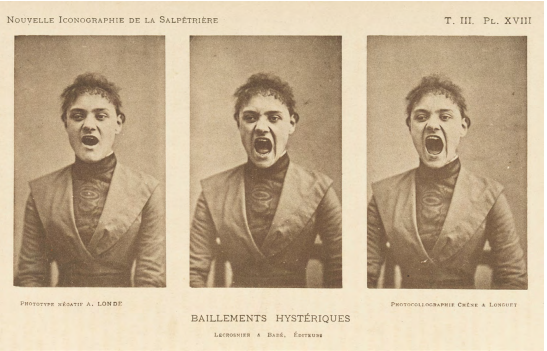

On Boredom

Baillements hystériques, plate XVIII. Three photos in a series showing a hysterical woman yawning.

The Oxford English Dictionary defines boredom, tautologically, as ‘the state of being bored’, and provides us with two synonyms, perhaps by way of compensation: ‘tedium’ and ‘ennui’. The entry states that the first uses of the word ‘boredom’ in literature are found in Charles Dickens’s Bleak House (1852–3). The aptly named Lady Dedlock suffers from the ‘chronic malady of boredom’ because she is stuck in a marriage of convenience. Meanwhile, another character called Volumnia is described as someone ‘who cannot long continue silent without imminent peril of seizure by the dragon Boredom, [and who] soon indicates the approach of that monster with a series of undisguisable yawns’. Boredom, for the Dickens of Bleak House at least, seems to be a female malady, one that is by turn chronic, monstrous and spasmodic, a deadly sickness. Lady Dedlock was ‘bored to death’, he writes.1

That the OED’s lexicographers could find no better way of describing boredom than by resorting to tautology shows just how difficult the condition is to define. The word names the experience of a kind of deadlock, one that can be so obdurate and self-referential that the best way of accounting for it may be in its own terms: boredom means being bored. Failing this, one might resort to the use of synonyms – ‘tedium’, ‘ennui’, but also ‘monotony’, ‘dullness’, ‘dreariness’, ‘weariness’, ‘inertia’, ‘apathy’ and so on – knowing that none of these words means the same thing. The attempt to define boredom precisely may be a hopeless task. Yet it is at least arguable that this resistance to definition, and indeed this hopelessness, resonate in some ways with the experience of boredom, and so provide a true enough description of it. We are bored when we lose interest. The world then feels unavailable or withdrawn, refuses to mean anything other than itself, and appears to prevent us from relating to it in a creative or meaningful way. Described in this manner, boredom starts to sound like depression, even melancholia, though the condition is probably more mundane than either.

Much has changed since Dickens used the word, and it is often held that boredom, understood as a by-product of industrial capitalism, describes a structure of feeling that characterised Britain and Europe in the nineteenth and early twentieth centuries, not what is now variously called postmodernity, late capitalism or the contemporary. Flaubert was bored, Emma Bovary was bored, Manet’s Olympia was bored, Lady Dedlock was bored, Volumnia was bored, the bourgeoisie was bored, Heidegger, Kierkegaard and Schopenhauer were bored, Nietzsche even thought that, after the seventh day of creation, God was bored, but we today are not bored. We are distracted, unable to maintain our attention for any considerable length of time, and this, it is claimed, prevents us from developing genuine and profound interests and from experiencing life authentically. This attention deficit, itself one of the most prevalent diagnoses in mental health today, especially of children, may also make us vulnerable to manipulation and exploitation. Our perception of the world is so fragmented and overloaded by new technologies that we risk losing our critical faculties altogether, even, according to one critic, our capacity for sleep.2 Meanwhile, hundreds of books are published each year that show us how to focus our minds, how to respond with greater ease to the proliferation of information in what has been called ‘the age of distraction’.3 The implication is that the ‘age of boredom’,4 as Flaubert described it, has now passed. The principal culprits are thought to be the culture industries and, more recently, the internet, together with the digital technologies that allow us to access it. Under such conditions, it would seem that the time needed to be bored is no longer available. We may now even feel nostalgic for those times in our lives when we were bored: in childhood, say, when time seemed to slow down, sometimes painfully so. The danger in this form of retrospection, of course, is that boredom is idealised or romanticised. ‘Boredom is the dream bird that hatches the egg of experience,’ wrote Walter Benjamin. ‘A rustling in the leaves drives him away.’5 Boredom may at times be a dream bird, the ground of creativity, and so quite unlike Dickens’s dragon or monster. Yet it should not be forgotten that, if the rustle of leaves distracts us from what may be the deeper and more fundamental experience of boredom, and if distraction, once a remedy or palliative, has since become its own sickness, then boredom nonetheless remains an experience that we spend much of our lives trying to avoid, and for good reason. Being bored is a little like being dead – in a minor key. ‘Concert, assembly, opera, theatre, drive, nothing is new to my Lady under the worn-out heavens,’ writes Dickens of Lady Dedlock.


On Boredom addresses boredom in its manifold and uncertain reality, and asks what might be at stake in thinking about the affect today. One of the basic questions the writing and art included in this volume pose is whether there is a creative or critical potential to boredom or whether it is in fact as deadening an experience as it is often held to be. ‘All boredom is counter revolutionary,’ cried the Situationists in the 1960s. Perhaps that is so. But perpetual revolution can itself become boring, permanent change can feel like sameness, and what is striking is how boredom, itself an ordinary, everyday experience, can become the site of some of our most extreme fantasies and projections: of revolution, counter-revolution, sickness, deadness, creativity, dream birds, dragons and monsters. Why might this be so? Is boredom really such a Pandora’s box? Or do these fantasies betray just how anxious we are at the possibility of confronting our own boredom, with the risk that we might encounter a meaningless kernel at the very heart of what we call life?


About the Authors

This is an excerpt from the open access book On Boredom, edited by Susan Morris and Rye Dag Holmboe (UCL Press).

Susan Morris is an artist interested in the relation between automatic drawing, writing and photography. She uses various media including chalk on paper, inkjet printing and Jacquard tapestry. Works are often generated directly from recordings of data such as her sleep/wake patterns (using a scientific-medical device called an Actiwatch) or her unconscious bodily movements as recorded in a motion capture studio. Recent essay writing includes ‘Drawing in the Dark’ for Tate Papers No. 18, 2012, and ‘A Day’s Work’, catalogue essay for the exhibition for A Day’s Work that Morris curated for SKK, Soest, Germany, 2019.

Rye Dag Holmboe is Leverhulme Early Career Fellow at UEA, where his research examines the relationship between creative process and psychoanalysis. He completed his PhD at UCL in 2015 where he was an AHRC Doctoral Scholar. Holmboe has published books on contemporary artists as well as articles on art, literature and theory. His book on Sol LeWitt will be published by MIT Press in 2021 and he is currently writing a monograph on Howard Hodgkin, which is supported by the Howard Hodgkin Legacy Trust. He is also in the third year of training at the British Psychoanalytic Association.

What are photographs ‘doing’ in museums?

Digital Camera with lens

What are photographs ‘doing’ in museums? Like the x-ray permeating objects to reveal internal structures, photographs permeate museum practices at all levels – display, collections management, conservation, retail, publicity and exhibition publications, for instance. Photographs inhabit museums in huge numbers. However, these photographs are rarely part of formally accessioned collections: despite their epistemic and historical presence, they are active yet invisible, there but not there. 

Museums are shaped and defined through photographic practices that constitute and reproduce values, hierarchies and knowledge systems, generally with little cognisance of the power of these practices. Such images and their uses are, as Crane has described them, ‘a lowly sort of thing’ that ‘appears or hides in many guises’. Consequently, this book is about the work of the photographs that are not part of a museum’s formal collection, although they might once have been, or might become so. It addresses a range of institutional conditions which exceeds ‘the collection’ as it is officially recognised.

Whether one is considering ‘the collections’ or the material accruals around them, museums are centres of calculation in Bruno Latour’s sense, where accumulated objects, networks, proximities and values become knowledge through an institution’s procedures and devices. Photographs are the unconsidered heart of these processes, as they accumulate and circulate knowledge, even more so in an age when digitally available photographs of objects are at the front line of ‘accessibility’. While it has been argued that museums have, for some time, been post-photographic in their increasing dependence on networked, digital and multimedia realms, it remains that beneath these developments of the last three decades or so, photographs as imaging practices remain central. Since the nineteenth century, photographs have widened the reach of what museums can do and how they can function. They form both the background and the spine of museum practice, from record keeping to questions of decolonisation, from archival accrual to retail source, to the degree that it has been impossible to think about museum function and praxis without encountering photographs.

This mass of photographs can be said to form an ‘ecosystem’: a finely balanced network of dependencies and connective tissue which create and underpin values, hierarchies and knowledge systems and which are present in the museum in dispersed multiple, folded and overlapping layers. The various sites of photographic activity, from the studio through collections management to exhibitions, are nodes in the ecosystem which have their own micro-cultures that mutually inform and conflict. They form massive and shifting bodies of photographic utility and practice which translate objects into certain kinds of things and displays into certain kinds of spaces. Photographs shape the texture and fabric of both internal professional procedures of museums and their external public face. 

They are, in sum, a key organising principle of museums and markers of its ’rhetoric of value’.


About the Authors

This is an excerpt from the open access book What Photographs Do, edited by Elizabeth Edwards and Ella Ravilious and published by UCL Press/ V&A.

Elizabeth Edwards is Professor Emerita of Photographic History at De Montfort University, Leicester, and also Honorary Professor in the Department of Anthropology at UCL. 

Ella Ravilious is Curator: Architecture and Design in the Art, Architecture, Photography and Design Department at the V&A.  

BSA 2025 reading list

To mark the BSA Conference 2025 in Manchester, we’ve put together a reading list of essential open access books in Sociology from UCL Press.

If you’re attending, Pat Gordon-Smith, our commissioning editor of sociology, will be there to talk you through our extensive list of titles, and answer questions about how to publish your next open access book with UCL Press.

Join the UCL Press mailing list to find out more about the latest open access titles, or visit our stand!

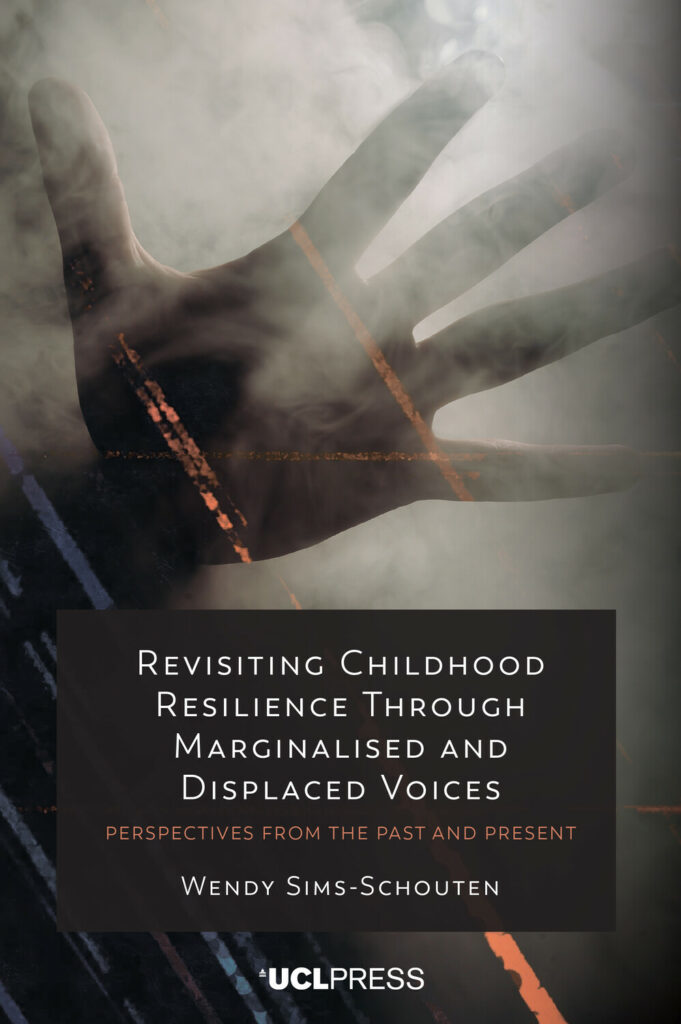
The image displays the cover of the book ‘Revisiting Childhood Resilience Through Marginalised and Displaced Voices: Perspectives from the Past and Present’, authored by Wendy Sims-Schouten. The cover features a blurred background with dark tones and light streaks, with a translucent silhouette of an outstretched hand reaching towards the viewer. The title is in white text, and the UCL Press logo is at the bottom.
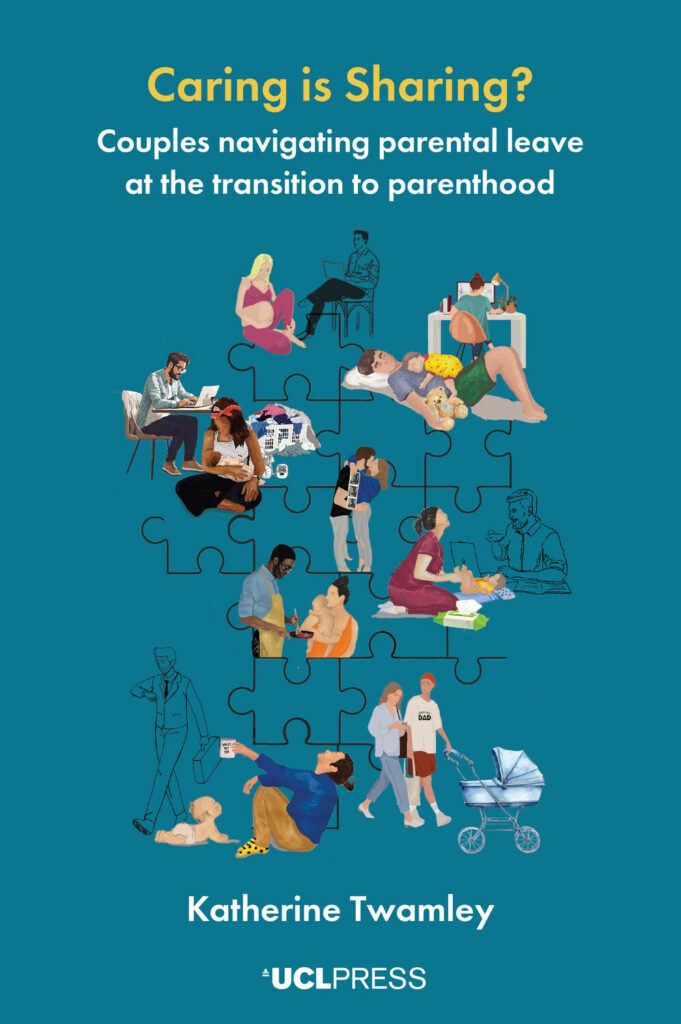
The image displays the cover of the book ‘Caring is Sharing? Couples Navigating Parenthood’, authored by Katherine Twamley. The cover features a teal background with illustrations of couples performing various parenting and household tasks, arranged like puzzle pieces. The title is in white and yellow text, and the UCL Press logo is at the bottom.

Why the work of Millicent Garrett Fawcett still matters

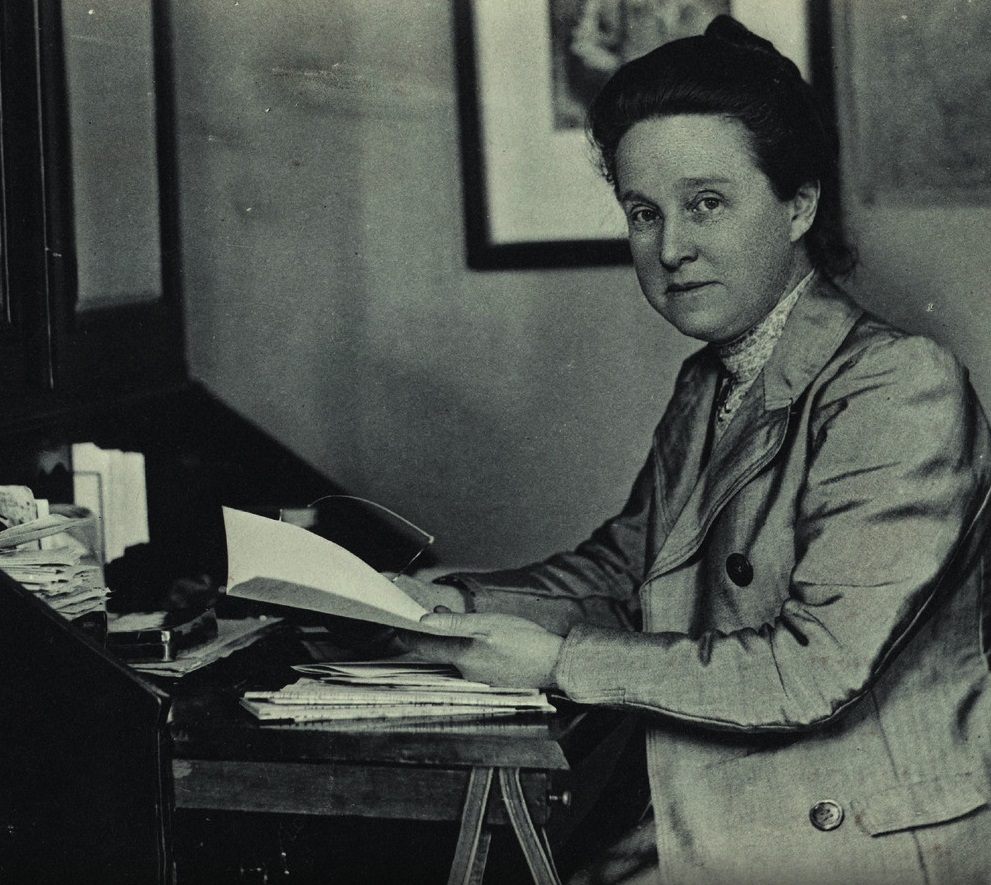
A black and whote picture of Millicent Garrett Fawcett, as show on the cover of Millicent Garrett Fawcett: Selected writings

In an excerpt for International Women’s Day, Fiona McTaggart explains why she welcomes the first scholarly appraisal of Millicent Garrett Fawcett Fawcett in over 30 years.

As the former chair of the Fawcett Society, I am pleased to welcome Millicent Garrett Fawcett: Selected writings, which brings together many of the writings and speeches of our eponymous predecessor Millicent Fawcett. We aim to continue in the tradition she built of campaigning for equality between women and men, focusing particularly on political power, education and work. Like her, we depend on robust research, clear argument and building alliances with women and men to advance our cause. It is a joy to present this collection, which will increase understanding of the role Millicent Fawcett played, not only in the struggle for the women’s franchise but in the series of other causes which she promoted.

The quality I have always most admired in Millicent Fawcett is persistence. She gathered signatures on the petition for women’s suffrage at the age of 18 in 1866, and she persisted with the cause, becoming its leader for many years, until the women of Britain had achieved her aim of the right to vote on the same terms as men, 62 years later in 1928. The Fawcett Society is the successor to the National Union of Women’s Suffrage Societies (NUWSS), which Millicent Fawcett led for many years. We inherited the brooch that appears in pictures reproduced in this volume, which was given to her by members of the society to recognise her leadership. It is engraved on the reverse with the words ‘Steadfastness and Courage’ and is now in the Museum of London.

This scholarly work, peppered with pictures of Millicent, shows her persistence in making the argument for the vote to audiences, many of whom were deeply hostile, and her determination to advance the cause of women through education. When women did gain a limited franchise, she was careful to record how this change had led to many new laws which benefitted women, from protection from forced marriage to the right to join the police. Fawcett’s words on her statue, a comment made relating to the death of Emily Wilding Davison, who was fatally injured by the King’s horse while carrying a banner that demanded votes for women (see Section 46), were a declaration of fact rather than a rallying call. While Fawcett recognised that the militant suffragettes had put the issue on the public agenda (‘They’ve rose the country’, in the words of an audience member at one of her speeches – see Section 25), she was critical of their tactics. And in some ways, the record of her doggedly persistent campaign to advance the cause of women without resorting to the violent tactics of the suffragettes is a lesson for feminists in the twenty-first century.

When I find myself disagreeing with other people who are concerned about issues facing women today, I take inspiration from Millicent. She was often generous in her appreciation of what the militant suffragists had done, while always rejecting their tactics. For universities and public platforms to exclude people because they take one side of a debate is unacceptable in a democratic society. I hope that the middle way which the Fawcett Society adopts can win wider acceptance, so that we can all stop being angry and upset with each other and carry on the dogged work which is still needed to build a society where women and men are truly equal.

The approach to the campaign for votes for women which Millicent Fawcett led has lessons for us today: be clear in your arguments, do not abuse those who disagree with you, build alliances and, above all, be persistent in working towards the changes we need.

About the Author

This is an excerpt from the introduction of Millicent Garrett Fawcett: Selected writings, edited by Melissa Terras and Elizabeth Crawford, with a foreword by Fiona McTaggart.

Fiona Mactaggart was Chair of the Fawcett Society between 2018 and 2021.

Walking the metro line in Lahore

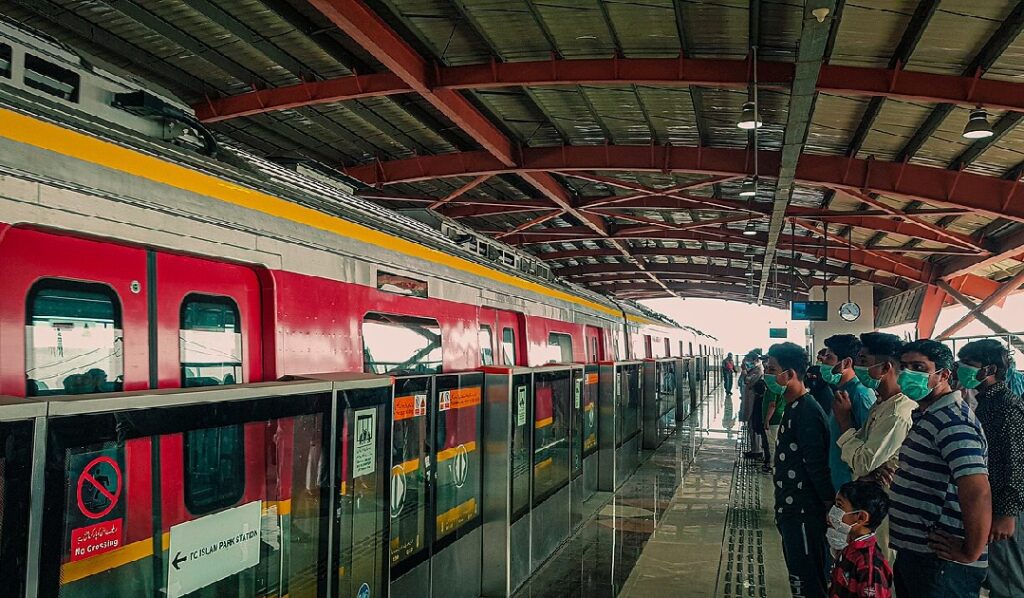
Orange Line Metro Train, Chauburji Station, Lahore

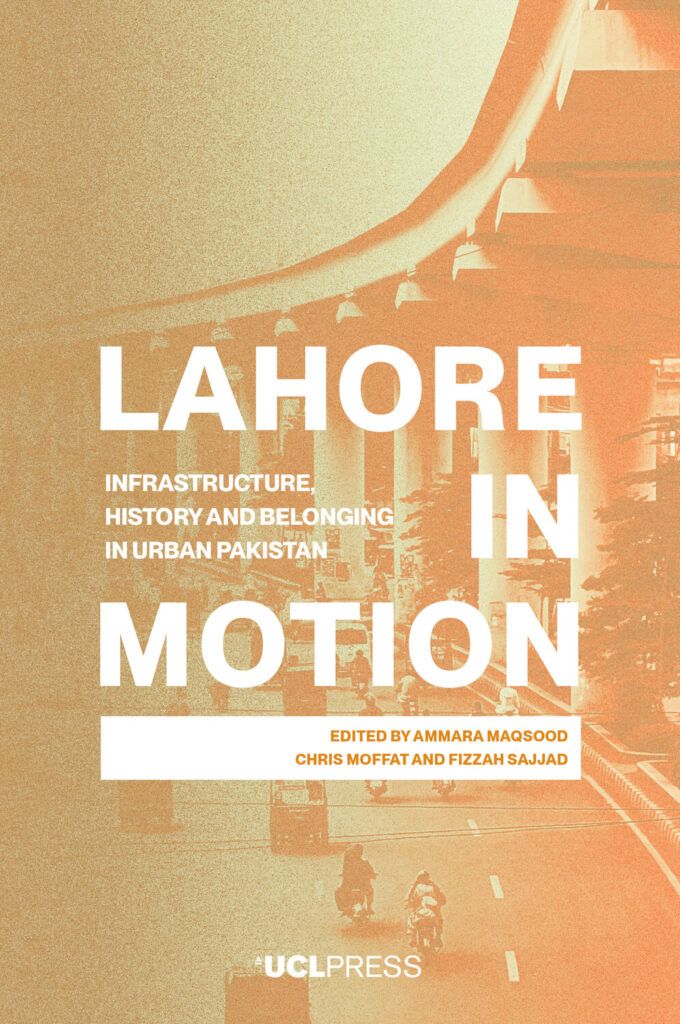
Published last month, Lahore in Motion provides a portrait of the Pakistani metropolis by tracing the path of the city’s first metro rail corridor. Construction for this major piece of public infrastructure began in 2015 and, over subsequent years, the nascent ‘Orange Line’ rapidly reconfigured Lahore’s urban landscape – displacing residents and slicing through existing structures along its route, all while offering Lahoris the promise of ‘world-class’ public transportation.

To mark the book’s publication, we are proud to share an extract from the introduction that explains why the stories from a series of walks along the metro’s 27-kilometre path are important in reflecting on the relationship between urban change and belonging in a historic city.

In October 2020, Pakistan’s first rapid transit metro train was inaugurated in Lahore. The ‘Orange Line’, as it is known, has dramatically reconfigured Pakistan’s second largest city. The metro connects the north-east of Lahore to its south-west along a 27-kilometre route dotted with 26 stations. In a city of 13 million, the train has the capacity to accommodate 30,000 passengers per hour. For most of its path across Lahore, the line takes the form of a viaduct, a raised track elevated over existing roadways, casting a shadow on the buildings and lives that fall beneath. For less than 2 kilometres near its midway point, where the line intersects with the old colonial-era thoroughfare of Lahore, the Mall Road, the metro dips briefly underground.

Even before the line was opened to the public, the monumental form of the viaduct was being integrated into the everyday rhythms of the environments it crossed. Its huge pillars provided ample space for posters and advertisements – cheap buses to Islamabad, news of an upcoming political rally. The paved or bricked islands it created in the middle of traffic-filled streets were turned, where they were wide enough, into new spaces for sociality or trade – men playing ludo near Bund Road, cans of paint for sale on Nicholson Road. Some of these islands acquired young gardens, or were planted with small trees, though much of this greenery wilted early on, covered in layers of dust, hidden from the sky by the viaduct and so unable to be refreshed by rain.

This process of incorporation into Lahori life has not been without its frictions. When construction of the Orange Line was announced in 2015, it prompted vocal opposition across a range of interest groups, from civil society activists to party politicians, religious leaders to local residents’ groups. Although never operating as a cohesive coalition, this shifting contingent was nevertheless responsible for a series of street protests, political campaigns and legal challenges over subsequent years. Much of this opposition was linked to the cost and scale of the project and to the nature of its implementation. Financed through a US$1.6 billion soft loan from China, the project was critiqued by many as a costly and unnecessary undertaking, particularly given widespread evidence of underinvestment in areas of health and education in the city. The 27-kilometre route was carved through some of the most densely populated areas of Lahore, and the line’s construction required the destruction of small commercial centres and neighbourhoods, displacing thousands of residents. Poor standards of occupational safety resulted in the deaths of at least 50 workers during the five years of construction. Many were migrant labourers, living and working in precarious conditions.1 Critics also seized on the proximity of the line’s path to several historic sites, from the seventeenth-century paradise garden at Shalamar Bagh to the monumental Mughal gateway Chauburji. Concerns with how official permission was secured to enable construction so close to legally protected built heritage led to a suspension of construction in August 2016, ordered by the Lahore High Court but eventually overturned (with some small concessions) by Pakistan’s Supreme Court in late 2017.

At the heart of civil society opposition to the Orange Line project was a deep unease with the Punjab government’s relentless pursuit of development, particularly as overseen by the popular centre-right political party in the province, the Pakistan Muslim League (PML-N) and its then-Chief Minister, Shehbaz Sharif. The petition which secured the High Court’s order of suspension characterised the Orange Line as a ‘white elephant’ pursued for ‘cheap publicity’, a prestige object for the ruling party rather than something genuinely needed by Lahore’s residents. Highly visible megaprojects like the Orange Line have been framed plainly by many activists as threats to the city of Lahore – its historic identity, its ways of life and its distinctiveness as an urban centre. The viaduct represented a dramatic example of what some viewed as the ‘Dubai-fication’ of Lahore: the creation of an anonymised, generic space of glass, steel and concrete, following a Gulf model for prosperity rather than something ‘appropriate’ to Lahore’s proud local culture and centuries-old history.

This brand of critique deploys a narrative that will be familiar across a range of twenty-first century urban contexts: neoliberal development, in the shape of large-scale infrastructure projects and associated speculation and commercialisation, is destroying local ways of navigating, knowing and inhabiting a city. But this narrative has its own risks. In framing development as an external imposition following a ‘foreign’ logic of neoliberalism, it can flatten our understanding of the ‘local’, failing to account for the variations in class, ideology and historical experience that shape individual lives in a city. Large-scale projects do, of course, have substantial (and, often, irreversible) impacts, and there does appear to be a shift in the manner and speed in which such developments are taking place. But the ways in which these changes are felt and understood can differ vastly between urban constituencies. They are also frequently contradictory. Many of those dispossessed and displaced by the construction of the Orange Line, for instance, opposed the project entirely. But some readily agreed to leave their homes in the hope that they would resettle in more upwardly mobile neighbourhoods elsewhere in the city. Other affected residents embraced the building of a new mass transit line, but simply wished for their voices to be included in project design and implementation.

Another risk of this narrative is its commitment to an ‘authentic’ Lahore that must be rescued from braying bulldozers and the vulgar aspirations of careerist politicians. The impact of unregulated expansion on the city’s environment – from polluted waterways to shrinking tree coverage to air pollution – certainly demands critical attention. But these processes are not merely symptoms of our neoliberal present. They are in fact constitutive of Lahore’s longer history as an urban space, and certainly since its establishment as the colonial capital of British Punjab in 1849 sparked a population and building boom that continues to this day.4 Earlier rulers had invested lavishly in the city, in particular during the Mughal period (1524–1725) which saw the establishment of many of Lahore’s historic landmarks. But it was in the British period that Lahore started expanding confidently beyond its millennia-old historic centre, the Walled City, absorbing the land and older villages around it. In the 1939 essay Lahore ka Jughrafiya (‘Lahore’s Geography’), the Urdu writer Patras Bokhari joked that ‘once Lahore had surrounding areas, now it is Lahore that surrounds Lahore’.5 In documents from 1941, the Lahore Improvement Trust – a colonial institution founded in 1936 to coordinate urban development – was already noting the ‘extensive purchases of land in the areas surrounding the centre of Lahore’ during the 1920s and 1930s, by residents who hoped to profit from the increase in land values brought about by municipal improvements.6 Change is a quality of urban life. Rather than lamenting a city ‘lost’ through change, it is important to interrogate the different ways change takes place, the inequalities that determine who gains and who suffers, and the political ideas and public imaginaries that frame and mediate interventions into the urban environment.

Lahore in Motion is an attempt to grapple with complexity and contradiction in Lahore’s urban landscape. It does so in a way that is intention- ally multi-vocal; that jumps back and forth across time; that is open to tangents, fragments and impressions as opposed to authoritative statements and comprehensive accounts. We approach the city as a forum of frictions, and the richly generative quality of the Orange Line justifies this concern. In her 2004 ethnography of Indonesia’s rainforests, the anthropologist Anna Lowenhaupt Tsing argues that capitalist desires for connectivity – the unimpeded flow of goods, ideas and people – ‘come to life in “friction”, the grip of worldly encounter’. For Tsing, ‘friction’ describes those awkward, unstable and creative outcomes produced by attempts to forge links across distance and difference. They might be destructive, they may provoke resistance, but they might also enable new social formations and alter conditions of political or economic possibility.

The chapters in Lahore in Motion trace the Orange Line’s work of connection and the ways this infrastructural project has been awkwardly, unstably and creatively incorporated into the city. Our contributors include academics, artists, activists, architects and more. Some have lived in Lahore for decades, others have made it a home more recently, while several consider it their home but no longer live there. All possess a strong affinity with the city and a deep interest in studying and understanding its histories, politics and everyday transformations. Each contributor was assigned one of the Orange Line’s 26 stations and asked to spend time in their respective area, to walk around the station’s environs, to speak to people and to note their own thoughts, concerns and associations. Rather than a conventional academic account of infra- structural development in a postcolonial city, our aim was to create a collaborative portrait of how change is experienced and felt, and how larger historical events, government policies and the politics of class, caste, gender and ethnicity become entangled with personal memories and everyday processes of place-making. Contributors were urged to resist the familiar framing of the Orange Line as an imposed obstruction and to avoid making judgements around ‘(in)authenticity’ in the city.

Many were open to this challenge; others felt compelled to push back against our exhortations and to defend a particular vision of Lahore. The volume thus reflects the fragmentation that characterises contemporary urban life. As editors, our approach recognised that belonging to and inhabiting Lahore entails traversing familiarity and unease, safety and risk, connection and disconnection.

While our work is grounded in Pakistan, it responds to a wider literature on urban life compiled by historians, anthropologists and geographers, in both the Global South and North. The volume is an experiment in how accounts of the contemporary city might profitably stage difference and contestation. We make no claim to provide a ‘representative’ sample of Lahore’s residents in these pages and are keenly aware of the contingent circumstances that brought this collection of (mostly middle class, mostly cosmopolitan, and primarily academic) contributors together, as well as the limitations this poses. Our aim is rather to model an approach for seeing and writing about the city, one that is simultaneously illuminating and inconclusive, one that grapples with friction in order to understand why urban spaces are so productive for thinking about history, identity, politics and belonging in the modern world.


About the Editors

Ammara Maqsood is Associate Professor in Social Anthropology at UCL.

Chris Moffat is Senior Lecturer in South Asian History at Queen Mary University of London.

Fizzah Sajjad is an urban planner and geographer with research positions at the London School of Economics and the Lahore University of Management Sciences.

This is an excerpt from the introduction of Lahore in Motion.

Image credit: Orange Line Metro Train, Chauburji Station, Lahore by Shahzaib Damn Cruze, CC BY-SA 4.0, via Wikimedia Commons

Romantic relationships on social media

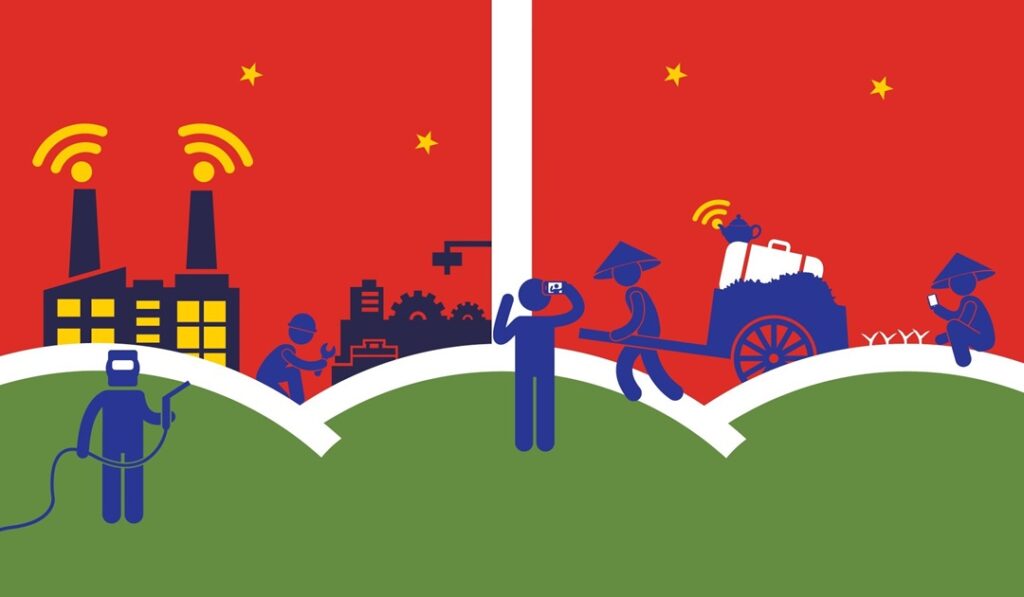
Illustration depicting a split scene, represnting the Chinese factory workers' split lives: on the left, a modern setting with industrial buildings, people using advanced technology, and a car; on the right, a historical setting with people in traditional attire, using an ox-drawn plow.

In celebration of Valentine’s Day, we bring you an excerpt from Xinyuan Wang’s popular book Social Media in Industrial China. In it, she describes the role of social media in the romantic relationships of the factory workers that she observed for her ethnographic fieldwork.

Every day after work, a group of young female factory workers leaves the factory plant together, hand in hand. All of them are unmarried young women, and gossip about relationships is always the most popular topic. Girls chatter avidly on the 10-minute walk from factory to dormitories; everybody is trying to contribute something to the daily ‘gossip time’:

‘Hey, did you hear that he just asked for her QQ number? I was surprised that he wanted to add her on QQ!’

‘Really? I didn’t know he was keen on her. Oh no — it is really bad news for his ex-girlfriend. A few days ago I just saw her new QQ status … sounds like she really regrets the break-up. Look, look … ’

The girl then took out her smartphone, showing her friends the evidence she had spotted on QQ.

The very action of men and women adding each other on QQ can easily be interpreted as romance, since, in the words of one girl, ‘QQ is not used for talking business or other things; QQ is for you to fall in love (tan lian ai)’. It has become almost a consensus among young people that one of the major functions of social media is to develop and maintain romantic relationships. Xiao Lin, a 20-year-old factory worker, sent me QQ messages explaining how QQ helped him to become a better lover:

‘I am much more bold and romantic on QQ … you just wouldn’t say those sweet words face to face … And I used lots of cute stickers when we were chatting on QQ, which made her find me really funny.’

Many young migrant workers, like Xiao Lin, think they can be a better lover on social media. Vivid stickers and emojis enrich people’s expression; an element of time delay allows more scope for strategic communication. Behind the screens of their smartphones, people feel more empowered and confident. Rather than a diminished form of intimate interaction, romantic relationships on social media have become an efficient modality combining elements of voice, image and text, as well as emoji and stickers. There is another reason why social media is regarded a place for romantic love: a public display of love offline is usually frowned upon in GoodPath. Walking hand in hand was the most intimate interaction that one could spot on the street. When Xiao Yu, a 21-year-old hairdresser’s apprentice, posted photos of herself kissing her boyfriend on QQ, she perceived QQ to be a romantic and liberating place where one can feel free to display intimacy as the ‘public’ was different:

In big cities people won’t make a fuss [about kissing in public]. But here some traditional people would dislike it … but the good thing is they are not on my QQ!

Xiao Yu’s kiss photographs elicited many comments. Rather than feeling embarrassed, she felt that was exactly what she was looking for: ‘… When you posted something like that, you just knew what people would comment. If I am not sure, then I won’t post it,’ Xiao Yu explained. To the question ‘do you think about what kind of reaction you will receive when you post something on social media?’, the majority of participants, both in GoodPath and in Shanghai, said yes. Moreover in many cases the imagined audience and presupposed reaction justify the posting. A few days later, Xiao Yu finally uttered the real reason why she posted the kiss photos — to warn another girl to stay away from her boyfriend as she assumed the girl had been stalking her.11 ‘It’s so annoying, she is still flirting with him (Xiao Yu’s boyfriend) on his Qzone. Is she blind? I am pretty sure she saw the kiss photo on my Qzone.’

In romantic relationships, surveillance on social media can lead to jealousy in various ways. For instance, a delayed reply to a WeChat message can make the romantic partner feel unimportant, especially when he or she can see on other social media platforms that their partner is online. Situations such as that described by Cai, a 22-year-old waitress in a restaurant, are very common: ‘I sent him a message half hour ago; he didn’t reply, but ten minutes ago, he updated his QQ status … that made me feel upset.’ She was always online throughout the day when working at the restaurant; the multiple social media platforms her boyfriend used allowed her to connect with him constantly, but such an environment also made it more difficult for her boyfriend to hide anything from her. Many young people share similar insecurities about their romantic relationships, As Zhu, a factory worker aged 20, complained: ‘She [his girlfriend] never mentioned our relationship on her QQ. My gut feeling is she is not that committed, or maybe she is hiding something from me?’

Because social media profiles are continuously subjected to scrutiny to a greater extent than most offline spaces, for many young people such as Zhu a romantic relationship gained its ‘legitimacy’ by a public announcement on social media. However, in practice, the attempt to make a public announcement may backfire. Lujia, a factory worker, set up a QQ group of 78 contacts in order to win the trust of his new girlfriend. He explained:

My girlfriend said she was not sure about my love, unless I showed it in public (gong kai); Once I set up the QQ group and show my love for her she will believe me.

On this QQ group, every few hours Lujia wrote something along the lines of ‘ … darling you are the most beautiful woman in my life and I love you so much’. Clearly not everybody thought Lujia’s declaration of love quite as sweet as his partner did, and most people soon quit the group. As one former member complained, he thought QQ was his own place to do whatever he wanted … But why should I read screenfuls of such goosebump-arousing nonsense?’ What was evident in Lujia’s case was that ‘audiences’ felt extremely disturbed and offended. Unlike posting something on one’s own social media profile, Lujia’s QQ group messaging, which constantly tried to grab people’s attention to witness something of little relevance for them, was way too aggressive and inappropriate.

However, in most cases some subtle strategies regarding the public display of love on QQ had been applied. It was very common to see a couple talk to each other in a way that others would not be able to understand without knowing the context of the dialogue. For example, a conversation between a young couple on Qzone that could be seen by all the online contacts was:

‘Don’t forget you promised me that you wouldn’t tell her about that.’

‘Yes I promised, and I didn’t tell her about that at all, quite the opposite, I told her that you said those three words on my birthday, and she was so delightfully surprised. I told you she liked you.’

Even though substantial information from the above correspondence was very limited, everyone who read the dialogue got the message that these two people were close to each other and that their relationship was exclusive. That is exactly the reason why, rather than this taking place on the seemingly more convenient and private basis of one-to-one chatting, the couple chose to talk secretly ‘in public’. Such ‘coded’ intimate talk on QQ between lovers skilfully displayed love in public without disturbing others too much.

The self-exposure of personal relationships on social media is not always about positive emotions. Having arguments on social media, for example, is regarded as a fatal hit to a romantic relationship. Huang Ling, a 19-year-old factory worker, explained the problem:

Each time, when we had some friction, he would update his QQ status immediately with things like ‘please introduce girls to me, I need a girlfriend, blah blah … I really hated him for that!

Two weeks after their break-up, Huang Ling was still complaining about her ex’s outrageous QQ usage, and every female friend of hers expressed the same resentment. As one of her close female friends remarked, ‘How could he say so regardless of the place and the situation (chang he)?! He just wanted her to lose face’. Ling applied some ‘media sanctions’ to cope with the break-up’s aftermath. First of all she locked her Qzone, which means nobody could view it except herself.

I need some space you know. I don’t want people to gossip about my break-up. Even though they do it out of kindness, I still find it so annoying.

Huang Ling’s elder cousin even called her very late at night to ask her what had happened when he saw her ‘unusual’ QQ status update. She felt embarrassed to explain the reason to her friends and relatives, and therefore locked the only channel (Qzone) from which most of her friends got news about her. After four days Huang Ling reopened her Qzone, having already deleted all her previous QQ status updates. Meanwhile Huang Ling’s updates on WeChat were very remarkable, even dramatic. During the four ‘non-QQ’ days she uploaded a large number of emotional remarks on WeChat. One day she even uploaded a photo of her arm, carved by herself with a steel ruler (Fig. 4.3). The two ‘bloody’ Chinese characters she carved on her skin were hate (hen) and love (ai). It seems that only carving her own skin would fully express her strong feelings about the frustrating break-up. She told me:

Because some of my family members are on Qzone, I don’t want to scare my relatives and other friends. Whereas the circle of friends on WeChat is much smaller; most of them are just colleagues at the factory, so it won’t cause me too much trouble. And he [the ex-boyfriend] will see the photo either way as he is also my WeChat friend.

If we view Huang Ling’s story together with the accounts of Xiao Yu’s careless display of a kiss photo on Qzone and Lujia’s less successful public display of love on QQ group, a more comprehensible picture emerges. First of all, we need to recognise that social media provides many possibilities; it enables people to practise romantic relationships online with much greater freedom than in offline situations. Social media has also become an essential arena in which romantic relationships take place in daily life. However, a more liberating place online does not equal fewer social norms. New norms about what is appropriate or inappropriate on social media dealing with romantic relationships emerged almost immediately. For instance, the release of private problems between couples on social media usually brought immense embarrassment, serving to trigger even worse consequences than in an offline situation. Sociologist Erving Goffman used the word ‘frame’ to explain how people’s behaviour is cued by elements that constitute the context of action. In the frame of social media, people were not only aware of the private/public nature of social media, but also intentionally played around with it to express the exclusiveness and intimacy of relationships — even though not everyone was successful at first.

Also, from the frequently applied and highly valued public displays of love on social media, we see how on social media the perceived public gaze is just as strong as in the offline situation. Online, young rural migrants may be free from the disapproval and judgement of senior relatives and fellow villagers, yet their peers’ opinions or those of even strangers were highly valued, and can also cause concern. Regardless of what kind of social rules one follows, as long as there are ‘others’ the risk of ‘losing face’ always exists, and sometimes the uncertainty of who is watching online exacerbates the anxiety.

Another point that emerged from the varied use of social media in romantic relationships is that, in order to make sense of sociality on social media, a whole range of available communication tools must be taken into account. As suggested by the concept of ‘polymedia’,13 it makes no sense to study only one particular media platform in isolation — the meaning and use of any one of them is relative to the others. As is clearly shown in Huang Ling’s situation, her choice of WeChat only made sense in comparison with the role that QQ and mobile phones played in her social life. Furthermore, in a polymedia environment, once one has either the smartphone or a personal computer, the decision which media to use is no longer much affected by either access or cost; instead it becomes a social and moral choices. For instance, in Lujia’s case, his choice of using QQ group messaging to declare his love for his girlfriend had been regarded as very inappropriate. The approach of polymedia, as well as the arguments put forward about new social norms on social media, are not confined to the analysis of romantic relationships on social media.


About the author

Xinyuan Wang is a digital anthropologist based at UCL’s Department of Anthropology. 

This is an excerpt from the open access book Social Media in Industrial China by Xinyuan Wang.

How a world-class university was founded

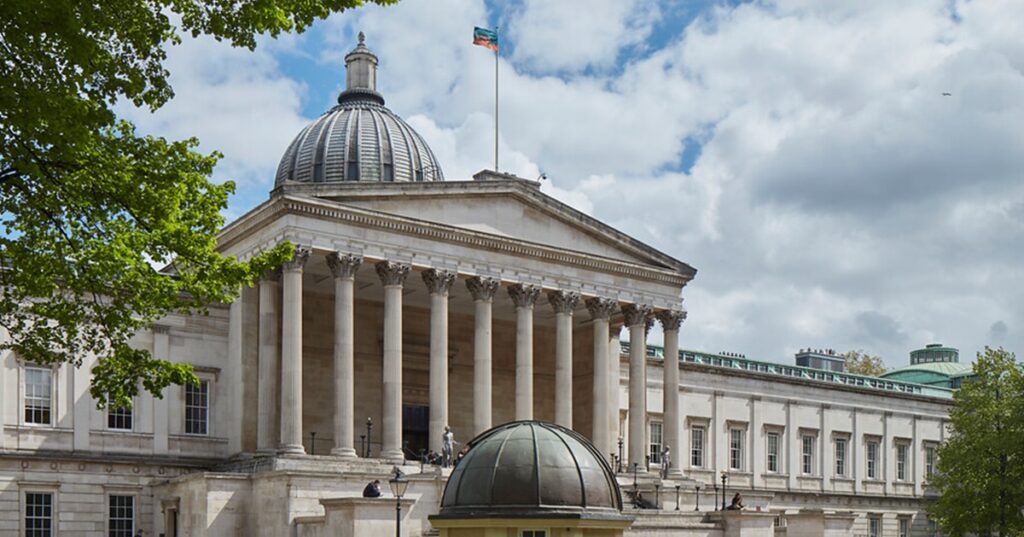
UCL Portico and quad

From its foundation on 11 February 1826, UCL embraced a progressive and pioneering spirit. It was the first university in England to admit students regardless of religion, and made higher education affordable and accessible to a much broader section of society. It was also effectively the first university to welcome women on equal terms with men. From the outset, UCL showed a commitment to innovative ideas and new methods of teaching and research.

To mark the 199th anniversary of the university’s foundation, we are proud to share an extract from The World of UCL exploring how the university was founded, and how – though not as its founder, as is commonly believed – utilitarian philosopher Jeremy Bentham was involved.

What we know today as University College London (UCL) was founded in 1826 and first opened its doors to students as the self-styled ‘University of London’ in October 1828. London at that date was the largest city in Europe and almost the only capital without a university. The new institution was intended from the beginning to open higher education to people excluded from the ancient seats of learning in Oxford and Cambridge. Its first students included nonconformists, Jews, Catholics and others. Notoriously described by Thomas Arnold as that ‘godless institution in Gower Street’, England’s third university prompted anxiety, contempt and curiosity among the early nineteenth-century establishment.

It is generally but incorrectly believed that Jeremy Bentham was the founder of UCL. This myth is sustained in a bizarre manner by the display of the body of the great philosopher of ethics, jurisprudence and government, ‘in the attitude in which I am sitting when engaged in thought’, as he instructed before his death in 1832. Besides the box with Bentham in it, UCL possesses over 200 more boxes full of his writings, a collection that has been called ‘one of the most remarkable monuments to the mind of a single man in all its aspects to be found anywhere’.

Prominently displayed in the Flaxman Gallery is the huge painting undertaken in 1922 by Henry Tonks, the then Slade Professor of Fine Art, portraying William Wilkins, the architect, offering the original College plans up to Bentham for his approval, while Henry Brougham, Thomas Campbell and Henry Crabb Robinson look on. The ‘Auto-Icon’ has been in the possession of UCL since 1850, and occasionally attends meetings of the College’s governing body. His most recent appearance was at a Council meeting in July 2013, the minutes recording that Jeremy Bentham was ‘present but not voting’.

In fact Bentham played no such personal role in the establishment of the College and was an old man of 80 when it opened. He did give his blessing and financial support to the venture, however, and the founders certainly owed a very considerable intellectual debt to him. UCL was founded by what Bentham called ‘an association of liberals’ in which the leading roles were played by an improbable duo formed by a poet and a lawyer. Credit for the original proposal must go to Thomas Campbell, the now largely forgotten Scottish poet whose Pleasures of Hope (1799) brought him popular fame and a rapid entrée into London literary society. In 1820, on a visit to Bonn, he was impressed by the religious toleration of the re-founded university there and formed the idea of establishing ‘a great London University’ for ‘effectively and multifariously teaching, examining, exercising and rewarding with honours, in the liberal arts and sciences, the youth of our middling rich people’. In February 1825 The Times printed a powerful open letter on this subject from Campbell to Henry Brougham, another Scot. Brougham was a brilliant man, one of the founders of the Edinburgh Review, who had moved to London to seek commanding outlets for his versatility and energy in the law and politics. First elected as an MP in 1810, he became particularly involved with the cause of popular education, associating himself with George Birkbeck and the mechanics’ institutes and founding in 1826 the Society for the Diffusion of Useful Knowledge.

Brougham regarded himself as a Benthamite, as a believer in the utilitarian principle of ‘the greatest happiness of the greatest number’ – though it has been claimed that in his view the greatest number was number one. His extravagant style smacked of humbug to many, but he was a man who got things done. Under his direction Campbell’s dreams of a ‘great London University’ were turned into reality. A second university which provided a model for UCL was Thomas Jefferson’s carefully planned University of Virginia, which had opened in 1825. The University of Edinburgh was the most powerful model of all, familiar as it was to Brougham and many of the founding professoriate in London.

When Campbell and Brougham began to organise a university for London, the only existing universities in England were those long established at Oxford and Cambridge – described by Bentham as ‘the two great public nuisances … storehouses and nurseries of political corruption’. Membership of the Church of England was necessary for admission to the one and for graduation from the other. All nonconformists, Catholics and Jews were thus excluded, while many Anglicans were kept out by the social restrictiveness, the cost or the institutions’ characteristic intellectual backwardness. The old universities were seen to be increasingly out of touch with a rapidly changing society. The population of England doubled in the first half of the nineteenth century, and the combined effects of industrialisation and urbanisation were producing new social patterns with new pressures and demands. The industrial revolution necessitated an extended system of higher education.

The main appeal of the new university was therefore to the interests excluded from the established system, such as it was, and to the various new social groups. Isaac Lyon Goldsmid, a millionaire financier and later the first Jew to become a baronet, played an especially significant role. He brought Campbell and Brougham together on the project and ensured the considerable support of the Jewish community. The nonconformists were actively led by Francis Augustus Cox, the Baptist minister of Hackney, while a different dissenting strand was represented by the support of Zachary Macaulay, whose main work had been devoted to the
abolition of the slave trade. Catholics were represented by the Duke of Norfolk and the Whig establishment provided a number of other titled luminaries. James Mill, the utilitarian philosopher and father of John Stuart Mill, actively represented Benthamism, and the various progressive influences rubbed shoulders readily with supporters from the City of London.

As the result of a year-long series of public and private meetings chaired by Brougham, the College came into formal existence on 11 February 1826 with the signing of an elaborate Deed of Settlement. It was agreed to raise a substantial sum of between £150,000 and £300,000 by the selling of shares of £100 each. From among the ‘proprietors’, as the shareholders were called, 24 men were to be elected as the Council, the all-powerful body which was to control the University’s property, appoint the Professors and regulate the education of the students. It was a fundamental principle of the new institution that religion in any form should be neither a requirement for entry nor a subject for teaching. As a corollary it was decided that no minister of religion should sit on the Council. The Revd Dr Cox served therefore as Honorary Secretary of that body until he became UCL’s Librarian in 1827.

From the outset the promoters sought incorporation. Brougham’s soundings towards a Royal Charter in 1825 were rebuffed by the Tory government of the day, and his subsequent efforts to achieve an Act of Parliament were defeated by the influence of Oxford and Cambridge. Parliamentary assistance was provided by Joseph Hume, one of the members of the original Council. A leading
radical, Hume was indefatigable in support of the College as well as of those other great progressive causes of the age, Catholic emancipation and parliamentary reform. After 1832 he was joined in the House of Commons by another member of the original Council, William Tooke, a prominent solicitor who became the first Treasurer of the College and of the Hospital.

The strength of the combined opposition of Oxbridge and of the London medical profession to legal recognition of the College as a ‘University’ could not easily be overcome in Parliament, despite the additional efforts of Brougham in the House of Lords, where he had gone in 1830 as Lord Chancellor. When UCL did eventually get its first charter in 1836, it took an unexpected form.

A base in Bloomsbury

One of the first acquisitions for the new University, even before it was officially constituted, was a building site. Nearly eight acres in Bloomsbury were bought in August 1825 for £30,000 by three of the richest promoters, Goldsmid, John Smith and Benjamin Shaw, and held by them until it could be transferred to the new University. Previously the site had served variously as a drilling ground, a place for duelling and a rubbish dump. It had been intended to develop it as Carmarthen Square, a projected addition to the yet unfinished Bloomsbury. By the time of the holding of the first meeting of the proprietors at the end of October 1826, 1,300 shares in the University had been sold, 200 fewer than the minimum believed necessary. Plans for the building were nevertheless being pressed ahead, and the digging of foundations was already underway. Despite the bad weather of the winter of 1826–27, work was sufficiently advanced by 30 April 1827 for the ceremony of laying the foundation stone.

This was undertaken with full masonic rights by the Duke of Sussex; a brother of George IV and the only member of the royal family with any intellectual pretensions, he was well known for his liberal sympathies. A copper plate with an inscription duly read out by Cox was placed in a cavity in the stone together with the traditional coins. Afterwards some 500 people gathered for a dinner at the Freemasons’ Tavern at which many speeches were made and £8,000 was raised. Henry Brougham made a memorably sarcastic oration attacking the opponents of the University, but annoyed Thomas Campbell’s friends by appearing to accept credit for founding the University single-handed. Campbell was absent from the foundation ceremony, being occupied as Lord Rector of the University of Glasgow, and he did not serve on the Council beyond the first year. Squeezed out by Brougham, Campbell’s connection with the University he had proposed ended as it was coming into being.

The architect chosen for the College was William Wilkins, whose fashionable, neo-Grecian design submitted in response to public advertisement in August 1825 was found exceedingly fine. Wilkins had previously designed new college buildings for Downing and King’s College at Cambridge, as well as Haileybury, the East India Company’s college in Hertfordshire. UCL is widely acknowledged to be Wilkins’ greatest work, far more distinguished than the National Gallery he built in Trafalgar Square a few years later. The main entrance was to be at the top of a wide staircase under a ten-column Corinthian portico topped by an elegant dome. A chapel was conspicuous by its absence, the main entrance being intended to give on to the three principal rooms: the Museum of Natural History to the left, the Library to the right and the Great Hall directly ahead. Lecture theatres of various sizes led off generous cloisters running to the impressive wings that contained further suites of rooms. In the event, shortage of money meant that Wilkins’ splendid design was only partially carried out.

The lowest tender received from a builder for the construction of Wilkins’ building was £110,000 – almost as much as the College had raised in total by autumn 1826. It was confidently declared that: ‘the wish of the Council will appear to have been rather to select a great design suited to the wants, the wealth, and the magnitude of the population for whom the Institution is intended, than one commensurate with its present means.’ To this heroic decision the College owes the iconic centrepiece to its present rambling and in many ways unimpressive premises; the Portico has long formed part of UCL’s branding. It was decided to build the central range of the building with the Portico and Dome as envisaged by Wilkins, but to delay the addition of the two wings until the financial position improved. Together with the stone ornamentation, various fittings and the two front lodges, the cost was not to exceed £86,000. Financial stringency also involved postponement of the Great Hall and strict curtailment of expenditure on
the Museum and Library. The steps under the Portico thus became something of a lavish white elephant; ‘the grandest entrance in London’, it has been called, ‘with nothing behind it’.

Augustus Pugin regarded the architecture of the College as pagan, adding acidly that it was ‘in character with the intentions and principles of the institution’. The College had to put up with a good many such snide remarks and attacks, especially in the crucial years between Campbell’s letter in The Times in 1825 and the opening in 1828. Verses and cartoons ridiculing what was quickly dubbed ‘the Cockney College’ or ‘the radical infidel College’ were published in the ultra-Tory John Bull and other papers:

Come bustle, my neighbours, give over your labours,
Leave digging and delving, and churning:
New lights are preparing to set you a staring,
And fill all your noddles with learning.
Each dustman shall speak, both in Latin and Greek,
And tinkers beat bishops in knowledge –
If the opulent tribe will consent to subscribe
To build up a new Cockney College.

‘The Cockney College’ in John Bull, July 1825

The opposition was provoked partly by the apparent pretension of a joint-stock company masquerading as a university in a period of financial speculation and partly by the College’s appeal to social groups excluded from the two old universities – an appeal intolerable to the Establishment. Above all it was provoked by the rejection of financial setbacks, the great hopes held by many for the new institution continued. Before the building had begun, the College was treated to the publication of what the historian Thomas Babington Macaulay called its ‘horoscope’ in the pages of the Edinburgh Review. ‘We predict’, he wrote, ‘that the
clamour by which it has been assailed will die away, that it is destined to a long, a glorious, and a beneficent existence, that, while the spirit of its system remains unchanged, the details will vary with the varying necessities and facilities of every age, that it will be the model of many future establishments, that even those haughty foundations which now treat it with contempt, will in some degree feel its salutary influence.’ A very bold prediction at the time, Macaulay’s words turned out to be remarkably percipient.


About the Authors

This is an excerpt from the open access book The World of UCL.

Negley Harte is Emeritus Senior Lecturer of History at UCL. He is interested in three main areas of British history: the origins of industrialisation; textile production and consumption (sixteenth to nineteenth centuries); and the history of higher education.

John North was appointed Assistant Lecturer in UCL’s Department of History in 1963, where he taught Greek and Roman History for 40 years. Since 2003 he has been Emeritus Professor of History.

Georgina Brewis is Senior Lecturer in the History of Education at the UCL Institute of Education. She is a historian of higher education, youth and voluntary action and teaches History across UCL. She is also a member of the International Centre for Historical Research in Education (ICHRE).

The challenges, issues and controversies of ‘Holocaust education’ 

A notebook with a black pen resting on it sits open on a dark blue surface. The notebook is mostly empty with handwritten notes in the top left corner.

This International Holocaust Remembrance Day, Professor Andy Pearce reflects on the challenges, issues and controversies of Holocaust education in the early twenty-first century. 

Since Holocaust education has become a principal conduit for the transmission of its memory and the object of numerous national and transnational initiatives in recent decades, it would be reasonable to presume there is clarity and consensus around elemental issues. This is, however, far from the case. Following Oliver Plessow, Holocaust education can, indeed, be viewed as a ‘field’ when field is taken to mean

‘a relatively autonomous social system with certain practices, rules, and institutions, which is constituted by a system of relative positions created by competitive interaction between different agents and thus prone to constant reorganization.’

 (Plessow 2017, 317

Even so, because it is ‘part of the wider discourse on the overall significance of the Holocaust’, Plessow suggests Holocaust education ‘is also subject to the conflicts that are being waged around the globe to determine the Shoah’s discursive position in memory and history’. Accordingly, ‘struggles between competing “memory frames” mirror in the debates about suitable pedagogies of the Shoah’ .

A perception of the field of Holocaust education as one characterised by fracture and fragmentation has been borne out by a number of studies conducted in recent years. Research by the Georg Eckert Institute on the position of the Holocaust in curricula and its representation in textbooks around the world uncovered ‘general convergent and divergent tendencies’ and ‘evidence of regional convergent and divergent trends’. Accordingly, its authors described ‘an overlapping multipolar pattern which is partly global, partly regional and partly national’, prompting them to forward the notion of ‘education about Holocausts’.

Meanwhile, a major ‘meta-analysis of existing studies’ on ‘teaching and learning about the Holocaust (TLH)’ conducted under the auspices of the International Holocaust Remembrance Alliance (IHRA) found ‘the field remains in quite different states of development in different linguistic communities of scholars, and it lacks mature exchanges between those language communities’ . Tellingly, among the general conclusions forwarded by the authors of this research was the assertion ‘TLH itself is a broad umbrella with many different approaches and areas of focus. Terms such as “Holocaust education” and “teaching and learning about the Holocaust” encompass such a wide range of content and practices that it is problematic to conceive of them as a single entity’.

Such claims pose particular challenges for an organisation which describes itself as ‘promoting Holocaust education, research and remembrance since 1998’ . Yet, according to a recent policy guide produced by UNESCO, ‘the expression “Teaching and Learning about the Holocaust” is used by the International Holocaust Remembrance Alliance’ and ‘addresses didactics and learning, under the larger umbrella of education about the Holocaust, which also comprises curricula and textbook studies’. Holocaust education, meanwhile, is defined by UNESCO as ‘efforts, in formal and non-formal settings, to teach about the Holocaust’.

One could well be forgiven for finding these developments disorienting. The phrase ‘Holocaust education’ has indeed long been problematic, suffering from the ailments of insufficient conceptualisation, lack of clarity, and imprecision. Despite this, the term has been institutionalised in a number of countries and become currency in international Holocaust politics. This does not mean, of course, that we are obliged to using ‘Holocaust education’ indefinitely; in refocusing attention on pedagogy, the phrase ‘teaching and learning about the Holocaust’ has much to commend it and is arguably preferable. However, because ‘Holocaust education’ has acquired normative dimensions  – partly through transnational initiatives promoted by organisations like the IHRA – it seems unlikely that a change in discursive frames will get good traction very quickly.

Ultimately, umbrella phrases are – by their nature – characterised by breadth and variety. They cease to be useful when they create confusion and handicap common understanding. In making sense of the growing questions around ‘Holocaust education’ it is worth reiterating that it has, for some time, been ‘largely under theorized’. On this Doyle Stevick notes, ‘a field requires a certain critical mass of data and research studies to enable the development of well-supported theory, and teaching and learning about the Holocaust is not yet in that position’. This would suggest that whether we call it ‘Holocaust education’ or ‘Teaching and Learning about the Holocaust’, we are talking about a collection of practices, principles adorned with the garbs associated with a field, but bound together by belief, conviction, and resolution rather than being housed within clear conceptual or empirical frameworks. As Eckmann and Stevick have written, ‘there is much more consensus about the importance of addressing the Holocaust than about “why, what and how to teach” it, and about how to know if those goals have been achieved’.

The coexistence of, on the one hand, consensus around addressing the Holocaust and, on the other, inability to determine what this looks like pedagogically, is both a product and cause of reductive understandings of memory, knowledge and education  – as well as the blurring of lines of separation between mnemonic and educational activity. Changes may be slowly occurring, but it remains to be seen how far new research into teaching and learning about the Holocaust, and new ways of theorising these enterprises, will affect practice in classrooms and at a policy-making level. As the IHRA study revealed, for all the diversity, certain trajectories and prevailing issues can be observed. These include the reality that teachers and students are products of their cultural milieu, the deleterious consequences that follow insufficient specialist training, and the potentially problematic ways in which memory is used to teach history, such as a ‘pedagogy of reverence’. In an ideal world, advances in research and changes in pedagogical approaches would exist in a reciprocal relationship. However, certain long-term trends have combined with more recent unforeseeable developments to add new immediacy and new pressures.


About the Author

This is an excerpt from Holocaust Education: Contemporary challenges and controversies, edited by Stuart Foster, Andy Pearce, and Alice Pettigrew. 

Andy Pearce is Associate Professor in Holocaust and History Education who has worked in Holocaust education for over ten years. He is involved in delivering CPD for teachers, in educational research, and has collaborated with the Imperial War Museum, the Wiener Holocaust Library, and the Organization for Security and Co-operation in Europe.

Trump’s ascent via Twitter

US flag flying against a clear blue sky.

Today marks the second inauguration of Donald Trump as US President, following his previous controversial stint from 2017 to 2021. To mark the occasion, we take a look back at how social media (in particular Twitter, now known as X) fuelled Trump’s ascent in the 2016 election in an excerpt from Ralph Schroeder’s open access book Social Theory after the Internet.

In the 2016 presidential primaries, Donald Trump dominated the news headlines on the side of the race to become the nominee for the Republican Party, even though he was a party outsider and the party favoured insider candidates. His dominance was achieved largely because of social media, mainly Twitter (though he also used other social media such as YouTube and Facebook), where he tweeted controversial positions on a range of issues. These positions then featured prominently in television newscasts and newspaper headlines. Many of these headlines were critical of Trump’s positions, which were far from the political
mainstream and promoted a populist right-wing agenda, including, most controversially, an anti-immigrant stance. Yet the headlines ensured that his views received a disproportionate amount of attention. The relation between the number of tweets in which Trump and other candidates are mentioned and their coverage in mainstream media over the course of the primary campaign and beyond has been tracked at http://viz2016.com/ (Groeling et al. 2016). It shows a clear correlation: Trump is mentioned in tweets far more than any other candidate in both parties, often more than all the other candidates combined, and the volume of tweets closely tracks his outsize coverage in the dominant mainstream media (which, in the same tracking analysis, includes CNN, Fox News, MSNBC, ABC, CBS, NBC and local news). Polling data (such as this) confirms that Trump pulled ahead of other Republican candidates in synchrony with his dominance of the media attention space, despite the fact that his nomination as Republican candidate was opposed by the party up until the party’s convention and
beyond.

Traditional news media were compelled to give a lot of time to Trump’s views since, as we have seen, the American media system is characterized by horse-race politics and market competition for audience share. Tomasky (2016) quotes the television executive Les Moonves, who said during the primary election campaign that ‘the Trump phenomenon “may not be good for America, but it’s damn good for CBS” ’. The ‘free’ extensive media coverage also meant that Trump had to spend far less on political advertising than his rivals. Furthermore, journalists covering the campaign, themselves extensive users of Twitter, eagerly picked up newsworthy items on Twitter. Hamby (2013) has argued that Twitter has changed presidential political campaigns, with journalists relying on Twitter as a major source, not just to follow candidates and campaign teams but also to follow each other. However, they are also under pressure from their editors to feature such ‘breaking news’ in their stories, especially attention-grabbing issues, to maximize audience share. Thus Trump was able to set the agenda by tweeting positions that were guaranteed a wide audience in mainstream media.

Hamby criticizes the dominance of Twitter, especially the way it contributes to the greater prominence of trivia or focuses on the process of campaigns rather than the substance. He notes that this is not a new criticism, but the trend is intensified by Twitter since messages are unfiltered – or, put the other way around, there is less editorial control – which allows minor incidents to gain widespread attention quickly. Here it can be noted that Trump’s tweets also went against the grain of the tighter management of campaign messages on social media, which has been characteristic of other presidential campaigns.

He tweeted himself (and still does so!), and the controversial nature of many of his messages means they are a boon to news-starved journalists. Hamby describes how there is often a desperate search to find something newsworthy to report among journalists during the primary campaign, and Trump often provided tweets (and again, still does) that were considered newsworthy enough to be reproduced in full in the news.


Trump’s position could not have been achieved without the support of a substantial proportion of the electorate. His base of support consisted of a part of the population that considers itself left out by the country’s media elites and its established party elites. And while there is an economic aspect to the demographic of this support, it is among the less educated, male, more rural, white population. Trump supporters are against established state elites and share a distrust of government, a deep-rooted tradition in American politics (Hall and Lindholm 2001). Their anti-immigrant, anti-refugee and anti-Muslim stances are more to do with citizenship rights and economic nationalism than purely economic disadvantage or uncertainty.

As we have seen, unlike elections elsewhere (such as in Sweden – Dimitrova and Strömbäck 2011), the focus during American elections in the media is on the horse race between candidates, who rely on personal media attention (as opposed to attention on parties and policies), within a media system where news is driven more strongly (and almost exclusively, unlike Sweden, with its public-service media) by market competition for audiences. The role of Twitter can be singled out here; it was a transmission belt to visibility in traditional media. It did not play a decisive role once Trump was the nominee of the Republican Party since, from that point onwards, the candidates of both parties were guaranteed a roughly equal share of media attention (and Trump could also gain attention by seeking media appearances). But Twitter did play a decisive role in his success in becoming the nominee for the Republican Party and, for a crucial period, he was able to circumvent media autonomy – or use digital media to amplify his message in traditional media.

This success cannot be explained by reference to Twitter alone; rather, again, the explanation relies on how Trump’s political message – his unconventional remarks on Twitter – received a level of attention in traditional media that would have been impossible had he relied on press conferences or traditional broadcast coverage. In other words, by communicating via Twitter, Trump was able to bypass the conventional gatekeepers of journalists and mainstream TV and newspapers because they were compelled to report his views in a competitive environment that relies on audience share. Put differently, Trump did not directly speak tohis audience via Twitter – too few Americans are on Twitter. But he could rely on traditional media to broadcast his new media messages. As Karpf (2016) argues: ‘In a world with digital media, but less analytics, this election drama would have unfolded differently…journalists and their editors would have been less attuned to the immediate feedback of Trump’s daily ratings effects, and this would have led them to spread their coverage more evenly (as they always have in the past). Trump’s media dominance isn’t just driven by our attention, it’s driven by the media industry’s new tools for measuring and responding to that attention.’ As we will see in chapter 6, these analytics have become important beyond politics and elections and now also shape the competition for online audiences generally.

In any event, the role of the media and of Twitter was decisive inasmuch as other factors that typically play a role can be ruled out: the argument that the party and its elites ‘decide’ on the candidate (Cohen et al. 2016) did not apply on this occasion (though arguably, it applied to Hillary Clinton’s nomination). Second, Trump had fewer resources; he spent far less than other candidates during the primary campaign (and he also spent less, and there was less overall spending, than in previous campaigns). Third, Trump did not have an effective data analytics-driven or ground campaign; in this respect, his campaign was less sophisticated
than that of his competitors.

Populists have traditionally been adept at using the mass media of their day. But the reach of their media was limited, as with direct mail and magazines or latterly email (Kazin 1998, 259–60), unless populists could also obtain sufficient attention in the mainstream media. Other populists have had a critical attitude to the mainstream media, and Trump has also maintained a critical – even conspiratorial – attitude towards the establishment-dominated media throughout the election (and beyond) and accused the media of being ‘rigged’ against him. The extent to which this attitude drove his supporters to alternative media and social media has not been systematically examined (to my knowledge). But the key is that Trump was able to continue to have his message relayed from his tweets to the mainstream media, even though the mainstream media often covered him negatively (and covered his claims that the media were biased against him).

Trump stands in a long line of right- and left-wing populism in America, though as Kazin (1998) points out, populism has generally moved rightwards since the Second World War. Populism as an ideology has waxed and waned in the post-war period, though it has often been just as strong as left, right, moderate and libertarian ideologies (Claggett et al. 2014). Trump’s language was strongly populist; only Bernie Sanders rivalled him on the left and Ben Carson on the right for populist language, as Oliver and Rahn (2016) show. They also show that support for his views was strong among voters, and argue that such populist views have not been taken into account by parties, and by the Republican Party in particular, which they say constitutes a ‘representation gap’: ‘Donald Trump’s simple, Manichean rhetoric is quintessentially populist…the opportunity for a Donald Trump presidency is ultimately rooted in a failure of the Republican Party to incorporate a wide range of constituencies’ (2016, 202). In other words, his populist appeal mattered too. In short, Twitter, translated into mainstream media, plus populism, explains Trump’s success.


About the author

Ralph Schroeder is a Professor at the Oxford Internet Institute. Before coming to Oxford University, he was Professor at Chalmers University in Gothenburg. His recent books are Rethinking Science, Technology and Social Change (2007) and, co-authored with Eric T. Meyer, Knowledge Machines: Digital Transformations of the Sciences and Humanities (2015).

Sign up to our newsletter

Don't miss out!
Subscribe to the UCL Press newsletter for the latest open access books,
journal CfPs, news and views from our authors and much more!