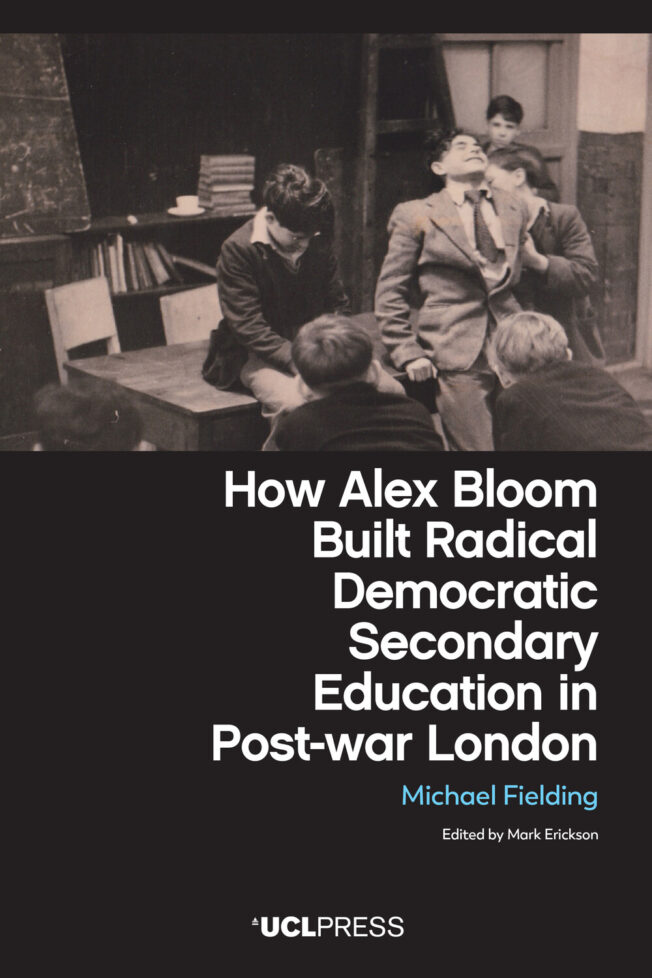

How Alex Bloom Built Radical Democratic Secondary Education in Post-war London
Michael Fielding (Author), Mark Erickson (Editor)
Alex Bloom (1895–1955) was a remarkable school leader whose reputation in his lifetime extended far beyond the UK. Against the odds, in the bomb-damaged remains of London’s East End immediately after the Second World War, he established a school that championed equality, democracy, diversity and creativity. That school – St George-in-the-East Secondary Modern in Cable Street – is known to many as the inspiration for the novel and film To Sir With Love, but its significance for education goes far deeper. An explicit affirmation of Bloom’s progressive values and aspirations, it had no punishments or rewards, no prizes or failures, and no set curriculum. It became a beacon for radical democratic schooling, achieving an astonishing international reputation and a lasting legacy.
Based on primary research with former teachers and pupils of St George-in-the-East, How Alex Bloom Built Radical Democratic Secondary Education in Post-war London recounts the story of the school’s founding, pedagogy and democratic inclusivity. Through the book’s own narrative, and in short contributions from some of today’s leading educators, it examines Bloom’s contemporary and subsequent influence on education in the UK and further afield. Most of all, this book reveals Alex Bloom’s extraordinary dedication and commitment to his staff, his pupils and their community, exemplifying the importance of engaging with the school’s contemporary realities.
List of figures
List of contributors
Foreword – David Bridges
Preface and acknowledgements
Editor’s note on language and usage
1 Renewal from the rubble
Reflection 1 – Alex Bloom: thinking and acting differently
Melissa Benn
2 Secondary Education in Postwar London, Jane Martin Reflection 2 – Future learning from the past
Alison Peacock
3 Alex Bloom, his life and work
Reflection 3 – Alex Bloom: the promise of a better future
Mike Davies
4 Radical democratic pedagogy: ‘They Learn What They Live’
Reflection 4 – Radical equality and radical collegiality in the work of Alex Bloom and Michael Fielding: distributed knowing and ignorance
Sara Bragg
5 Radical democratic curriculum in action: on teaching, learning and living democracy together
Reflection 5 – Elective echoes: reviving Bloom’s ‘elective activities’ in modern schooling
Andrew B. Jones
6 On the democratic necessity of radical inclusion Reflection 6 – Interventions
Patrick Yarker
7 Networks, integrity, and the ongoing need for progressive education
Reflection 7 – Why we need Alex Bloom today
Peter Moss
Appendix: Selected articles by Alex Bloom
References
DOI: 10.14324/111.9781806551446
Number of illustrations: 11
Publication date: 01 September 2026
EPUB ISBN: 9781806551453
Michael Fielding (Author) 
Michael Fielding is Emeritus Professor of Education at UCL’s Institute of Education. He was a secondary school teacher for more than two decades, focused on practising radical democratic education. He was deputy head teacher (1984–89) of Stantonbury Campus, Milton Keynes, a leading progressive comprehensive secondary school, then taught at the universities of Cambridge, Sussex and the Institute of Education. Michael is one of the key writers in the field of student voice, leading innovative research in school improvement, educational leadership and radical education.
Mark Erickson (Editor)
Mark Erickson is Honorary Reader in Sociology at the University of Sussex. He was formerly Director of Brighton Doctoral College, University of Brighton. A sociologist by training Mark has published extensively in sociology of science, social theory, and sociology of work.
How Alex Bloom Built Radical Democratic Secondary Education in Post-war London
Michael Fielding, Mark Erickson,
01 September 2026
Creating a Framework for Developing Sessional Teachers in Higher Education
Neil Sutherland, Alex Standen,
01 August 2026
Bringing Powerful Knowledge into Classrooms
Mark Hardman, Marie Nilsberth, Mikko Puustinen,
22 July 2026
ABC Learning Design
Clive Young, Nataša Perović, Leo Havemann, Karen Shackleford-Cesare,
14 April 2026
Reading Randomised Controlled Trials
Robert Savage, Amy Fox, Anneka Dawson, Helen Gray, Clare Huxley,
03 March 2025
Inclusion, Diversity and Innovation in Translation Education
Alejandro Bolaños García-Escribano, Mazal Oaknín, Olga Castro,
01 October 2024
Belonging and Identity in STEM Higher Education
Camille Kandiko Howson, Martyn Kingsbury,
30 July 2024
Generalism in Clinical Practice and Education
Sophie Park, Kay Leedham-Green, John Launer,
25 July 2024
How Alex Bloom Built Radical Democratic Secondary Education in Post-war London
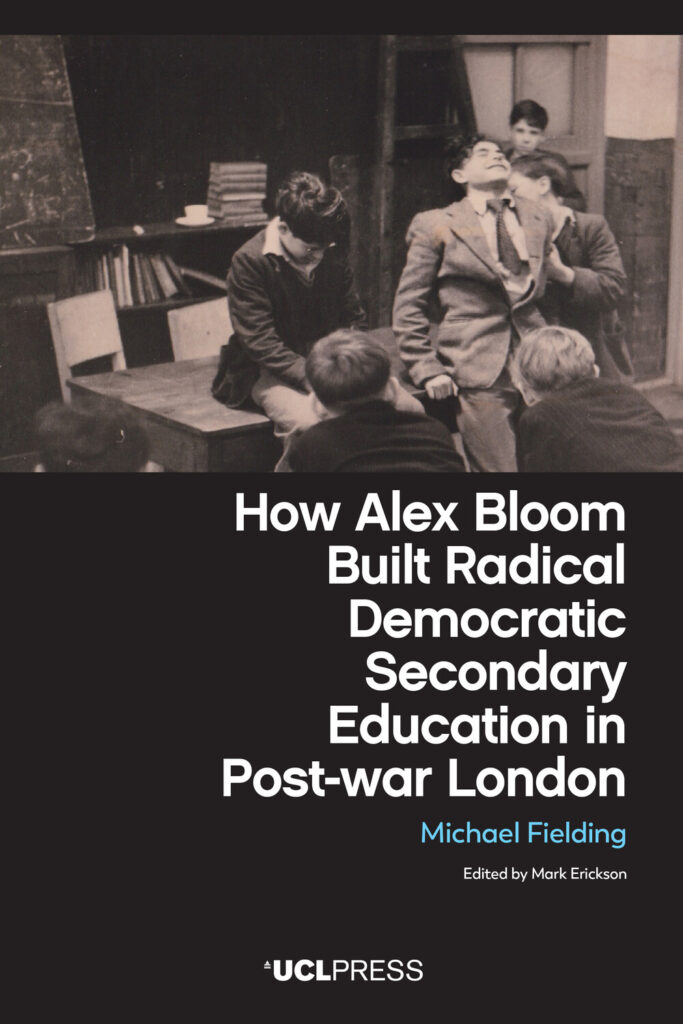
Alex Bloom (1895–1955) was a remarkable school leader whose reputation in his lifetime extended far beyond the UK. Against the odds, in the bomb-damaged remains of London’s East End immediately after the Second World War, he established a school that championed equality, democracy, diversity and creativity. That school – St George-in-the-East Secondary Modern in Cable Street – is known to many as the inspiration for the novel and film To Sir With Love, but its significance for education goes far deeper. An explicit affirmation of Bloom’s progressive values and aspirations, it had no punishments or rewards, no prizes or failures, and no set curriculum. It became a beacon for radical democratic schooling, achieving an astonishing international reputation and a lasting legacy.
Based on primary research with former teachers and pupils of St George-in-the-East, How Alex Bloom Built Radical Democratic Secondary Education in Post-war London recounts the story of the school’s founding, pedagogy and democratic inclusivity. Through the book’s own narrative, and in short contributions from some of today’s leading educators, it examines Bloom’s contemporary and subsequent influence on education in the UK and further afield. Most of all, this book reveals Alex Bloom’s extraordinary dedication and commitment to his staff, his pupils and their community, exemplifying the importance of engaging with the school’s contemporary realities.