
Publication date: 14 April 2026
DOI: https://doi.org/10.14324/111.9781806550494
Number of illustrations: 57

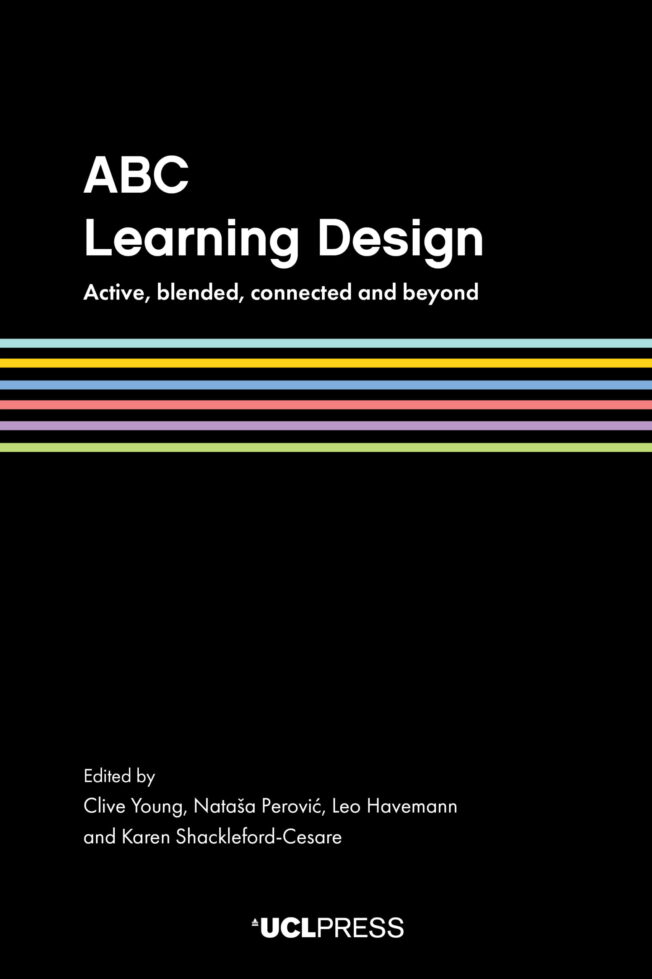
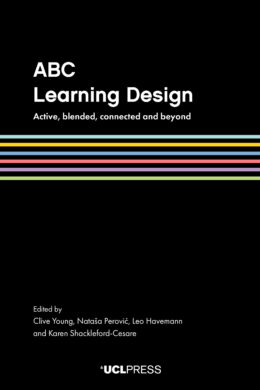
ABC Learning Design
Active, blended, connected and beyond
Clive Young (Editor), Nataša Perović (Editor), Leo Havemann (Editor), Karen Shackleford-Cesare (Editor)
ABC Learning Design is a popular and effective rapid design method for developing educational programmes, modules and short courses. Created at UCL in 2015, ABC enables academic teams to collaborate in short, focused workshops to co-create visual storyboards of students’ learning journeys. Its ease of use, adaptability, and open licence have led to widespread adoption across the UK, Europe and beyond.
ABC Learning Design: Active, blended, connected and beyond introduces ABC to a new audience, adding insights from institutions that have localised and implemented the method in diverse contexts. ABC provides practical, ready-to-use tools, but it is often reframed as more than a set of resources. Its built-in flexibility not only allows for transferability but actively encourages creative modifications that respond to institutional needs. The core ABC workshop remains the heart of the method and is central to all implementations. Around this, institutions have built locally relevant adaptations that retain the method’s participatory ethos. This shared structure creates a design lingua franca that supports collaboration within and across institutions. Drawing on facilitator and participant experiences, the book reviews ABC’s key strengths and explains why it continues to inspire innovation. It invites a global conversation on enriching learning design for students, faculty, and institutions alike.
List of figures
List of tables
List of contributors
Acknowledgements
Foreword by Diana Laurillard
Introduction
Clive Young, Nataša Perović, Leo Havemann and Karen Shackleford-Cesare
1 Introducing ABC Learning Design
Clive Young, Nataša Perović, Leo Havemann and Karen Shackleford-Cesare
2 Embedding ABC Learning Design into programme development at UCL
Clive Young, Karen Shackleford-Cesare, Leo Havemann and Nataša Perović
3 Constructive alignment: institutional strategy for blended learning success
Loulou Detienne and Ele Holvoet
4 Enhancing reflection and inclusivity in teaching practice at two Irish universities
Clare Gormley, Rob Lowney and Suzanne Stone
5 One year later: tracing the impact of ABC on faculty development at Humanitas University
Manuela Milani
6 Adapting ABC for online learning design
Vicky Devaney, Dionysios Dimakopoulos and Jo Stroud
7 Enhancing online learning at the University of Glasgow
John Kerr
8 Digital asynchronous ABC for postgraduate teaching
Tim Neumann
9 An ABC of co-design methodology: collaborative professional learning in challenging environments
Eileen Kennedy
10 ABC Learning Design in schools: scaling up professional development in learning design
François Jourde and Jacques Dubois
11 The ABC-LD@4EU+: enhanced version of the ABC Learning Design workshop tailored for the European University Alliance’s needs
Vassiliki Michou, Angela Maria Prataviera, Bartłomiej Michałowicz and Zbyněk Tonar
Conclusion
Clive Young, Nataša Perović, Leo Havemann and Karen Shackleford-Cesare
Appendices
1 Facilitating an ABC workshop
Clive Young, Nataša Perović, Leo Havemann and Karen Shackleford-Cesare
2 Evaluating ABC: does it work?
Clive Young, Nataša Perović, Leo Havemann and Karen Shackleford-Cesare
3 ABC tool wheels
Clive Young, Nataša Perović, Leo Havemann and Karen Shackleford-Cesare
Index
DOI: 10.14324/111.9781806550494
Number of illustrations: 57
Publication date: 14 April 2026
PDF ISBN: 9781806550494
EPUB ISBN: 9781806550500
Hardback ISBN: 9781806550470
Paperback ISBN: 9781806550487
Nataša Perović (Editor) 
Nataša Perović works in programme and academic development at UCL. With a background in science, digital education and teaching, she has worked in higher education for over 20 years. She is the co-creator of the ABC Learning Design method.
Leo Havemann (Editor)
Leo Havemann works in programme and academic development at UCL, with a background in digital education, library, teaching and technology roles. His research interests are in teaching and learning, learning design, and policies and practices in open and digital higher education.
Karen Shackleford-Cesare (Editor)
Karen Shackleford-Cesare works in programme and academic development at UCL, having previously worked in digital education at UCL and at Roehampton University and City St. George's University of London. She was a lecturer at the University of the West Indies and has worked in higher education for over 30 years.
Clive Young (Editor)
Clive Young was Head of the Programme Development team at UCL until retiring in 2023. He previously held positions as a consultant, lecturer, developer, and manager at Imperial College London, the University of St Andrews, the UK Open University, and UMIST, Manchester. He is the co-creator of the ABC Learning Design method.
How Alex Bloom Built Radical Democratic Secondary Education in Post-war London
Michael Fielding, Mark Erickson,
01 September 2026
Creating a Framework for Developing Sessional Teachers in Higher Education
Neil Sutherland, Alex Standen,
01 August 2026
Bringing Powerful Knowledge into Classrooms
Mark Hardman, Marie Nilsberth, Mikko Puustinen,
22 July 2026

ABC Learning Design
Clive Young, Nataša Perović, Leo Havemann, Karen Shackleford-Cesare,
14 April 2026





Reading Randomised Controlled Trials
Robert Savage, Amy Fox, Anneka Dawson, Helen Gray, Clare Huxley,
03 March 2025
Inclusion, Diversity and Innovation in Translation Education
Alejandro Bolaños García-Escribano, Mazal Oaknín, Olga Castro,
01 October 2024
Belonging and Identity in STEM Higher Education
Camille Kandiko Howson, Martyn Kingsbury,
30 July 2024
Generalism in Clinical Practice and Education
Sophie Park, Kay Leedham-Green, John Launer,
25 July 2024
ABC Learning Design
Active, blended, connected and beyond
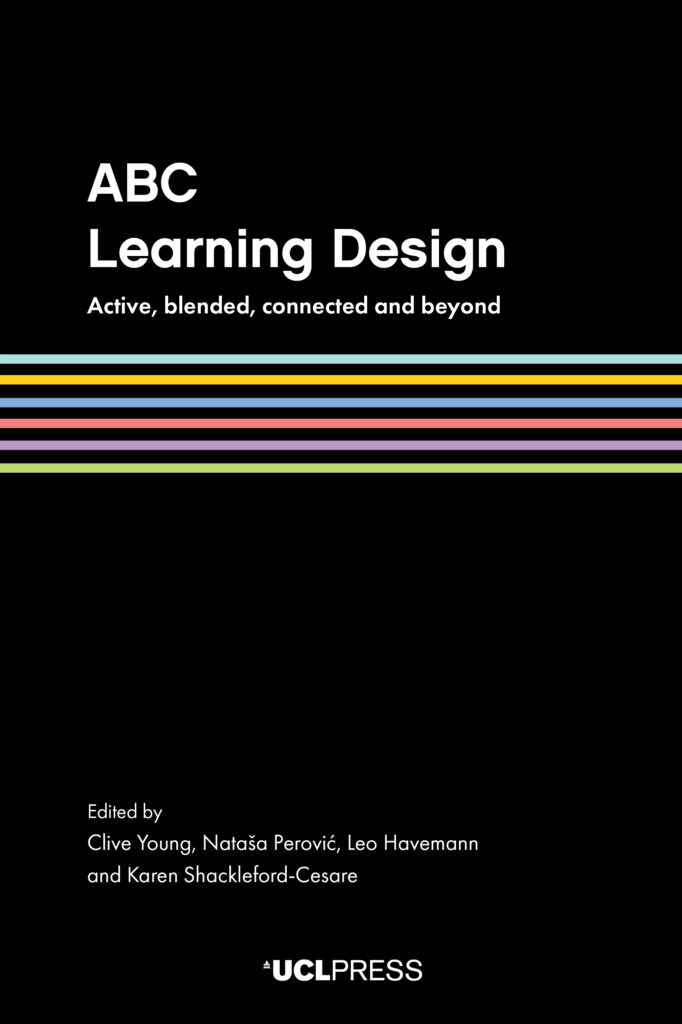
Publication date: April 14, 2026
Open Access PDF ISBN: 9781806550494
Paperback ISBN: 9781806550487
Hardback ISBN: 9781806550470
Trim size (hardback): 23.4cm x 15.6cm
Trim size (paperback): 23.4cm x 15.6cm
ABC Learning Design is a popular and effective rapid design method for developing educational programmes, modules and short courses. Created at UCL in 2015, ABC enables academic teams to collaborate in short, focused workshops to co-create visual storyboards of students’ learning journeys. Its ease of use, adaptability, and open licence have led to widespread adoption across the UK, Europe and beyond.
ABC Learning Design: Active, blended, connected and beyond introduces ABC to a new audience, adding insights from institutions that have localised and implemented the method in diverse contexts. ABC provides practical, ready-to-use tools, but it is often reframed as more than a set of resources. Its built-in flexibility not only allows for transferability but actively encourages creative modifications that respond to institutional needs. The core ABC workshop remains the heart of the method and is central to all implementations. Around this, institutions have built locally relevant adaptations that retain the method’s participatory ethos. This shared structure creates a design lingua franca that supports collaboration within and across institutions. Drawing on facilitator and participant experiences, the book reviews ABC’s key strengths and explains why it continues to inspire innovation. It invites a global conversation on enriching learning design for students, faculty, and institutions alike.