We are currently upgrading our shopping cart; in the interim all orders are being diverted to Waterstones. If you would like to redeem a promotional code, or are an author wanting to place an order, please email us.

Contact us

New series editor for FRINGE series

Abstract pattern of overlapping pastel-coloured diamonds in shades of blue, green, pink, and lavender. This image is taken from the cover of Invisible Reconstruction, a book in the FRINGE series.

We are delighted to welcome Dr. Uta Staiger as a new series editor of the FRINGE series.

Uta is Associate Professor of European Studies and Executive Director of the UCL European Institute, a European Commission designated Jean Monnet Centre of Excellence. Since 2010, she has led the Institute in its mission to develop and support UCL research and teaching activities on Europe across faculties, advise UCL leadership on European matters, and maximise the reach and impact of UCL expertise beyond the university. She joins Dr. Peter Zusi, who previously co-edited the series with Prof. Alena Ledaneva.

The FRINGE series explores the roles that complexity, ambivalence and immeasurability play in social and cultural phenomena. A cross-disciplinary initiative bringing together researchers from the humanities, social sciences and area studies, the series examines how seemingly opposed notions such as centrality and marginality, clarity and ambiguity, can shift and converge when embedded in everyday practices. Popular titles in the series include ‘Am I Less British?’, Violent Affections, Writing Resistance and Central Peripheries, in addition to the 3 volume Global Encyclopaedia of Informality.

We would like to thank outgoing series editor Prof. Alena Ledeneva, who was pivotal in the successful establishment of the series, for her tenure as series editor.

An Anthropological Approach to mHealth: interview with Professor Daniel Miller

Illustration of a hand holding a smartphone displaying health app icons.

To mark the publication of An Anthropological Approach to mHealth, which is available to readers all over the world as an open access download, we are delighted to publish an interview with one of the book’s editors, Professor Daniel Miller.

This book proposes a radically different anthropological approach to the development and dissemination of mobile health (mHealth), a rapidly growing sector in healthcare. The studies carried out by the book’s contributors found that many people use their mobile and smartphones for health purposes to a surprising extent. But instead of using bespoke apps created by health and other professionals, they take the communicative apps they have become comfortable with, such as LINE, WeChat and WhatsApp, and are highly creative in turning them into their own health apps.

This body of research also provided many additional insights, and shows how an anthropological approach situated in the observation of everyday life can be the foundation for an alternative but highly promising perspective on the future of mHealth.

Tell us more about your background and experience in this field.

I have worked at the department of anthropology at UCL for 43 years. I have also had a very productive relationship with UCL Press. My book series Why We Post published with UCL Press has now reached 1,800,000 downloads. This book is the eighth in our new series, Ageing with Smartphones.

UCL is surely the leading centre for the study of digital anthropology. We have the first and so far only master’s programme in these studies. We published the first textbook and have a centre for Digital Anthropology, we have the most staff dedicated to such studies etc. This book series arose from a five-year programme of research funded by the European Research Council, with fieldsites all around the world, including Africa, China, Europe and Latin America. What is new about it is that it is our first book in either of these series to focus on how our work can be used to enhance the welfare of populations through a better understanding of smartphone apps used for health purposes.

What do you enjoy most about your work?

I passionately believe in anthropology as an increasingly important discipline. We cannot educate on the basis of ignorance and as life has become more private we need to have the commitment and patience to get to know people and become part of their everyday life such that we really do have direct knowledge of what their lives are like and in our case the actual consequences of digital technologies. All our work involves spending 16 months in fieldwork. Basically, this is the kind of work you do if you really like people and find them endlessly fascinating. Also if you are sociable and enjoy friendship and companionship. My own fieldwork was in a small town in Ireland. I got to spend evenings in pubs listening to Irish trad music, and joining many community activities such as trying (and failing) to play the ukelele or helping the local theatre or men’s shed. Every day consisted of meeting and learning from the people I was living amongst. Of course I enjoy this work immensely, as also the subsequent process of analysis, making sense of what I have observed and trying to convey it to others through writing, making films and other forms of dissemination.

How do you work with authors and contributors to ensure their voices are heard and their work is presented in the best possible light?

This book, as all the others in our series, is a product of teamwork. A group of people who constantly met or discussed each other’s research and then writing. Just as fieldwork is essentially a sociable activity, so is the work that produced this book. Everyone in the team is equally represented in this volume. Anthropology is no longer an ‘us’ studying a ‘them’: the researchers who author this book are themselves from Africa, Palestine, China and Latin America, representing also the range of places where we studied. The style of anthropological writing is to provide empathetic portraits of the people we lived amongst so one has a sense of their individual voice. Often we discuss with them our findings and writings. Thanks to our books being open access and translated into the languages of our fieldsites the people we worked with are able to read them and comment on them. There has been considerable interest in my own writing about this town in Ireland and extracts from my work have been published in the town’s own bi-weekly magazine.

How do you balance the need for academic rigour with the need to make your publications accessible and engaging to a broader audience?

Anthropology has perhaps a special place in balancing scholarship and accessibility, since the foundation of our publications is trying to empathetically convey the lives and feelings of the people we lived amongst. So all our publications include stories of the lives and struggles of individuals, so that we show our humanist acknowledgement that every individual is unique at the same time as presenting analytical and theoretical generalisations that we use to try and explain why people do what they do and think what they think. The nearly two million downloads of our publications with UCL Press suggest that this does lead to the kind of engagement with audiences we hope for. As well as our books our UCL website includes short videos, cartoons, brief descriptions of our findings and other multimodal forms that complement our work. What was unique to much of the recent series, though not included in this particular book, is the inclusion of short videos within the UCL books.

What advice would you give to aspiring editors, and what do you think are the key skills and attributes required?

Editing is hard and responsible work. Often our books include authors who are just starting out on their career and welcome detailed commentary on how best to improve their work. Often papers will go back and forth between authors and editors many times before we are jointly satisfied with the result. Editors also have to balance the desire by some authors to continue working on their papers with the need to publish quickly in order not to let down those who sent in their papers early and need the publications for their career. Often I find myself writing passages to authors that try to exemplify what we are aiming for and provide concrete examples, rather than just criticising a submission.

Surprise us with something unexpected you encountered in your work on this book.

Before we started this work hardly any of the authors had experience in trying to shift from purely academic work to actually getting engaged in activities designed to directly improve people’s welfare. So it was really great that everyone managed to make that transition and provide so many interesting insights as a result. For example I had never imagined prior to this that I would actually jointly produce a game that can be downloaded on your smartphones (Trini Food Quiz) to help people in Trinidad and Tobago learn about hypertension and diet. But others found themselves involved in chemotherapy clinics or the work of nutritionists and a broad range of other medical activities which again was entirely new to us.

What do you think are the biggest challenges facing academic book publishing today, and how do you see the industry evolving in the future?

I feel passionately committed to UCL Press in particular. Thanks to open access, ethnographic monographs that used to sell around 600 copies might now be downloaded to 200,000 people. As well as the agreement to publish our books in translation that ensures we reach people in the places where we do our fieldwork. For an anthropologist, the global reach of the Press aligns closely with our own ethical commitments. So my main concern is that universities in general should combine together to take back publishing from commercial concerns and as an aggregate provide the business model that ensures that universities will actually save money, by no longer paying exorbitant fees to other publishers but as with UCL Press undertake the publishing ourselves. In a way I am just surprised that this is taking so long to achieve.


About the author

Daniel Miller is Professor of Anthropology at UCL. He has specialised in the anthropology of material culture, consumption and now digital anthropology. He recently directed the Why We Post project about the use and consequences of social media. He is author/editor of 47 books including The Comfort of Things, Stuff, The Global Smartphone, Ageing with Smartphones in Ireland (with Pauline Garvey) and his most recent book The Good Enough Life.

Charlotte Hawkins is Postdoctoral Researcher in Social Anthropology and author of Ageing with Smartphones in Uganda. Her work focuses on social economies of mental health and wellbeing.

Patrick Awondo is a lecturer at the University of Yaoundé 1, Cameroon. He is the author of Le sexe et ses doubles. (Homo)sexualités en postcolonie.

Structural Injustice and the Law: meet the editors

Today we are proud to publish Structural Injustice and the Law, edited by Professor Virginia Mantouvalou and Professor Jonathan Wolff. This interdisciplinary collection presents theoretical approaches and concrete examples to show how the concept of structural injustice can aid legal analysis, and how legal reform can reduce or even eliminate some forms of structural injustice.

We are grateful to Virginia and Jonathan for taking the time to answer a few questions about their research, their experiences compiling this volume and their techniques for communicating academic topics to a broad audience.

Tell us more about your background and experience in this field.

Virginia: I have researched and taught on issues affecting precarious workers for many years now. I have also worked with civil society organisations that focus on workplace exploitation. In doing so, I try to understand the role of the law in protecting precarious workers or in increasing their vulnerability to exploitation. I have realised that the exploitation of precarious workers is not only due to some bad employers, ‘a few bad apples’, but that legal rules may have a role to play in increasing their vulnerability: an idea that I describe as ‘state-mediated structural injustice’. Legal change can also strengthen the position of these workers. On the basis of these ideas, I wrote a monograph on Structural Injustice and Workers’ Rights (OUP 2023). While working on that book, I felt strongly that I wanted to understand more broadly the role of the law in relation to structural injustice. Do legal rules, perhaps inadvertently, contribute to structural injustice? Can the law help address injustices that appear to be structural, namely when it may seem that no one is to blame? I discussed this broader idea on structural injustice and the law with Jonathan Wolff, a leading political philosopher, who was immediately positive and enthusiastic about co-organising a workshop at UCL. That’s how it all started!

Jonathan: I have, for a long time, been interested in the topic that is now known as ‘structural injustice’: essentially the idea that there are injustices that cannot be attributed to particular agents, but are instead a result of combined social forces. One can find such a view in the Marxist tradition, for example, but in recent years it is the American philosopher Iris Marion Young who has brought the issue to wide attention. I wrote a paper on the topic, taught it in graduate classes, and have discussed it widely. My co-editor Virginia Mantouvalou has been a pioneer in applying the idea of structural injustice to the law. She proposed that we put on a conference together on the topic, and it was so successful that we decided to co-edit this book.

What do you enjoy most about your work?

Virginia: There’s so much I love about academic work: that I can focus on social and legal problems I find pressing; read widely and across disciplines on these issues and develop my own arguments; discuss with colleagues and be challenged by them; teach students and learn from them; learn from people who have practical experience and share any insights from my work with them; and much more.

Jonathan: As a political philosopher who has been in academia for 40 years, it’s wonderful to see people being stimulated by the writings of people of my generation and to develop it their own way. It’s the idea, I think, of learning from the previous generations and hoping to build on that and pass on a little more that motivates many of us in academia, and it certainly does for me. I greatly enjoy seeing younger scholars developing their ideas and projects for themselves. At the same time, as a teacher, it’s wonderful to see people falling in love with the subject, whether or not they want to make it the centre of the rest of their lives.

How do you work with authors and contributors to ensure their voices are heard and their work is presented in the best possible light?

Jonathan: I can’t say that this is something I would especially claim to do. For this volume we chose excellent, highly respected figures, and gave them the space and forum to develop their own ideas under our gentle guidance, which most of them don’t really need.

Virginia: I think that it always helps if an edited book is based on a workshop or conference, as we did with Structural Injustice and the Law where we hosted a workshop at the Faculty of Laws at UCL. This helped us understand better some key ideas and terms, hear and consider objections to our arguments, and improve our papers. My co-editor and I also read draft papers of all authors and gave them feedback, but their work was of such quality that this was very straightforward.

How do you balance the need for academic rigour with the need to make your publications accessible and engaging to a broader audience?

Jonathan: I don’t see a trade-off between rigour and accessibility, though there is often a conflict between the use of jargon and understandability. It’s easy as academics to fall into the mistake of assuming that everyone knows the same vocabulary as you do, but this can be problematic, especially in inter-disciplinary fields where the same term can mean different things. As a writer you have to ask yourself who your hoped-for audience is, and what you need to do to make your ideas available to them. For myself I tend to use examples and anecdotes to illustrate ideas and distinctions, but everyone has their own ways.

Virginia: I don’t think that academic rigour is in conflict with accessibility. Writing clearly and avoiding jargon is important so that our work is read widely and across disciplines. I personally also like using stories to illustrate my points. In law, these stories can come from cases, but also from empirical research about the effects of the law on people’s lives. One other way in which I try to make my work more accessible is by writing blog posts with the main ideas and problems that I identify in my academic research. These blog posts are even less technical and more easily accessible to a wide range of audiences.

What advice would you give to aspiring editors, and what do you think are the key skills and attributes required?

Virginia: Editing a book is a lot of work, so I’ve only done it when I was passionate about a topic and felt that there is a real need for this work to be done. Having a co-editor is always great because you can exchange ideas and deal with challenges together. An important skill is to be well organised, as you will need to remind authors about deadlines, which can be a challenge when editing a book.

Jonathan: Editing a volume can be a huge amount of work. It’s better, in my experience, to work with a co-editor, so you can bounce ideas around. It can also be dispiriting – when papers are late, and not exactly what you expected – but with two editors you can share the load and keep cheerful. I’d also say that if someone is unsure whether they can deliver a paper for a collection, don’t put them under pressure, but find others who want to do it. If someone feels under enormous pressure it’s unlikely they will deliver their best work, and you will all be frustrated. The key skills needed as an editor are patience and the ability to encourage, motivate, and give constructive feedback. Most academics are perfectly capable of this if they put their minds to it.

Surprise us with something unexpected you encountered in your work on this book.

Jonathan: It was a great surprise to me to find myself reading a paper on the films of Ken Loach, in a volume on structural injustice and the law. But Guy Mundlak’s is not only a superb paper in itself; it is a wonderful illustration of the themes of the book. Hugely illuminating and enjoyable.

Virginia: I don’t know if it was unexpected, but I was delighted by the enthusiasm that all our authors in the book showed from the minute we invited them to contribute. It was really rewarding.

What do you think are the biggest challenges facing academic book publishing today, and how do you see the industry evolving in the future?

Jonathan: I only have the most obvious things to say. People are getting used to the idea of not paying to read books or articles. That’s not a shocking idea – it’s the way public libraries have always functioned. Nevertheless, money is needed to produce books and articles, to publish them to a high standard and to market them. Public and school libraries were, in effect, paid for by the taxpayer, so the publishing industry had a huge, hidden, public subsidy. Now, with open access we are moving to a new world, and I don’t think we’ve figured out the business model on a large scale. I’m sure there will still be physical books and public libraries, but the balance will continue to shift as it is developing.

Virginia: Publishing open access is a challenge and an opportunity in the field, I think, as academic books can be very expensive and hence inaccessible to most people. I am delighted that our book Structural Injustice and the Law is published open access by UCL Press. Thank you so much for your support on that!


About the editors

Virginia Mantouvalou is Professor of Human Rights and Labour Law at UCL Faculty of Laws.

Jonathan Wolff is Alfred Landecker Professor of Values and Public Policy, Blavatnik School of Government, University of Oxford and Governing Body Fellow, Wolfson College Oxford.


Introducing UCL Press Play

'Pink and yellow graphic featuring a line drawing of Jeremy Bentham, the text 'Coming soon: The Greatest Good'.

UCL Press Play is a new initiative presenting documentary videos and podcasts featuring aspects of UCL’s sector-leading research, and casting light on the contribution UCL makes to society.

Just as UCL Press makes its work accessible through Open Access, UCL Press Play brings the groundbreaking research of London’s global university to audiences worldwide.

The Greatest Good

The inaugural series, The Greatest Good, explores the lasting influence of the philosopher Jeremy Bentham, whose radical progressivism was the intellectual inspiration for UCL. As the first entirely secular university to admit students regardless of religion, UCL was inspired by Bentham’s principles of equality and intellectual freedom.

Documentary film: Bentham’s Defence of Sexual Liberty

Based on original research, the flagship documentary film takes an interdisciplinary approach to Bentham’s pioneering defence of sexual liberty, at a time when society took a very different view.

Watch the documentary (13 mins 13 seconds) to hear more from UCL researchers.

The documentary features Professor Philip Schofield, Director of the Bentham Project, based in UCL’s Faculty of Laws, and Professor Judy Stephenson, an economic historian based at UCL’s Bartlett School of Sustainable Construction.

Podcasts

An inaugural series of weekly podcasts, The Greatest Good, will be released during autumn 2024. Hosted by Professor Philip Schofield, Director of UCL’s Bentham Project, the podcasts feature a series of five conversations with UCL’s world-leading academics.

Episode 1: Professor Gregory Dart – Bentham, Romanticism and the ‘Cockney College’

Professor Philip Schofield and Professor Gregory Dart, from UCL’s Department of English, discuss the philosophical differences between Utilitarianism and Romanticism, in the context of the founding of “the Cockney College”, as UCL was known at the time. They explore how Bentham’s utilitarian principles, emphasising happiness and the greatest good, contrasted with Romantic notions of moral intentions and conscience.

Episode 2: Dr Jonathan Galton – Queerness, Islam and the Left

Professor Philip Schofield hosts Dr Jonathan Galton, a social scientist from UCL IOE’s Thomas Coram Research Unit, to explore his research into the perceived political tension on the progressive left between queerness and Islam. Discussing the historical and cultural context surrounding queerness and Islam, they find surprising affinities between Bentham’s writing on freedom of religion and sexual liberty, and the contemporary theological work reinterpreting Quranic verses on homosexuality today.

Episode 3: Dr Xine Yao – Queer Aesthetics and the Panoptic Gaze

Professor Philip Schofield discusses queer aesthetics and the idea of a racialised panoptic gaze with Dr Xine Yao, co-director of qUCL (UCL’s Queer Studies network) and an expert on American literature in the Department of English. They dig into the archive of bestselling, but now forgotten, American novels, and tease out the ways in which the biggest issues of the 19th century still resonate in everyday life today.

Episode 4: Dr Luciano Rila – The UK’s First Gaysoc

Professor Philip Schofield sits down with Dr Luciano Rila, from UCL’s Department of Mathematics, to delve into the history of the UK’s first university-affiliated Gaysoc, founded at UCL by Jamie Gardiner in 1972. Dr Rila discovered archival materials in UCL’s Special Collections revealing that though the society was initially met with backlash, UCL’s liberal tradition prevailed, and the movement gained momentum, slowly leading to nationwide improvements in the lives of queer students.

Episode 5: Professor Bob Mills – Nonbinary Gender in the Middle Ages: Recognising Wilgefortis (video podcast)

Professor Philip Schofield engages with art historian and co-director of qUCL (UCL’s Queer Studies network), Professor Bob Mills, to explore the legend and cult of St. Wilgefortis in medieval Europe. Professor Mills highlights Wilgefortis as a non-binary figure, challenging both the popular belief that the Middle Ages adhered to strictly binary gender norms, and the notion that gender diversity is a modern phenomenon.

Episodes will be made available via the UCL Press Play homepage, www.uclpress.co.uk/play

Design Research in Architecture series welcomes new editor

We are happy to announce the newest addition to the editorial team of the Design Research in Architecture series, Prof. Andong Lu. Currently Professor in Architecture and Urbanism at Nanjing University, China, he joins Prof. Murray Fraser from UCL’s renowned Bartlett school of Architecture.

Featuring work from Early Career Researchers and leading architect-scholars in practice and academia, books in the open access Design Research in Architecture series vary widely in tone and structure, covering aspects such as design method, visual representation, reasoned critique, social processes and strategies for action. The series is deliberately inclusive to encourage a vibrant, novel approach, and is openly international. Each book combines serious historical or theoretical research with creative propositions expressed through drawings, models or texts; indeed, it is the symbiotic interplay between these components that forms the basis for design research in architecture. It is currently a fertile time for design research and this book series acts as the heart of these investigations.

Find out more about the series here.

Parliament Buildings shortlisted for prestigious Colvin Prize

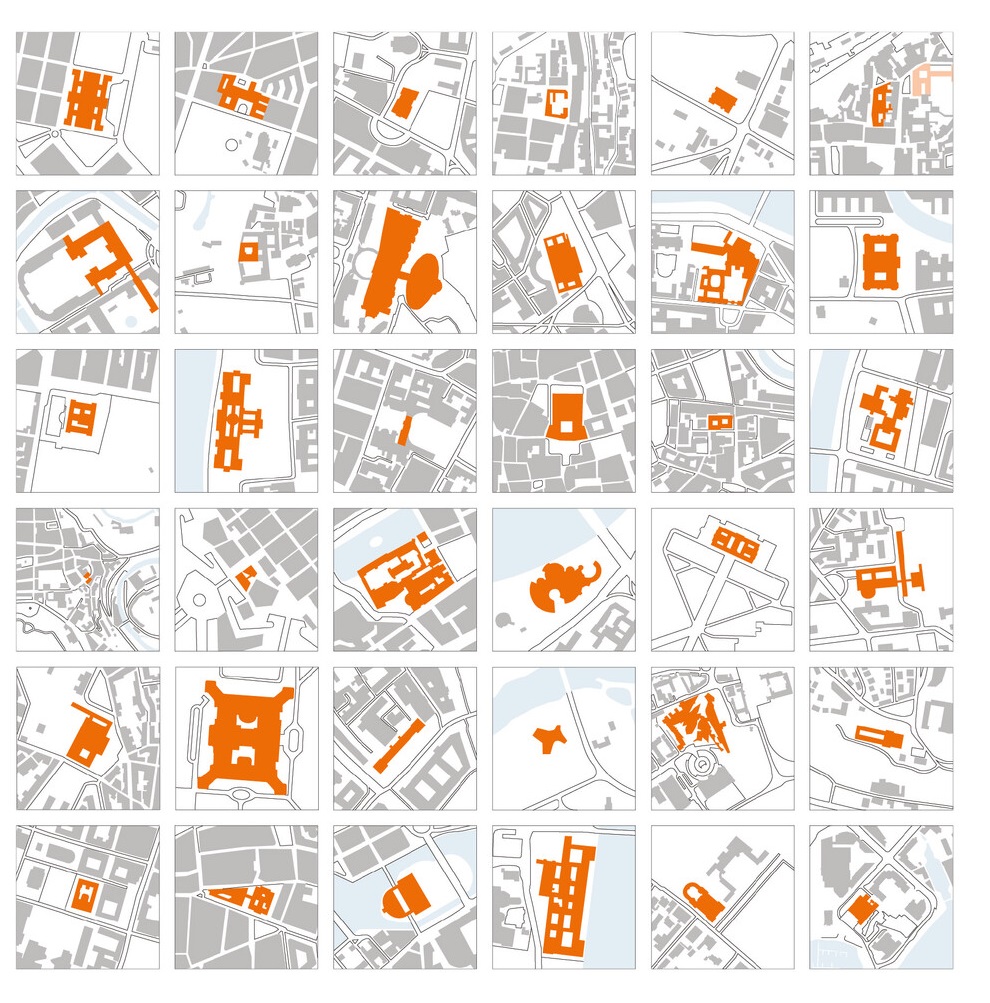
The image, from the cover of Parliament Buildings, is a collage of multiple square panels, each depicting different urban planning maps. The maps show a variety of building layouts in orange against a gray background representing streets and open spaces. Each panel focuses on different configurations and densities of urban structures, providing an overview of city planning designs or layouts

We are delighted to announce that the open access book Parliament Buildings: The architecture of politics in Europe has been shortlisted for the prestigious Colvin Prize.

Edited by Sophia Psarra, Uta Staiger and Claudia Sternberg, with a host of outstanding contributors from across  architecture, history, art history, history of political thought, sociology, behavioural psychology, anthropology and political science, the book explores the complex nexus between architecture and politics in Europe.

The Colvin Prize is regarded as one of the most significant prizes in the history of architecture and is awarded annually to the author or authors of an outstanding work of reference that relates to the field of architectural history, broadly conceived. All modes of publication are eligible, including catalogues, gazetteers, digital databases and online resources. It is named in honour of Sir Howard Colvin, a former president of the Society, and one of the most eminent scholars in architectural history of the twentieth century. The prize was inaugurated in 2017; winners receive a commemorative medal designed by contemporary medallist Abigail Burt.

The winners will be revealed at the Society’s Annual Lecture and Awards Ceremony in December 2024.

UCL Press exceeds ten million global downloads

UCL Press, the UK’s first fully Open Access University Press, has announced that its open access books and journals have been downloaded more than ten million times around the world.

UCL Press’s pioneering publishing programme spans many of the major academic disciplines, from history to philosophy and the sciences to anthropology. The Press has published 339 books that have been downloaded more than 8.7 million times, whilst its 14 journals have attracted more than 2.6 million downloads.

Its publications – which feature monographs, edited collections, academic journals and textbooks – have reached readers in 242 countries and territories worldwide, providing access to vital academic research to readers in the Global South and beyond.

The ten millionth download was the journal article A short history of the successes and failures of the international climate change negotiations by Mark A. Maslin, John Lang and Fiona Harvey, which appeared in the pioneering open science journal UCL Open: Environment.

The most popular title in the UCL Press list continues to be How the World Changed Social Media by UCL Professor of Anthropology Daniel Miller and a collective of eight other global anthropologists. The first book in the hugely popular 11-book Why We Post series, it has been downloaded an astonishing 828,129 times since it was published by UCL Press in early 2016, and it  has been translated into a variety of languages, including Hindi, Tamil, Portuguese and Italian. 

Paul Ayris, Pro-Vice-Provost at UCL LCCOS (Library, Culture, Collections and Open Science), commented: ‘Started in 2015, UCL Press continues to get better and better. 10,000,000 downloads and consultations underline the transformative effect that Open Access can have, particularly in the OA monograph space. UCL is proud to be developing a sustainable model for institutional OA publishing in Europe.’

Lara Speicher, Head of Publishing at UCL Press, said: ‘It is an immense achievement to have achieved 10 million downloads for UCL Press’s publications and it is thanks to the combined contributions of our incredibly talented and forward-thinking authors who have embraced the OA model, the original vision of senior leaders at UCL to start the Press in the first place and to provide ongoing support and encouragement, and last but not least, the dedication, skill and commitment of the UCL Press team who work hard behind the scenes every day to bring UCL Press’s outputs to the world.’

Explore UCL Press downloads here.

The final years and death of Jeremy Bentham uncovered

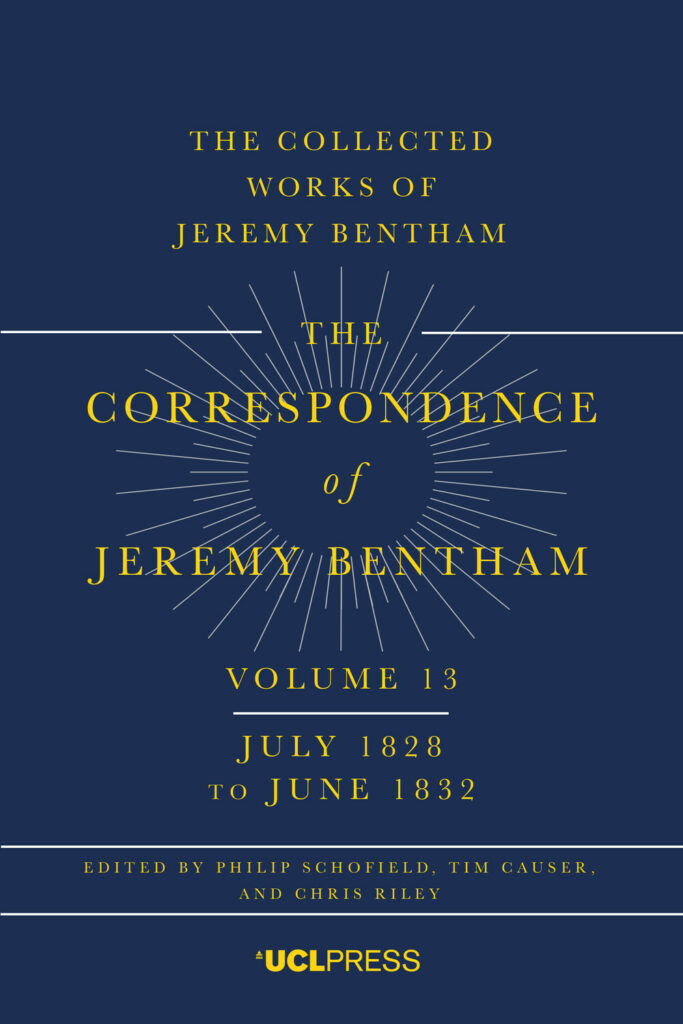
Cover of The Correspondence of Jeremy Bentham, Volume 13

The Correspondence of Jeremy Bentham, Volume 13 completes the critical edition of all known and publishable letters sent both to and from philosopher Jeremy Bentham.

The publication today (11 April 2024) of The Correspondence of Jeremy Bentham, Volume 13, edited by UCL’s Bentham Project, is a landmark in historical and philosophical scholarship, completing the critical edition of the correspondence of the philosopher, reformer, and intellectual inspiration for the foundation of UCL.

The Correspondence of Jeremy Bentham, Volume 13, published in open access by UCL Press, is edited by Professor Philip Schofield, Dr Tim Causer, and Dr Chris Riley of the Bentham Project, based in UCL Faculty of Laws. The volume publishes all known correspondence—474 letters in all—to and from Bentham from 1 July 1828 until his death on 6 June 1832. The introduction to the volume outlines the main occurrences in Bentham’s life during this period, while the detailed historical annotation of the letters brings vividly to life Bentham’s domestic, cultural, and intellectual world for the modern reader—including accounts of Bentham’s regular dinner guests, his dry sense of humour, his visits to the theatre, and his continued production of written works and active commitment to the causes of legal and political reform up until the last weeks of his life. The first volume of Bentham’s Correspondence was published in 1968, and now researchers and the public, for the first time, have access to correspondence across Bentham’s lifetime.

By 1828 Bentham was a fêted figure and was at the height of his international fame. His correspondents include Robert Peel, Henry Brougham, the Duke of Wellington, his old friend the Marquis de La Fayette, the Guatemalan politician José del Valle, and Andrew Jackson, the President of the United States of America. A particularly notable feature of Correspondence, Volume 13 is the publication, for the first time, of all known correspondence between Bentham and Daniel O’Connell, the Irish ‘Liberator’. The volume also includes considerable biographical detail about Bentham, and a particularly moving account of his meeting, just weeks prior to his death, on 14 April 1832 with Maria Gisborne, who he had not seen since the early 1790s.

The volume includes Bentham’s Last Will and Testament of 1832, in which he makes arrangements for the disposal of his property, for funding the production of an edition of his work, for a large donation of books to UCL, and for the dissection of his remains and subsequent use of them to create his auto-icon, which came to UCL in 1850.

Bentham spent his final years continuing to actively pursue and promote a variety of projects, including legal and political reform, through various direct and indirect strategies, including the placing of articles in newspapers and periodicals promoting radical causes. His literary output during this period was extraordinary: he continued to work on his massive ‘Constitutional Code’, Official Aptitude Maximized; Expense Minimized (1830) sought to promote the aptitude of official functionaries, and Jeremy Bentham to his Fellow Citizens of France, on Death Punishment (1831) was perhaps his clearest statement on the evils of capital punishment. All of the biographical and intellectual context of the correspondence is expertly illuminated by members of UCL’s Bentham Project.

The Bentham Project was formally established as a central UCL initiative in 1959 in order to produce an authoritative edition of The Collected Works of Jeremy Bentham. To date, the Bentham Project has published 36 volumes in the edition, which when complete will eventually run to over 80 volumes.

The Correspondence of Jeremy Bentham, Volume 13 can be downloaded for free or purchased from the UCL Press website.

London Review of Education marks UCL IOE’s 120th year with special issue

The image depicts a purple cover featuring the title “LONDON REVIEW OF EDUCATION” in white capital letters. Below the title is a white silhouette skyline of London, including recognizable landmarks such as the London Eye and Tower Bridge.

London Review of Education (LRE), marks IOE, UCL’s Faculty of Education and Society’s 120th year with a special issue celebrating the past and ongoing influence of the faculty in educational and social thought, practice and development.

Edited by Professor Hugh Starkey (LRE’s editor-in-chief) and Professor Li Wei (IOE Director and Dean), the result is a range of articles that critically engage with the educational and social thought, practice and development associated with IOE over its 120-year history. 

Articles published to date offer critical reflections on some of IOE’s foundling disciplines, such as the philosophy of education, to intercultural studies and diversity in education, as shaped by notable figures in the history of the Institute, and include:

The issue also explores how hierarchies linked to colonialism shaped educational and institutional practice and analyse the journey towards decolonialised, socially just alternatives, as well as the emergence of the sociology of education in Britain, comparing competing conceptions of the discipline. Forthcoming topics will cover forms of knowledge and its influence on teaching practice, the development of primary teacher education, and much more. 

Founded in 2003, the LRE is an open-access, peer-reviewed journal that reflects IOE’s broad interests in all types, sectors and phases of education in all contexts and its commitment to cross-discipline analysis. All volumes are available online and article and book review submissions are welcome. 


Links

Sign up to our newsletter

Don't miss out!
Subscribe to the UCL Press newsletter for the latest open access books,
journal CfPs, news and views from our authors and much more!