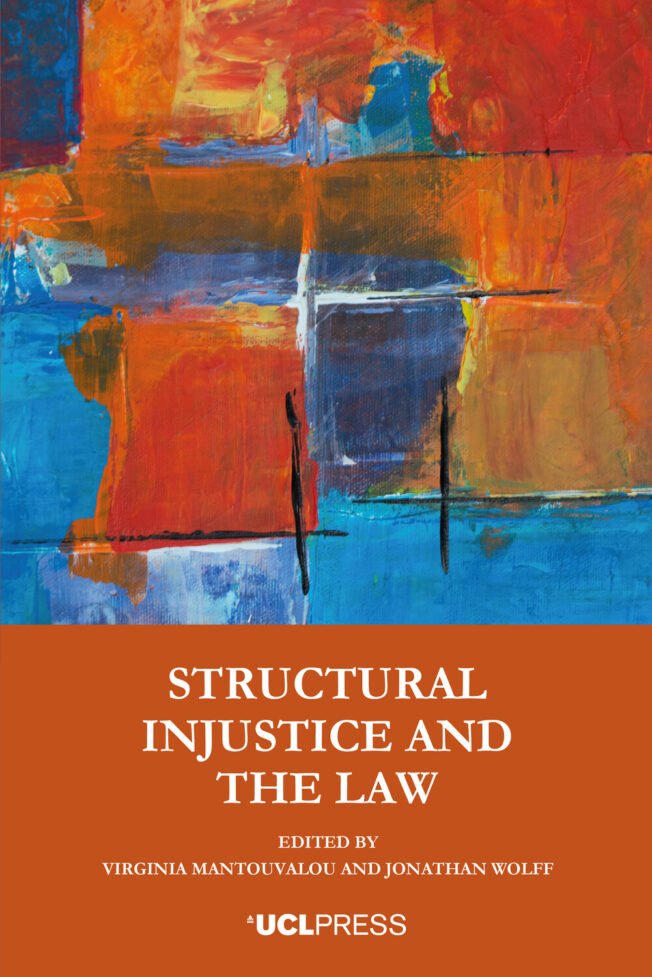

Structural Injustice and the Law
Virginia Mantouvalou (Editor), Jonathan Wolff (Editor)
In developing her conception of structural injustice, Iris Marion Young made a strict distinction between large-scale collective injustice that results from the normal functions of a society, and the more familiar concepts of individual wrong and deliberate state repression. Her ideas have attracted considerable attention in political philosophy, but legal theorists have been slower to consider the relation between structural injustice and legal analysis. While some forms of vulnerability to structural injustice can be the unintended consequences of legal rules, the law also has potential instruments to alleviate some forms of structural injustice.
Structural Injustice and the Law presents theoretical approaches and concrete examples to show how the concept of structural injustice can aid legal analysis, and how legal reform can, in practice, reduce or even eliminate some forms of structural injustice. A group of outstanding law and political philosophy scholars discuss a comprehensive range of interdisciplinary topics, including the notion of domination, equality and human rights law, legal status, sweatshop labour, labour law, criminal justice, domestic homicide reviews, begging, homelessness, regulatory public bodies and the films of Ken Loach. Drawn together, they build an invaluable resource for legal theorists exploring how to make use of the concept of structural injustice, and for political philosophers looking for a nuanced account of the law’s role both in creating and mitigating structural injustice.
Franziska Arnold-Dwyer, Mark Dsouza, Jeevan Hariharan, Maria Lee,
01 November 2026

The Correspondence of Jeremy Bentham, Volume 14
Philip Schofield, Tim Causer, Chris Riley,
07 May 2026

The Correspondence of Jeremy Bentham, Volume 13
Philip Schofield, Tim Causer, Chris Riley, Jeremy Bentham,
11 April 2024



New Directions in Private Law Theory
Fabiana Bettini, Martin Fischer, Charles Mitchell, Prince Saprai,
16 October 2023






Panopticon versus New South Wales and other writings on Australia
Tim Causer, Philip Schofield, Jeremy Bentham,
24 February 2022
Structural Injustice and the Law
Publication date: October 15, 2024
Open Access PDF ISBN: 9781800087392
Paperback ISBN: 9781800087378
Hardback ISBN: 9781800087347
Trim size (hardback): 23.4cm x 15.6cm
Trim size (paperback): 23.4cm x 15.6cm

In developing her conception of structural injustice, Iris Marion Young made a strict distinction between large-scale collective injustice that results from the normal functions of a society, and the more familiar concepts of individual wrong and deliberate state repression. Her ideas have attracted considerable attention in political philosophy, but legal theorists have been slower to consider the relation between structural injustice and legal analysis. While some forms of vulnerability to structural injustice can be the unintended consequences of legal rules, the law also has potential instruments to alleviate some forms of structural injustice.
Structural Injustice and the Law presents theoretical approaches and concrete examples to show how the concept of structural injustice can aid legal analysis, and how legal reform can, in practice, reduce or even eliminate some forms of structural injustice. A group of outstanding law and political philosophy scholars discuss a comprehensive range of interdisciplinary topics, including the notion of domination, equality and human rights law, legal status, sweatshop labour, labour law, criminal justice, domestic homicide reviews, begging, homelessness, regulatory public bodies and the films of Ken Loach. Drawn together, they build an invaluable resource for legal theorists exploring how to make use of the concept of structural injustice, and for political philosophers looking for a nuanced account of the law’s role both in creating and mitigating structural injustice.