
Publication date: 1 September 2026
DOI: https://doi.org/10.14324/111.9781787356948
Number of illustrations: 4

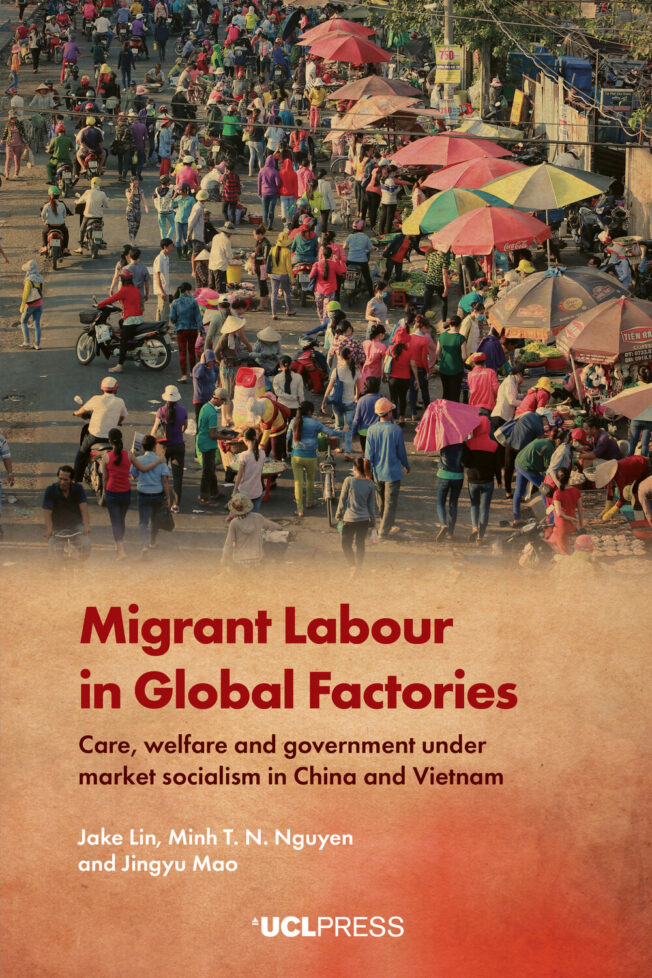
Migrant Labour in Global Factories
Care, welfare and government under market socialism in China and Vietnam
Jake Lin (Author), Minh T. N. Nguyen (Author), Jingyu Mao (Author)
The labour of hundreds of millions of internal migrant workers plays a crucial role for China and Vietnam’s national development and the expansion of global production chains in these market socialist countries. As the Communist party states have been promoting both marketization and welfare expansion since their respective reforms began, the contradictions between the commodification and the social protection of labour that coexist in these polities lead to significant obstacles to the migrant workers’ welfare and wellbeing in the post-reform era.
Bringing into focus the connection between the reconfiguration of labour and changes in the two countries’ welfare systems, Migrant Labour in Global Factories analyses how these contradictions shape the care of their huge migrant labour forces. It explores how they unfold in the historical and political contexts of both countries, bringing a range of relevant theories about welfare and social policymaking to bear on the features of the market socialist economy. The book argues that the evolving welfare systems in China and Vietnam fail to address meaningfully the social consequences of labour commodification in contexts where neoliberal development is instrumentalized to serve the political control and legitimacy of the party states. This is often at the cost of long-term and sustainable social policies for migrant labour in global factories.
List of Figures
List of abbreviations
Acknowledgements
1 Introduction
2 Conceptualising the Politics of Care: Labour, Welfare and Government
3 Land development, labour commodification and the restructuring of welfare
4 Liberalising household registration, precaritising labour and commodifying social reproduction
5 Changing labour laws, individualisation of rights and flexibilisation of labour
6 Fiscal systems, welfare and the social reproduction of labour
7 Labour, welfare, government: unravelling the social contract under market socialism
References
DOI: 10.14324/111.9781787356948
Number of illustrations: 4
Publication date: 01 September 2026
PDF ISBN: 9781787356948
EPUB ISBN: 9781787356955
Hardback ISBN: 9781787356924
Paperback ISBN: 9781787356931
Jake Lin (Author) 
Jake Lin is Assistant Professor of Political Science at the University of Texas, Rio Grande Valley. He is an associate editor for the Journal of Labor and Society. His current research explores labour migration and social policy reconfigurations in China and Vietnam, and their broader implications on global development and world order. He is the author of Chinese Politics and Labor Movements (Palgrave Macmillan 2019). He is also the co-editor for two special issues and author for articles appearing in journals such as positions: asia critique, Journal of Labor and Society, Global Public Policy and Governance, Journal of Contemporary Asia, and Socialism and Democracy.
Minh T. N. Nguyen (Author)
Minh T.N. Nguyen is Professor of Social Anthropology at Bielefeld University in Germany. She is the author of Vietnam’s Socialist Servants (Routledge, 2014) and Waste and Wealth (2018, OUP, winner of Society for the Anthropology of Work Book Prize 2019). She is co-editor of Rural Life in Late Socialism (2024, Brill), Reconfiguring Vietnam (2025, Yale Southeast Asian Monographs Series) and The Contradictions of Market Socialism (forthcoming, Policy Press) as well as special issues for journals such as positions: asia critique or Global Social Policy. Nguyen is the Principal Investigator of the ERC Starting-Grant project WelfareStruggles and the ERC Consolidator Grant project FinancialLives.
Jingyu Mao (Author)
Jingyu Mao is Lecturer at the University of Edinburgh. Her research focuses on migration and work, ethnicity and gender, emotions and intimacy, and the politics of care. She has published in Sociology and China Studies journals such as the China Quarterly, China Perspectives, Emotions and Society, and Families, Relationships, and Societies. She co-edited two special issues published on Global Social Policy and Journal of Political Sociology. Her monograph entitled Intimacy as a Lens on Work and Migration was published by Bristol University Press in 2024.





Unmaking to Make
Alex Ungprateeb Flynn, María Iñigo Clavo, Beatriz Lemos, Florencia Portocarrero,
11 May 2026


Postdigital Intimacies
Adrienne Evans, Jamie Hakim, Jessica Ringrose, Amy Shields Dobson, Shaka McGlotten,
16 March 2026



The Chronopolitics of Life
Nolwenn Bühler, Nils Graber, Victoria Boydell, Cinzia Greco,
04 December 2025

Evaluating Anti-Trafficking Interventions
Ella Cockbain, Aiden Sidebottom, Sheldon X. Zhang,
18 November 2025







The Hand that Feeds
Alexander Mullan, Riley Smallman, Herre de Bondt, Juliette Waterman,
13 May 2025
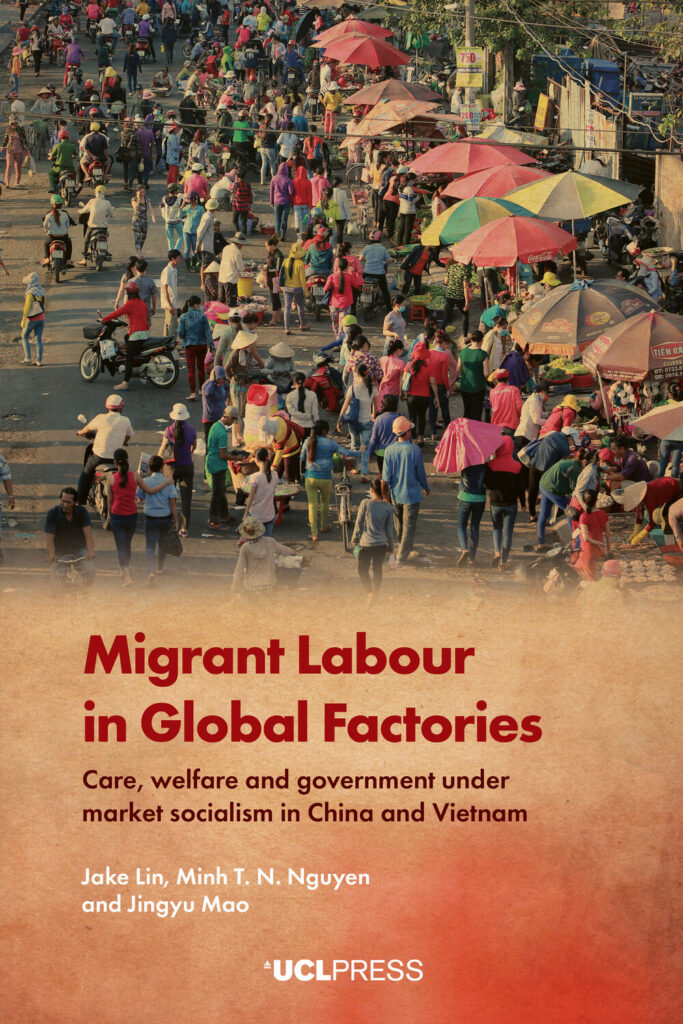
Migrant Labour in Global Factories
Care, welfare and government under market socialism in China and Vietnam
Publication date: September 1, 2026
Open Access PDF ISBN: 9781787356948
Paperback ISBN: 9781787356931
Hardback ISBN: 9781787356924
Trim size (hardback): 23.4cm x 15.6cm
Trim size (paperback): 23.4cm x 15.6cm
The labour of hundreds of millions of internal migrant workers plays a crucial role for China and Vietnam’s national development and the expansion of global production chains in these market socialist countries. As the Communist party states have been promoting both marketization and welfare expansion since their respective reforms began, the contradictions between the commodification and the social protection of labour that coexist in these polities lead to significant obstacles to the migrant workers’ welfare and wellbeing in the post-reform era.
Bringing into focus the connection between the reconfiguration of labour and changes in the two countries’ welfare systems, Migrant Labour in Global Factories analyses how these contradictions shape the care of their huge migrant labour forces. It explores how they unfold in the historical and political contexts of both countries, bringing a range of relevant theories about welfare and social policymaking to bear on the features of the market socialist economy. The book argues that the evolving welfare systems in China and Vietnam fail to address meaningfully the social consequences of labour commodification in contexts where neoliberal development is instrumentalized to serve the political control and legitimacy of the party states. This is often at the cost of long-term and sustainable social policies for migrant labour in global factories.