
Publication date: 14 August 2023
DOI: https://doi.org/10.14324/111.9781800085282
Number of illustrations: 8

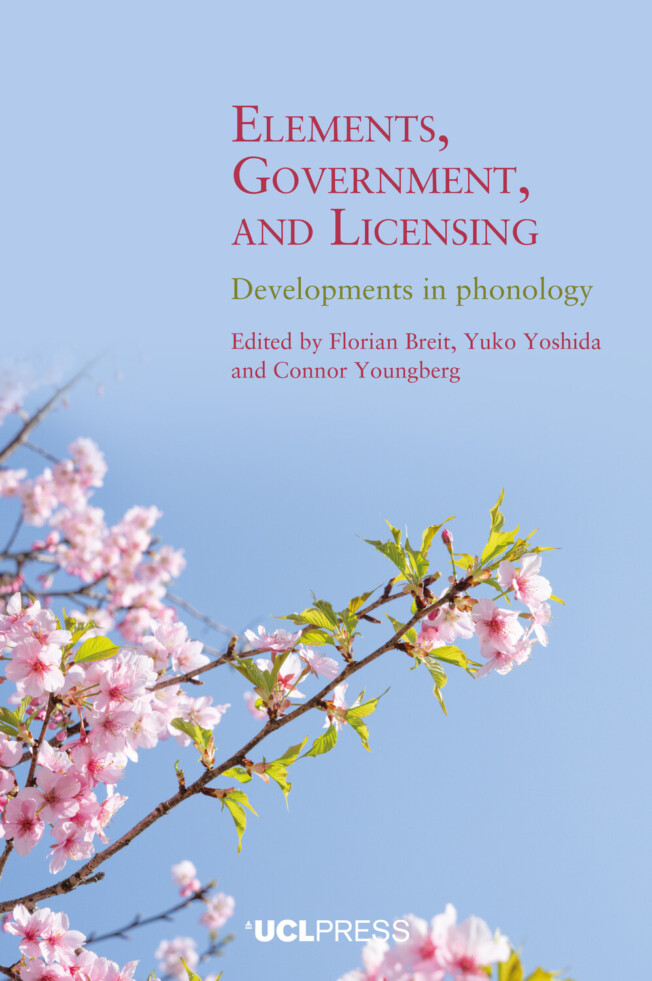
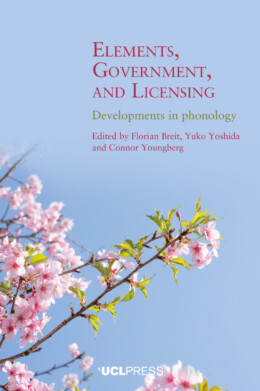
Elements, Government, and Licensing
Developments in phonology
Florian Breit (Editor), Yuko Yoshida (Editor), Connor Youngberg (Editor)
Elements, Government, and Licensing brings together new theoretical and empirical developments in phonology. It covers three principal domains of phonological representation: melody and segmental structure; tone, prosody and prosodic structure; and phonological relations, empty categories, and vowel-zero alternations. Theoretical topics covered include the formalisation of Element Theory, the hotly debated topic of structural recursion in phonology, and the empirical status of government.
In addition, a wealth of new analyses and empirical evidence sheds new light on empty categories in phonology, the analysis of certain consonantal sequences, phonological and non-phonological alternation, the elemental composition of segments, and many more. Taking up long-standing empirical and theoretical issues informed by the Government Phonology and Element Theory, this book provides theoretical advances while also bringing to light new empirical evidence and analysis challenging previous generalisations.
The insights offered here will be equally exciting for phonologists working on related issues inside and outside the Principles & Parameters programme, such as researchers working in Optimality Theory or classical rule-based phonology.
Hosts, Hospitals and Hospitalities
Susana Araújo, Catarina Nunes de Almeida, Santiago Pérez Isasi,
27 July 2026
Creative Critical Interventions for Social Justice
Natasha Tanna, Abeyamí Ortega Domínguez, Hakan Sandal-Wilson,
04 February 2026
Translation Studies before ‘Translation Studies’
Kathryn Batchelor, Iryna Odrekhivska,
15 January 2026


Fernando Cabo Aseguinolaza, Fernando Cabo Aseguinolaza, Tomás Espino Barrera, Tomás Espino Barrera,
06 October 2025

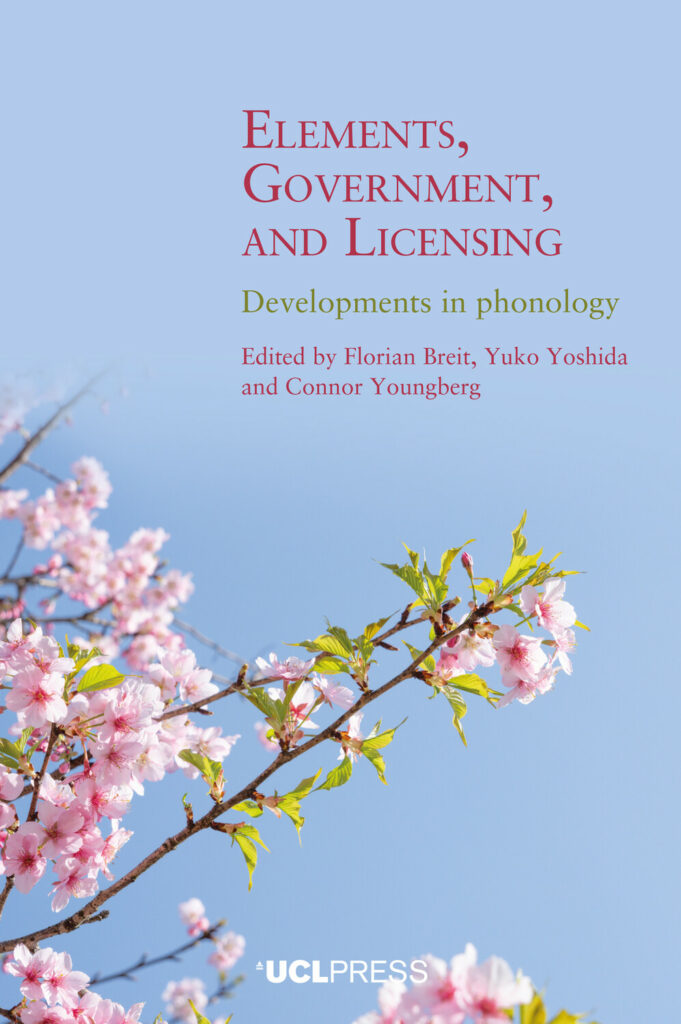
Elements, Government, and Licensing
Developments in phonology
Publication date: August 14, 2023
Open Access PDF ISBN: 9781800085282
Paperback ISBN: 9781800085299
Hardback ISBN: 9781800085305
Trim size (hardback): 23.4cm x 15.6cm
Trim size (paperback): 23.4cm x 15.6cm
Elements, Government, and Licensing brings together new theoretical and empirical developments in phonology. It covers three principal domains of phonological representation: melody and segmental structure; tone, prosody and prosodic structure; and phonological relations, empty categories, and vowel-zero alternations. Theoretical topics covered include the formalisation of Element Theory, the hotly debated topic of structural recursion in phonology, and the empirical status of government.
In addition, a wealth of new analyses and empirical evidence sheds new light on empty categories in phonology, the analysis of certain consonantal sequences, phonological and non-phonological alternation, the elemental composition of segments, and many more. Taking up long-standing empirical and theoretical issues informed by the Government Phonology and Element Theory, this book provides theoretical advances while also bringing to light new empirical evidence and analysis challenging previous generalisations.
The insights offered here will be equally exciting for phonologists working on related issues inside and outside the Principles & Parameters programme, such as researchers working in Optimality Theory or classical rule-based phonology.
‘Each contribution is, in that sense, truly a contribution… The phenomena that are discussed are of broad interest… and the successful implementation of the per-part introduction strategy makes this volume an accessible entry into a world that can, for non-specialists, appear somewhat idiosyncratic and even intimidating, without dumbing anything down.’
Phonology