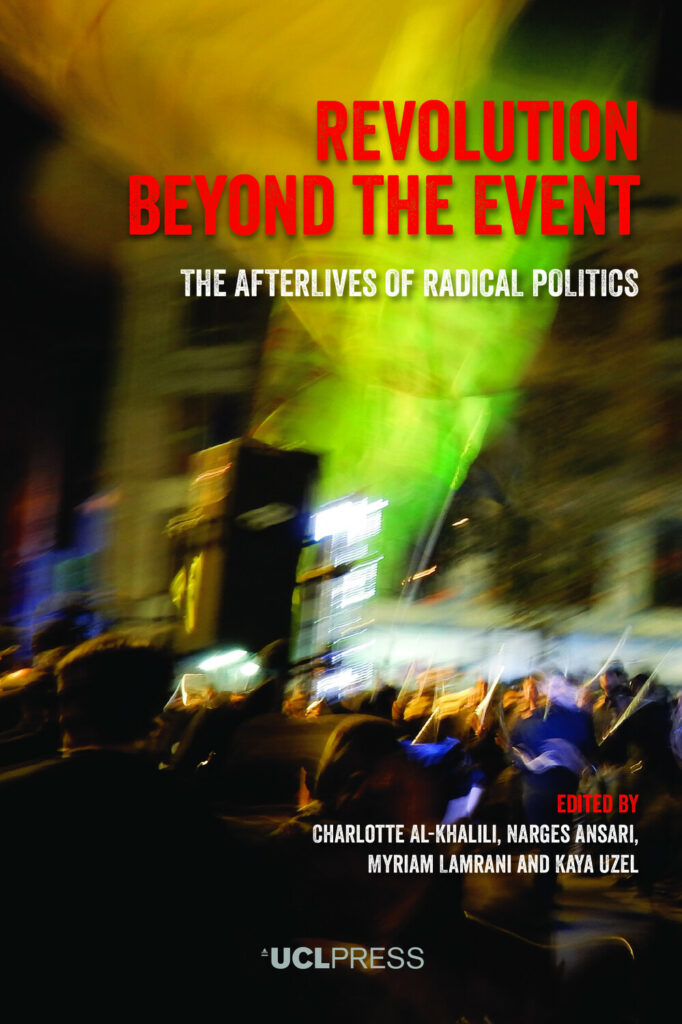
Revolution Beyond the Event

Revolution Beyond the Event brings together leading international anthropologists alongside emerging scholars to examine revolutionary legacies from the MENA region, Latin America and the Caribbean. It explores the idea that revolutions have varied afterlives that complicate the assumptions about their duration, pace and progression, and argues that a renewed focus on the temporality of radical politics is essential to our understanding of revolution. Approaching revolution through its relationship to time, the book is a critical intervention into attempts to define revolutions as bounded events that act as sequential transitions from one political system to another. It pursues an ethnographically driven rethinking of the temporal horizons that are at stake in revolutionary processes, arguing that linear views of revolution are inextricably tied to notions of progress and modernity. Through a careful selection of case studies, the book provides a critical perspective on the lived realities of revolutionary afterlives, challenging the liberal humanist assumptions implicit in the ‘modern’ idea of revolution, and reappraising the political agency of people caught up in revolutionary situations across a variety of ethnographic contexts.
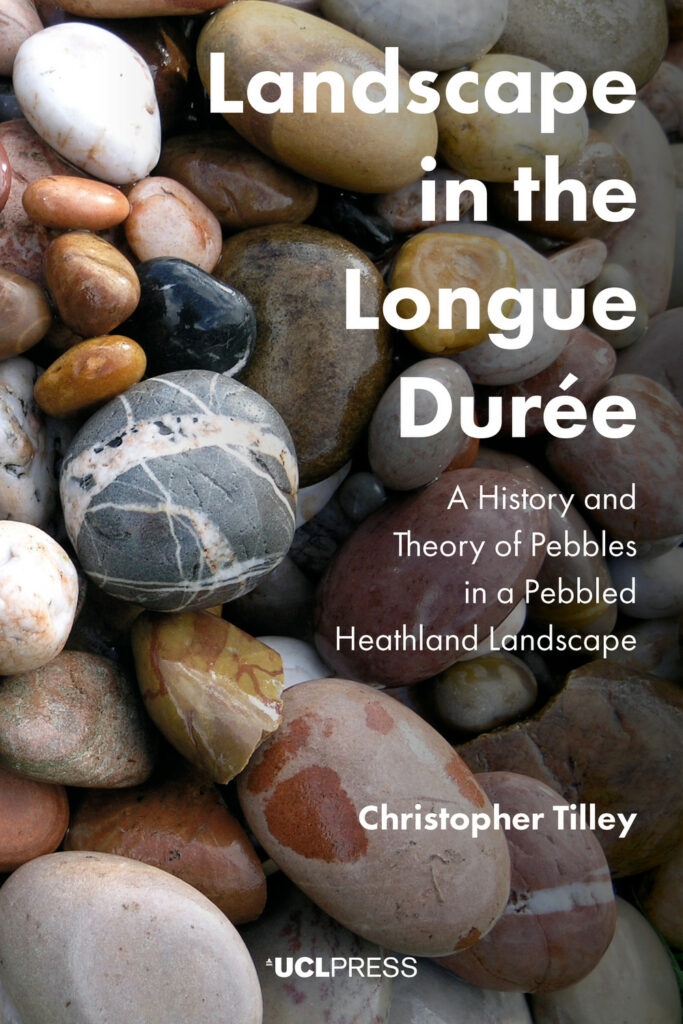
Landscape in the Longue Durée

Pebbles are usually found only on the beach, in the liminal space between land and sea. But what happens when pebbles extend inland and create a ridge brushing against the sky?

Landscape in the Longue Durée is a 4,000 year history of pebbles. It is based on the results of a four-year archaeological research project of the east Devon Pebblebed heathlands, a fascinating and geologically unique landscape in the UK whose bedrock is composed entirely of water-rounded pebbles. Christopher Tilley uses this landscape to argue that pebbles are like no other kind of stone – they occupy an especial place both in the prehistoric past and in our contemporary culture. It is for this reason that we must re-think continuity and change in a radically new way by considering embodied relations between people and things over the long term.

Dividing the book into two parts, Tilley first explores the prehistoric landscape from the Mesolithic to the end of the Iron Age, and follows with an analysis of the same landscape from the eighteenth into the twenty-first century. The major findings of the four-year study are revealed through this chronological journey: from archaeological discoveries, such as the excavation of three early Bronze Age cairns, to the documentation of all 829 surviving pebble structures, and beyond, to the impact of the landscape on local economies and its importance today as a military training camp. The results of the study will inform many disciplines including archaeology, cultural and art history, anthropology, conservation, and landscape studies.

This book also includes a downloadable appendix. Download it here (.pdf).

Sign up to our newsletter

Don't miss out!
Subscribe to the UCL Press newsletter for the latest open access books,
journal CfPs, news and views from our authors and much more!