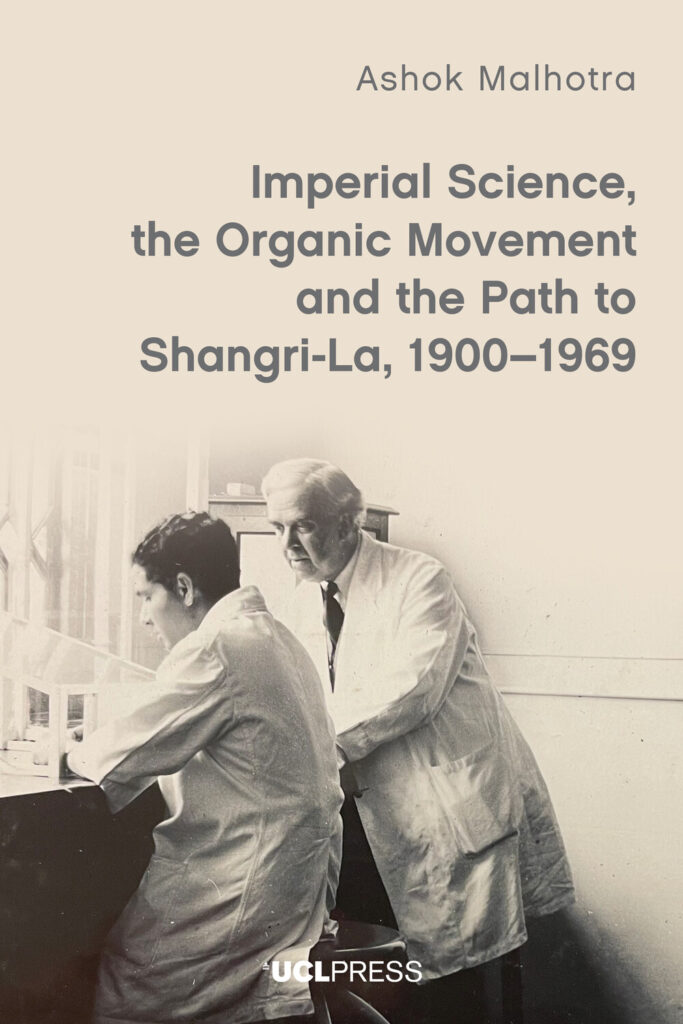
Imperial Science, the Organic Movement and the Path to Shangri-La, 1900-1969 investigates scientific studies undertaken in British India by Robert McCarrison and Albert Howard in the 1920s, and how this research was later adapted in Britain and the USA. It examines how imperial agendas and colonial stereotyping shaped McCarrison’s dietary laboratory experiments and Howard’s development of the Indore Composting Process. Ashok Malhotra reveals how Indian scientists and Indian Princes contributed to the research culture in the institutes that were founded by these two British scientists, and in so doing, he draws attention to figures whose contributions have previously been overlooked by scholars. Malhotra demonstrates how McCarrison’s and Howard’s research was interpreted by British and US-based organic farming advocates to advocate for agricultural methods which returned organic matter to the soil and rejected chemical fertilisers.
It discusses how organic advocates on both sides of the Atlantic deployed the Hunzas, a community in British India (later Pakistan), as an example of a ‘tribe’ whose vigour could be ascribed to their farming techniques and diets. The narrative concludes by demonstrating how US travel writers in the 1950s and 1960s represented Hunza as a Shangri-La – a paradise whose inhabitants lived prolonged lives in blissful contentment.