We are currently upgrading our shopping cart; in the interim all orders are being diverted to Waterstones. If you would like to redeem a promotional code, or are an author wanting to place an order, please email us.

Contact us

Essays on Logic, Ethics, and Universal Grammar

This new volume of Bentham’s philosophical writings deals with his most fundamental ideas concerning logic, language, ethics, and grammar. It includes four major essays written between 1814 and 1816, namely ‘Essay on Logic’, ‘Essay on Ethics’, ‘Didacologia’, and ‘Universal Grammar’, all of them closely related to Chrestomathia, Bentham’s major work on education.

In ‘Essay on Logic’, Bentham contrasts the præcognita of Aristotle with his own ‘characteristics’ of logic and deals with methodization, ontology, and the relationship between logic and language. In ‘Essay on Ethics’, he offers a critique of the Aristotelian virtues and outlines his own division of ethics into prudence, probity, and benevolence. In ‘Didacologia’, he presents an outline of a comprehensive plan for the division of the arts and sciences based on the method of exhaustive bifurcation and a new nomenclature. In ‘Universal Grammar’, Bentham deals with language as the basis for thought and communication and investigates the nature of the different parts of speech. The volume is completed with an Appendix containing fragmentary material, written in August and September 1813, with a focus on language. All the texts are based on Bentham’s original manuscripts and have never before been published in authentic form.

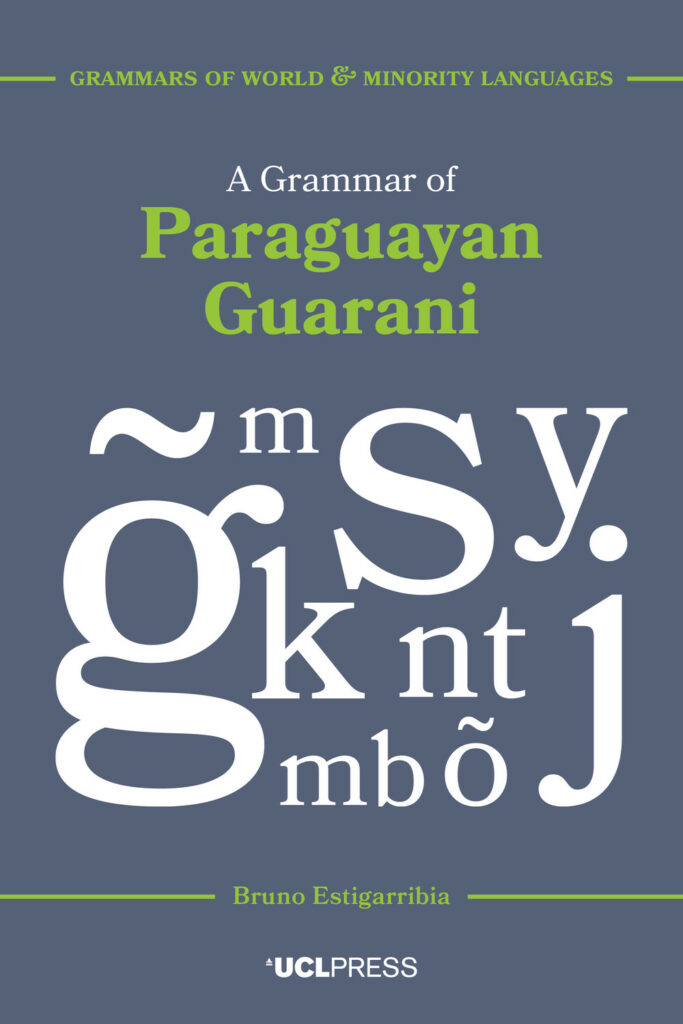
A Grammar of Paraguayan Guarani

The history of Guarani is a history of resilience. Paraguayan Guarani is a vibrant, modern language, mother tongue to millions of people in South America. It is the only indigenous language in the Americas spoken by a non-ethnically indigenous majority, and since 1992, it is also an official language of Paraguay alongside Spanish. This book provides the first comprehensive reference grammar of Modern Paraguayan Guarani written for an English-language audience. It is an accessible yet thorough and carefully substantiated description of the language’s phonology, morphosyntax, and semantics. It also includes information about its centuries of documented history and its current sociolinguistic situation.

Examples come from literary sources and film, scholastic grammars, online newspapers, blogs and other publications, publicly accessible social media data, and the author’s own fieldwork. They are specifically chosen to reflect the diversity of uses of modern-day Guarani, with the aim of providing a realistic picture of the current state of the language in twenty-first century Paraguay.

This book will benefit researchers and students of Guarani and Paraguay, such as linguists, anthropologists, ethnographers, sociologists, historians, or cultural studies and literature scholars. Typologically-oriented researchers and students of other Tupian and Amerindian languages will have reliable data for comparative purposes. Given the unique socio-historical profile of Guarani, researchers in fields such as language contact, bilingualism, code-switching, language planning, language education, and literacy will find this book a valuable reference resource.

A Grammar of Elfdalian

Elfdalian is the language traditionally spoken in Övdaln (Älvdalen), central Sweden. Due to its linguistic differences to Swedish, coupled with the determination of the speech community, several attempts have been made to acquire an official recognition of Elfdalian as a minority language in Sweden. However, despite growing interest in documenting and revitalising Elfdalian, it is still regarded as a dialect.

As one of the best-preserved members of a larger but lesser-known Dalecarlian (or Dalmål) sub-branch of the Scandinavian languages, Elfdalian is a unique language to study. The purpose of the grammar is to account for Late Classical, or ‘Preserved’, Elfdalian from linguistic, historical and sociolinguistic angles, and to make the language, including both its archaic and innovative features, accessible to a wider audience.

The grammar has multiple target groups: people in Övdaln who wish to revitalise or reclaim their language in a more original form than the one it was transferred into through language decline and Swedish influence since the beginning of the twentieth century; those who wish to transmit the language to others through preschool, school or adult instruction; and likewise others who wish to study a lesser-known North Germanic language. Linguists may find Elfdalian interesting from the angles of comparative historical linguistics, language structure, as well as sociolinguistics and language planning.

A Grammar of Khowar

This book is the first full-length English-language grammar of Khowar, one of the Far Northwestern Indo-Aryan languages. It reflects more than 30 years of field research by the author, and attempts to capture a snapshot of the language at the end of the twentieth century, a time when this and other small mountain languages in northern Pakistan were undergoing rapid change, the pace of which continues to accelerate.

An introductory chapter presents the language in its genetic, geographical, and typological contexts, and its multi-layered lexicon. There follow chapters on phonology, word formation and derivational morphology, nominal morphology, deictic elements, the verbal system, adjectival modification, adverbial modification, morphosyntax, and morphosemantics. This final chapter is a distillation of features of the language that are central to understanding how it conceives of and portrays the world.

In addition to grammatical analysis and discussion, A Grammar of Khowar features numerous original example sentences, mostly contributed by senior, highly competent speakers of the language. A significant number of examples are drawn from oral texts recorded by the author in several villages. They are presented in roman representation and are accompanied by a complete morphological analysis and English translation.

Additionally, an Appendix contains a 30-page sample text, presented first in Khowar’s Perso-Arabic script then by roman-based morphological analysis and an English translation by the author.

A Grammar of Gaddi

This is the first long-form descriptive grammar of the Pahari Indo-Aryan language, Gaddi (also called Bharmauri), spoken by the Gaddi people, a traditionally pastoral community now undergoing rapid occupational and lifestyle change. In 2010, the language was considered ‘definitely endangered’ by the UNESCO Atlas of the World’s Languages in Danger.

A Grammar of Gaddi begins with an account of the historical and sociolinguistic profile of the community, including a discussion on the vitality of the language. Following this is a detailed documentation of the linguistic properties of the language, with chapters dedicated to the language’s phonetics and phonology, its word classes, its morphosyntax and its syntax. The appendices in the book contain the phonemic inventory of the language, a basic word list, and the cardinal, ordinal, fractional and distributive numerals of Gaddi.

The careful linguistic analysis in the book allows for Gaddi language data to be presented in the International Phonetic Alphabet, with minute morphological glosses for maximum transparency. The book thus serves as a vital resource for public and private bodies, and will be of use to the language community as a basis for primers, textbooks and learning tools.
A Grammar of Akajeru

A Grammar of Akajeru describes aspects of the grammatical system and lexicon of Akajeru, a traditional dialect of the North Andamanese language, as it was reportedly used around the beginning of the twentieth century. It is based primarily on the fragments of this variety provided by the British anthropologist Alfred R. Radcliffe-Brown and scattered among the published results of his anthropological research carried out on the islands between 1906 and 1908. These are supplemented by published lists of 46 anatomical terms and 28 toponyms collected by Edward Horace Man, Officer in Charge of the Andamanese 1875–79.

The book provides a linguistic analysis of all the extant Akajeru material, plus items identified by Radcliffe-Brown as ‘North Andaman’ without further specification, his few records of Akabo and Akakhora and Man’s few records of Akakhora, which together constitute all the documentation of these other traditional North Andamanese dialects. It includes a grammatical sketch of Akajeru, a list of all the words that were recorded, together with an English-Akajeru finder list, and a comparison between Akajeru and Present-day Andamanese, an Akajeru-based variety with elements from all the other traditional dialects of North Andamanese that is today remembered by only three people.

Sign up to our newsletter

Don't miss out!
Subscribe to the UCL Press newsletter for the latest open access books,
journal CfPs, news and views from our authors and much more!