We are currently upgrading our shopping cart; in the interim all orders are being diverted to Waterstones. If you would like to redeem a promotional code, or are an author wanting to place an order, please email us.

Contact us

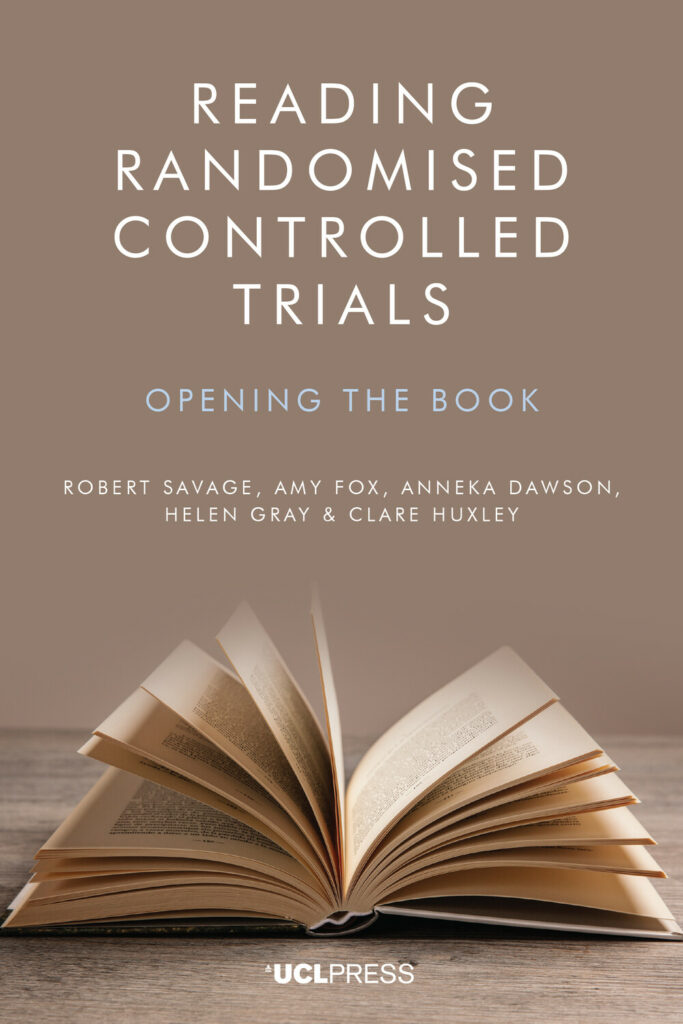
Reading Randomised Controlled Trials

Book cover titled 'Reading Randomised Controlled Trials: Opening the Book.' by Robert Savage, Amy Fox, Anneka Dawson, Helen Gray, and Clare Huxley. The cover displays an open book with pages spread out on a wooden surface, set against a plain backdrop.

In early 2021-22, the Flexible Phonics reading intervention, a large-scale randomised controlled trial, took place in 118 schools in England and involved nearly 3,000 children. This study aimed to provide valuable insights into the success of largely school-based education trials. The Flexible Phonics trial proved to be not only an important experiment in improving children’s literacy, but a case study in which the methodology of single randomised controlled trials in education can be considered.

Reading Randomised Controlled Trials investigates the complexities of conducting randomised controlled trials in the field of education and how they can be seen as a cultural activity. The book emphasises the human operations, decision-making, and actions that drive such trials, which are often overlooked in published reports. Through the case study of Flexible Phonics, the book highlights the key differences between scaled educational trials and other types of trials, such as pharmaceutical trials. The additional focus on early childhood literacy is of significant educational importance, particularly in the context of UK school partial closures in 2020 and 2021 during the Covid-19 pandemic. Reading Randomised Controlled Trials is ultimately a unique resource on the implementation of randomised controlled trials in authentic school contexts and for the sustained improvement of practice in education.
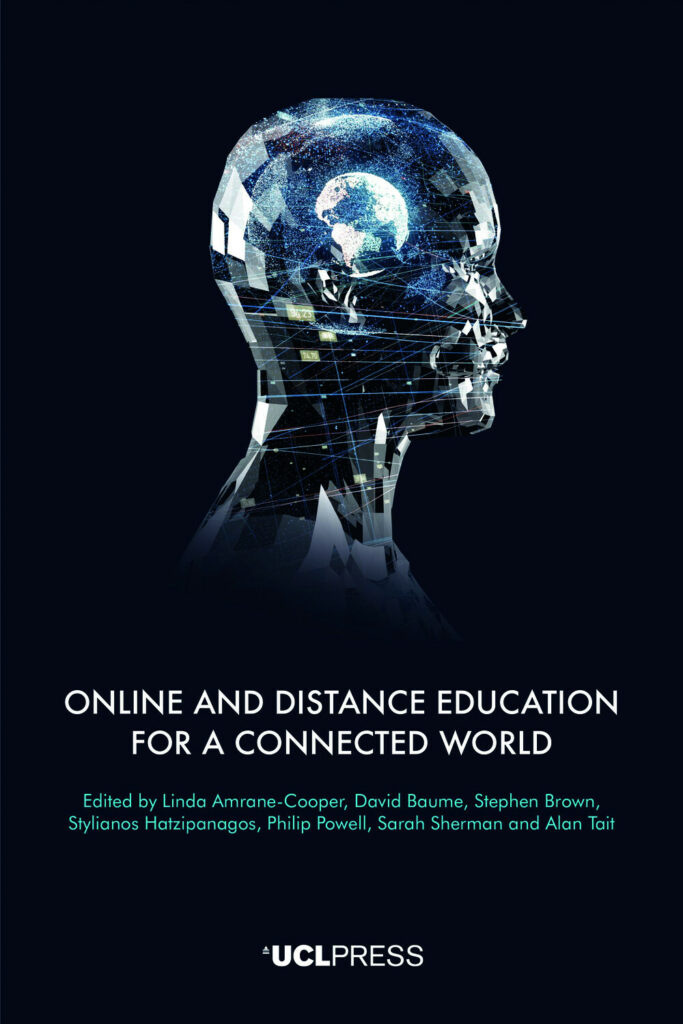
Online and Distance Education for a Connected World

Learning at a distance and learning online are growing in scale and importance in higher education, presenting opportunities for large scale, inclusive, flexible and engaging learning. These modes of learning swept the world in response to the Covid-19 pandemic. The many challenges of providing effective education online and remotely have been acknowledged, particularly by those who rapidly jumped into online and distance education during the crisis.

This volume, edited by the University of London’s Centre for Online and Distance Education, addresses the practice and theory of online and distance education, building on knowledge and expertise developed in the University over some 150 years. The University is currently providing distance transnational education to around 50,000 students in more than 180 countries around the world. Throughout the book, contributors explore important principles and highlight successful practices in areas including course design and pedagogy, online assessment, open education, inclusive practice, and enabling student voice. Case studies illustrate prominent issues and approaches. Together, the chapters offer current and future leaders and practitioners a practical, productive, practice- and theory-informed account of the present and likely future state of online and distance higher education worldwide.

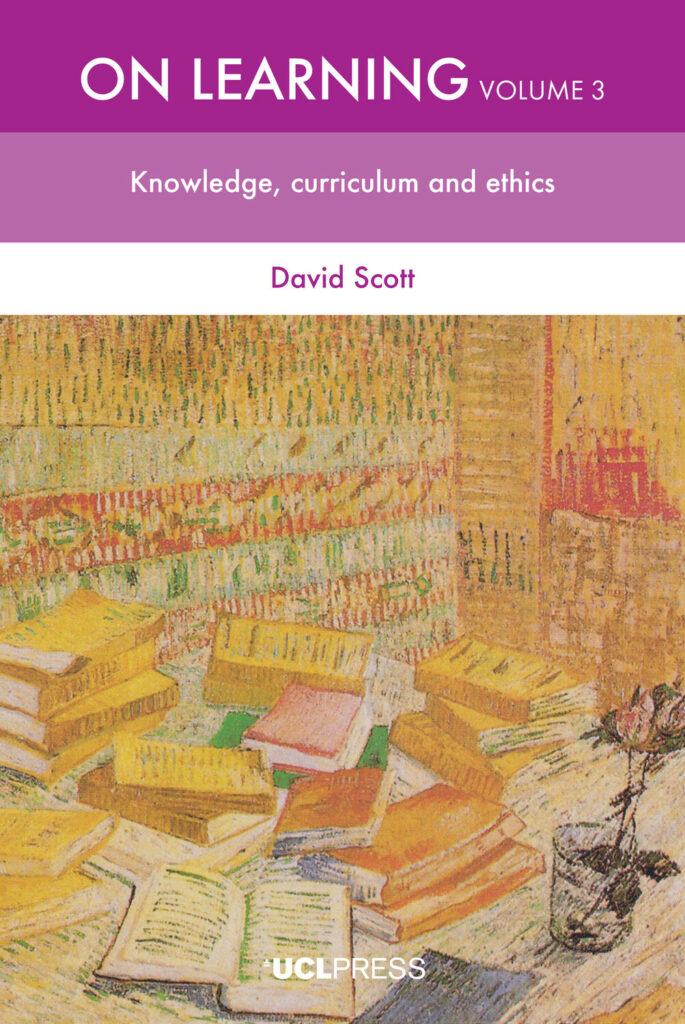
On Learning, Volume 3

This book, as you can see from its title, is about learning, or at least about the concept and practice of learning. It investigates two meta-concepts, knowledge and learning, the relationship between the two, and the way these can be framed in epistemic, social, political and economic terms. Knowledge and learning, as meta-concepts, are positioned in various networks of meaning, principally the antecedents of the concepts, their relations to other relevant concepts, and the way the concepts are used in the lifeworld. This book explores a number of important concepts that are relevant to the idea of learning. These are meta-concepts such as epistemology, semantics, phenomenology, rationality, thinking, hermeneutics, critical realism and pragmatism, and meso-concepts such as a Bildung, justification, mathematical concepts such as averaging, probability, comparison, prediction and correlation, a bureaucratic theory of learning, social categories of learning and knowledge, and the relationship between ethics and learning.

On Learning, Volume 3: Knowledge, curriculum and ethics, like the first two volumes, is a response to empiricist and positivist conceptions of knowledge. The author challenges detheorised and reductionist ideas of learning that have filtered through to the management of our schools, colleges and universities, over-simplified messages about learning, knowledge, curriculum and assessment, and the denial that values are central to understanding how we live and how we should live.

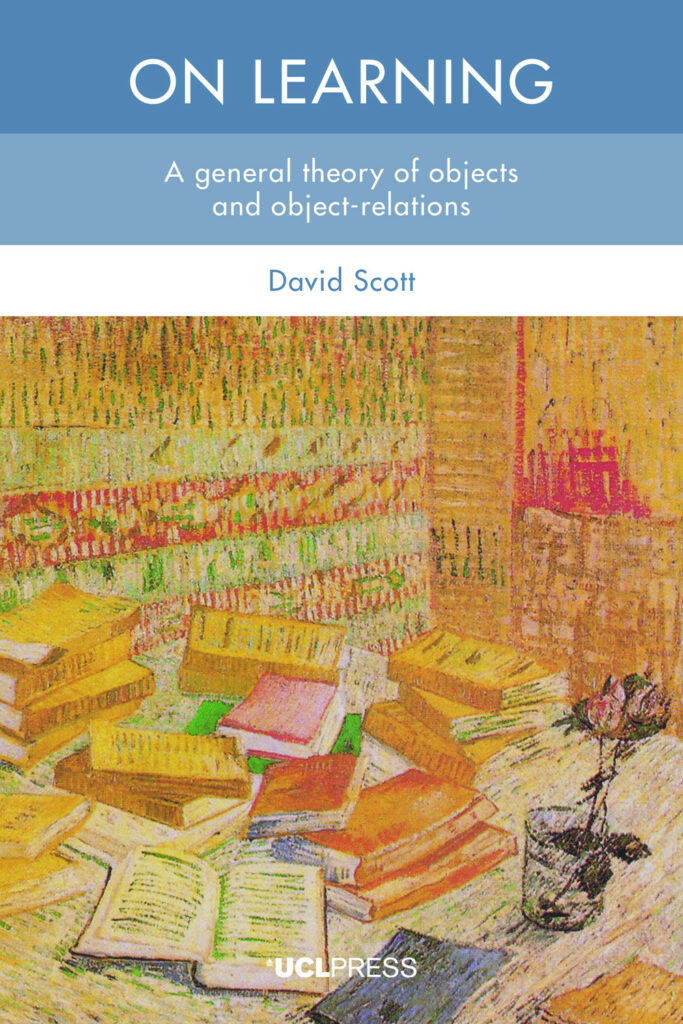
On Learning

This is a philosophical work that develops a general theory of ontological objects and object-relations. It does this by examining concepts as acquired dispositions, and then focuses on perhaps the most important of these: the concept of learning. This concept is important because everything that we know and do in the world is predicated on a prior act of learning.

A concept can have many meanings and can be used in a number of different ways, and this creates difficulty when considering the nature of objects and the relationships between them. To enable this, David Scott answers a series of questions about concepts in general and the concept of learning in particular. Some of these questions are: What is learning? What different meanings can be given to the notion of learning? How does the concept of learning relate to other concepts, such as innatism, development and progression?

The book offers a counter-argument to empiricist conceptions of learning, to the propagation of simple messages about learning, knowledge, curriculum and assessment, and to the denial that values are central to understanding how we live. It argues that values permeate everything: our descriptions of the world, the attempts we make at creating better futures and our relations with other people.

Praise for On Learning

‘Provides a nuanced and layered understanding of the complex concept and practice of learning to students and researchers.’
Educational Review

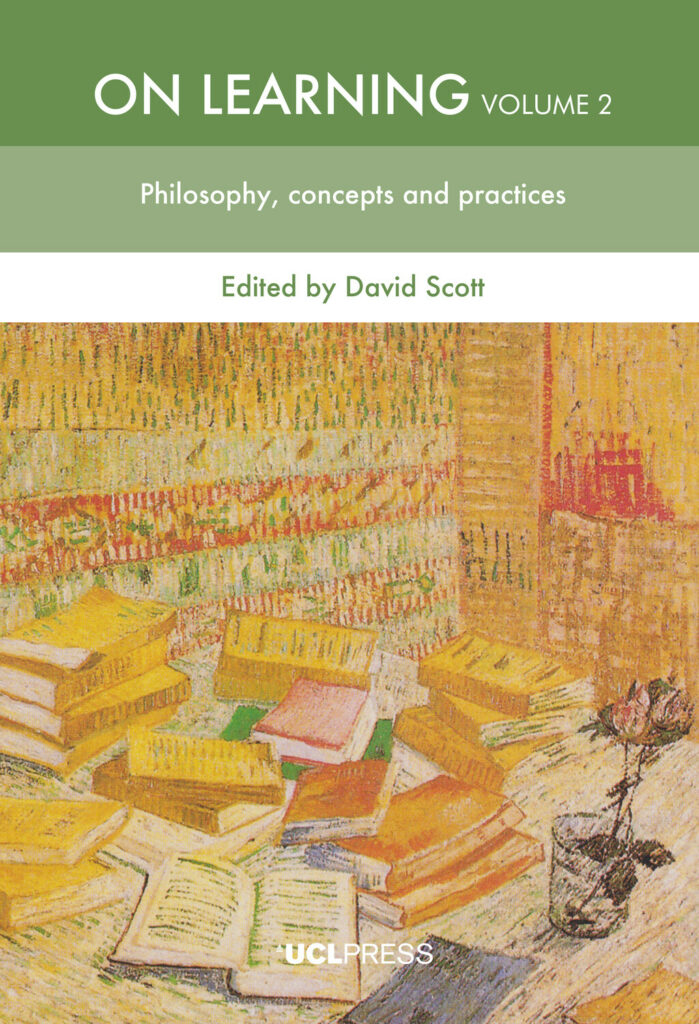
On Learning, Volume 2

This edited book, as you can see from its title, is about learning, or at least about the concept and practice of learning. The contributors to this volume are focusing on two meta-concepts, knowledge and learning, on the relationship between the two, and the way these can be framed in epistemic, social, political and economic terms. Knowledge and learning, as meta-concepts, are positioned in various networks or constellations of meaning, principally: the antecedents of the concepts, their relations to other relevant concepts, and the way the concepts are used in the lifeworld.

In this book the various authors explore a number of important concepts that are relevant to the idea of learning. These are meta-concepts such as epistemology, inferential role semantics, phenomenology, rationality, thinking, hermeneutics, critical realism and pragmatism, and meso-concepts such as probability, woman, training, assessment, education, system, race, friendship, Bildung, curriculum, ecology and pedagogy. Like David Scott’s first volume of On Learning, this collection focusing on philosophy, concepts and practices is a response to empiricist and positivist conceptions of knowledge. It challenges detheorised and reductionist ideas of learning that have filtered through to the management of our schools, colleges and universities; over-simplified messages about learning, knowledge, curriculum and assessment; and fostered the denial that values are central to understanding how we live and how we should live – the normative dimension to social policy and social theorising. This book is also an attempt at a Bildungstheorie.

Matters of Significance

Application of scientific findings to effective practice and informed policymaking is an aspiration for much research in the biomedical, behavioural, and developmental sciences. But too often translations of science to practice are conceptually narrow, ethically underspecified, and developed quickly as salves to an urgent problem. For developmental science, widely implemented parenting interventions are prime examples of technical translations from knowledge about the causes of children’s mental distress. Aiming to support family relationships and facilitate adaptive child development, these programmes are rushed through when the scientific findings on which they are based remain contested and without ethical grounding of their aims.

In Matters of Significance, Marinus van IJzendoorn and Marian Bakermans-Kranenburg draw on 40 years of experience with theoretical, empirical, meta-analytic, and translational work in child development research to highlight the complex relations between replication, translation, and academic freedom. They argue that challenging fake facts promulgated by under-replicated and under-powered studies is a critical type of translation beyond technical applications. Such challenges can, in the highlighted field of attachment and emotion regulation research, bust popular myths about the decisive role of genes, hormones, or the brain on parenting and child development, with a balancing impact for practice and policymaking. The authors argue that academic freedom from interference by pressure groups, stakeholders, funders, or university administrators in the core stages of research is a necessary but besieged condition for adversarial research and myth busting.

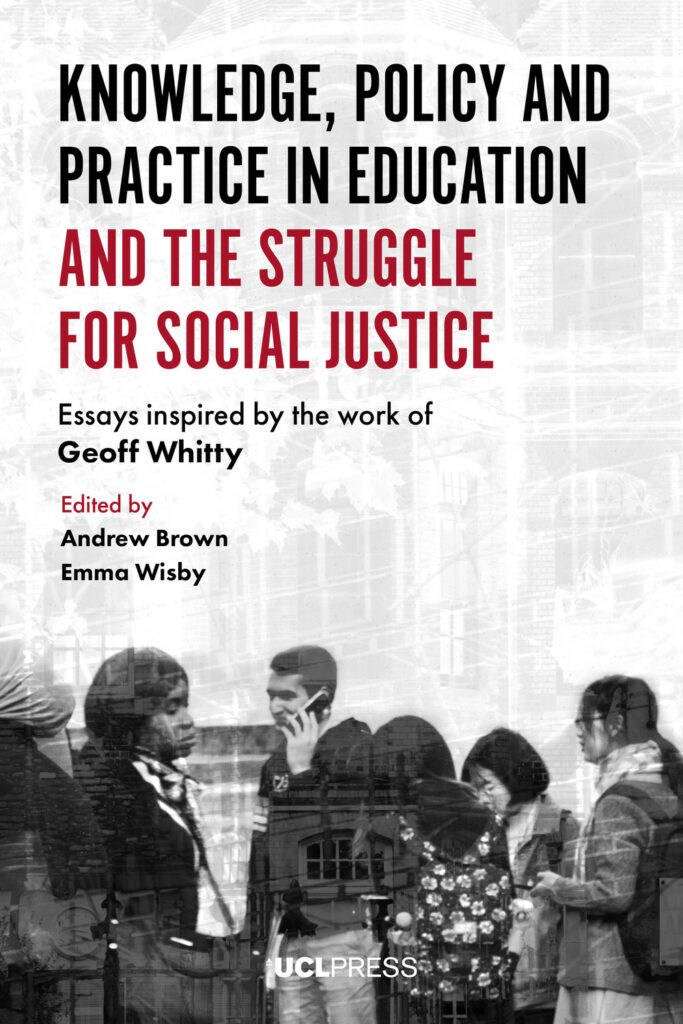
Knowledge, Policy and Practice in Education and the Struggle for Social Justice

For 50 years, educator and sociologist Geoff Whitty resolutely pursued social justice through education, first as a classroom teacher and ultimately as the Director of the Institute of Education in London.

The essays in this volume – written by some of the most influential authors in the sociology of education and critical policy studies – take Whitty’s work as the starting point from which to examine key contemporary issues in education and the challenges to social justice that they present. Set within three themes of knowledge, policy and practice in education, the chapters tackle the issues of defining and accessing ‘legitimate’ knowledge, the changing nature of education policy under neoliberalism and globalization, and the reshaping of teacher workplaces and professionalism – as well as attempts to realize more emancipatory practice. Whitty’s scholarship on what constitutes quality and impact in educational research is also explored.

Together, the essays open a window on a life in the sociology of education, the scholarly community of which it was part, and the facets of education policy, practice and research that they continue to reveal and challenge in pursuit of social justice. They celebrate Whitty as one of the foremost sociologists of education of his generation, but also as a friend and colleague. And they highlight the continued relevance of his contribution to those seeking to promote fairer and more inclusive education systems.

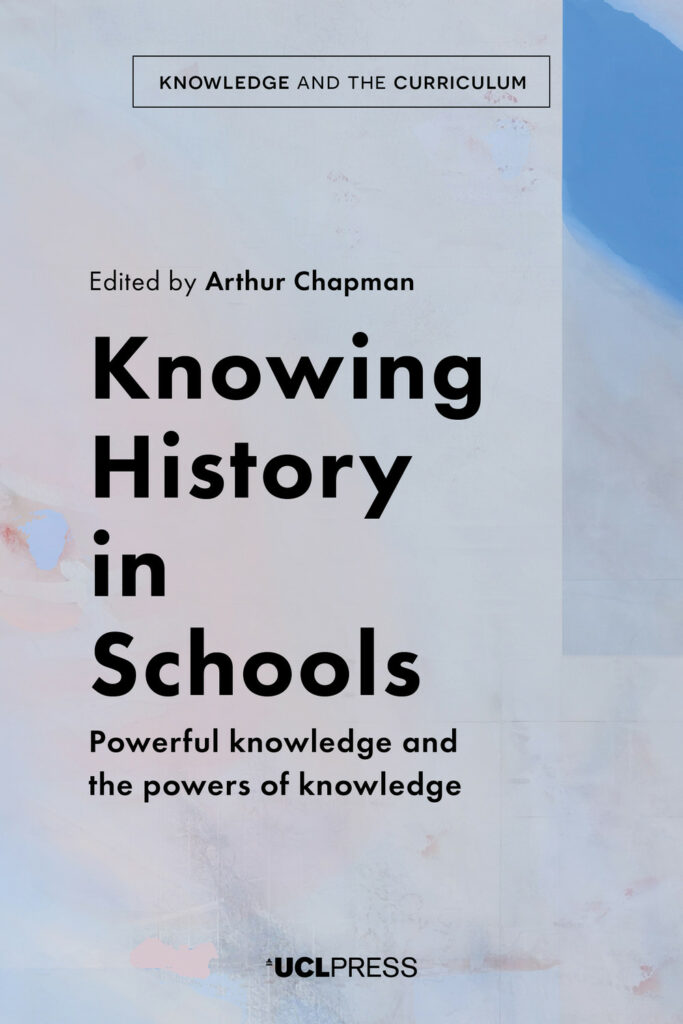
Knowing History in Schools

The ‘knowledge turn’ in curriculum studies has drawn attention to the central role that knowledge of the disciplines plays in education, and to the need for new thinking about how we understand knowledge and knowledge-building.

Knowing History in Schools explores these issues in the context of teaching and learning history through a dialogue between the eminent sociologist of curriculum Michael Young, and leading figures in history education research and practice from a range of traditions and contexts. With a focus on Young’s ‘powerful knowledge’ theorisation of the curriculum, and on his more recent articulations of the ‘powers’ of knowledge, this dialogue explores the many complexities posed for history education by the challenge of building children’s historical knowledge and understanding. The book builds towards a clarification of how we can best conceptualise knowledge-building in history education. Crucially, it aims to help history education students, history teachers, teacher educators and history curriculum designers navigate the challenges that knowledge-building processes pose for learning history in schools.

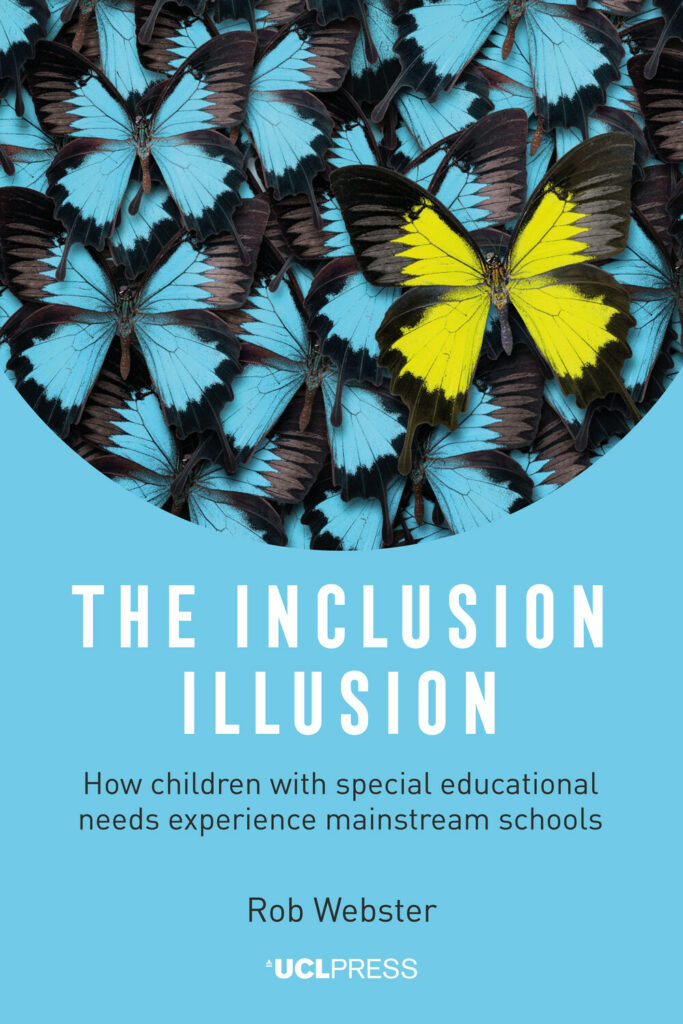
The Inclusion Illusion

Inclusion conjures images of children with special educational needs and disabilities (SEND) learning in classes alongside peers in a mainstream school. For pupils in the UK with high-level SEND, who have an Education, Health and Care Plan (formerly a Statement), this implies an everyday educational experience similar to that of their typically-developing classmates. Yet in vital respects, they are worlds apart.

Based on the UK’s largest observation study of pupils with high-level SEND, The Inclusion Illusion exposes how attendance at a mainstream school is no guarantee of receiving a mainstream education. Observations of nearly 1,500 lessons in English schools show that their everyday experience of school is characterised by separation and segregation. Furthermore, interviews with nearly 500 pupils, parents and school staff reveal the effect of this marginalisation on the quality of their education. The way schools are organised and how classrooms are composed creates a form of ‘structural exclusion’ that preserves mainstream education for typically-developing pupils and justifies a diluted pedagogical offer for pupils with high-level SEND. Policymakers, not mainstream schools, are indicted over this state of affairs. This book prompts questions about what we think inclusion is and what it looks like. Ultimately, it suggests why a more authentic form of inclusion is needed, and how it might be achieved.

Sign up to our newsletter

Don't miss out!
Subscribe to the UCL Press newsletter for the latest open access books,
journal CfPs, news and views from our authors and much more!