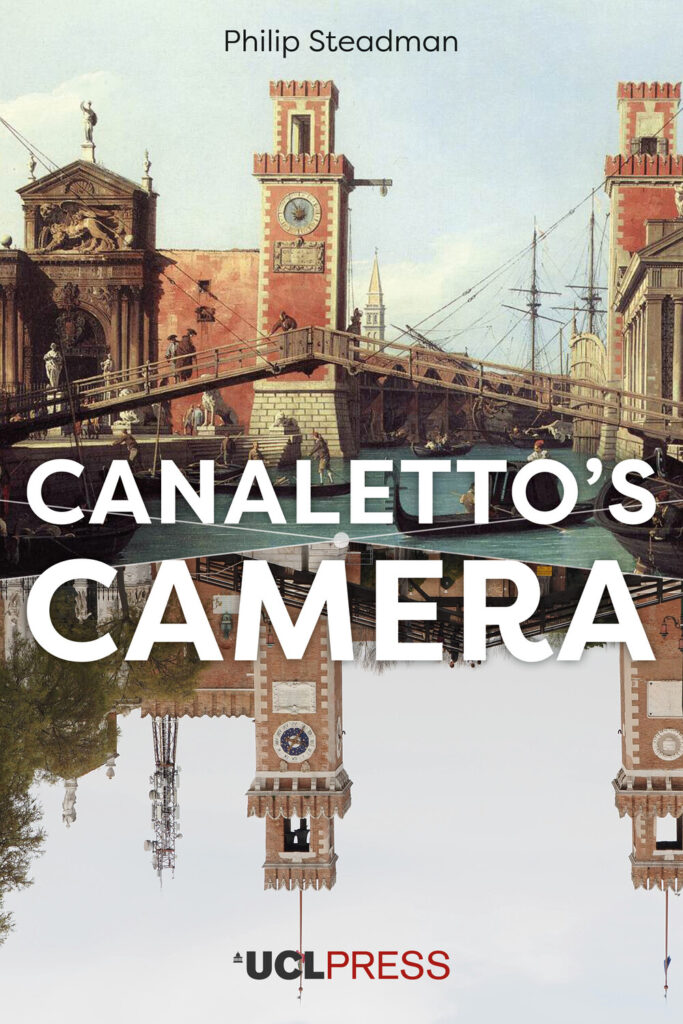
Canaletto’s Camera explores the ways in which the great Venetian artist Antonio Canaletto (1697-1768) made use of the camera obscura – the forerunner of the photographic camera – as an aid to drawing and painting. It surveys Canaletto’s contacts with contemporary Venetian and Paduan scientists, in particular Francesco Algarotti who wrote on Newton’s philosophy and the camera obscura. Canaletto also relied on many measured drawings of Venetian buildings by his colleague Antonio Visentini, a debt that has not previously been recognised.
Steadman proposes that Canaletto used the camera for two purposes: tracing from real scenes, and copying and collaging drawings and engravings by other artists. By analysing camera sketches made by Canaletto in a notebook, he shows how the artist traced views in Venice and then altered the real scenes in his finished drawings and paintings. By using a reconstructed eighteenth-century design of camera obscura, the author and his colleagues have made drawings of views that Canaletto painted in London. Steadman has recreated both a veduta (a real view) and a capriccio (a fantasy) using Canaletto’s processes of ‘photomontage’. The experiments are detailed in the book, shedding new light on the artist’s procedures, and emphasising how weak and permeable the boundary is between the two types of picture.