
Publication date: 5 June 2025
DOI: https://doi.org/10.14324/111.9781800088412
Number of illustrations: 196

Canaletto’s Camera
Philip Steadman (Author)
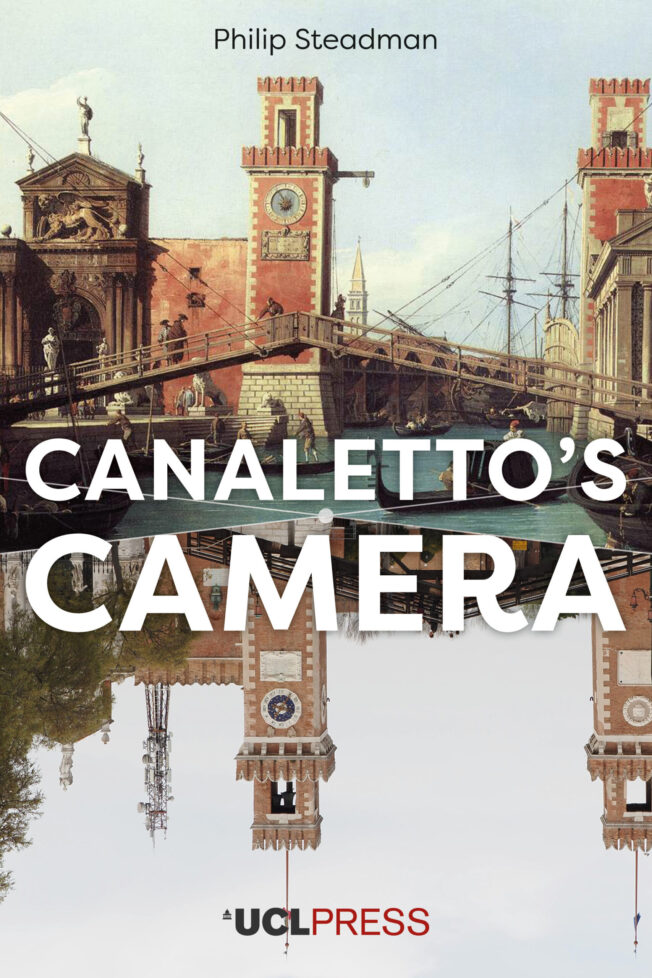
Canaletto’s Camera explores the ways in which the great Venetian artist Antonio Canaletto (1697-1768) made use of the camera obscura – the forerunner of the photographic camera – as an aid to drawing and painting. It surveys Canaletto’s contacts with contemporary Venetian and Paduan scientists, in particular Francesco Algarotti who wrote on Newton’s philosophy and the camera obscura. Canaletto also relied on many measured drawings of Venetian buildings by his colleague Antonio Visentini, a debt that has not previously been recognised.
Steadman proposes that Canaletto used the camera for two purposes: tracing from real scenes, and copying and collaging drawings and engravings by other artists. By analysing camera sketches made by Canaletto in a notebook, he shows how the artist traced views in Venice and then altered the real scenes in his finished drawings and paintings. By using a reconstructed eighteenth-century design of camera obscura, the author and his colleagues have made drawings of views that Canaletto painted in London. Steadman has recreated both a veduta (a real view) and a capriccio (a fantasy) using Canaletto’s processes of ‘photomontage’. The experiments are detailed in the book, shedding new light on the artist’s procedures, and emphasising how weak and permeable the boundary is between the two types of picture.
Related titles
Canaletto’s Camera
Publication date: June 5, 2025
Open Access PDF ISBN: 9781800088412
Paperback ISBN: 9781800088405
Hardback ISBN: 9781800088399
Trim size (hardback): 23.4cm x 15.6cm
Trim size (paperback): 23.4cm x 15.6cm
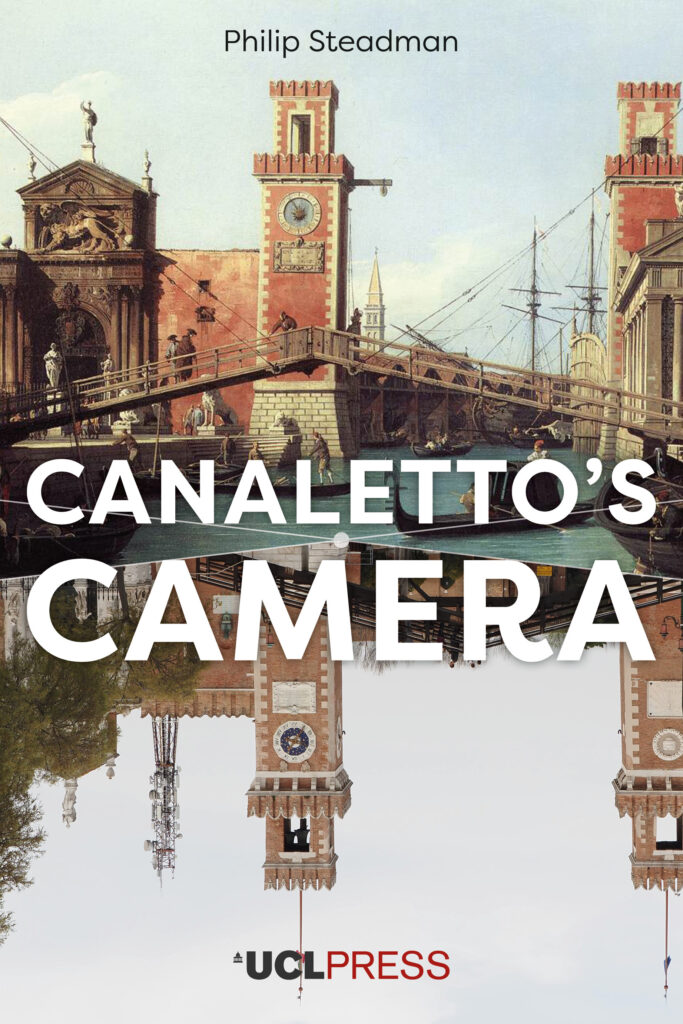
Canaletto’s Camera explores the ways in which the great Venetian artist Antonio Canaletto (1697-1768) made use of the camera obscura – the forerunner of the photographic camera – as an aid to drawing and painting. It surveys Canaletto’s contacts with contemporary Venetian and Paduan scientists, in particular Francesco Algarotti who wrote on Newton’s philosophy and the camera obscura. Canaletto also relied on many measured drawings of Venetian buildings by his colleague Antonio Visentini, a debt that has not previously been recognised.
Steadman proposes that Canaletto used the camera for two purposes: tracing from real scenes, and copying and collaging drawings and engravings by other artists. By analysing camera sketches made by Canaletto in a notebook, he shows how the artist traced views in Venice and then altered the real scenes in his finished drawings and paintings. By using a reconstructed eighteenth-century design of camera obscura, the author and his colleagues have made drawings of views that Canaletto painted in London. Steadman has recreated both a veduta (a real view) and a capriccio (a fantasy) using Canaletto’s processes of ‘photomontage’. The experiments are detailed in the book, shedding new light on the artist’s procedures, and emphasising how weak and permeable the boundary is between the two types of picture.
‘I’m reading this extraordinary book by Phillip Steadman, and am blown away by it …The book charts the analysis of how Canaletto worked, and [the author] and an Italian colleague built a mobile camera obscura to reproduce many of the scenes that figure in the artist’s work. It’s a striking example of how to be scrupulously scholarly while also being readable and accessible.’
John Naughton (johnnaughton.substack.com)
‘Steadman’s approach to research is one that I greatly admire. Supported by a Leverhulme Trust grant, he and his collaborators used what art and design PhD programmes like to call a ‘practice-based methodology’. As well as excavating the literature and the archives—both of which yielded fruitful new findings—they reconstructed various eighteenth-century optical devices, lugged them around cities and buildings, made images with them, compared their images to those made by Canaletto and his contemporaries and experimented with optics, 3D graphics, photographs, montages and projections. It is a way of doing research that I once heard someone call “thinking with the hands”, but in this case also the eyes and the body; it is research that is at once practical, open, playful, visually driven and genuinely insightful. The book is a lucidly presented, generously illustrated, helpfully annotated and indexed account of what was done and found, and if nothing else stands as an exemplar of this kind of research.’
Leonardo
‘In this enthralling book, Philip Steadman effortlessly bridges art and science. He depicts Canaletto’s Venice not as the city of Casanova and carnival but as a hub of Enlightenment knowledge, exploring the artist’s use of the latest optical instruments through practical experiment and penetrating visual analysis. The results are fascinating and totally convincing.’
Deborah Howard, Cambridge University and author of The Architectural History of Venice
‘It has always been known that Canaletto used camera obscuras. More than one of his contemporaries wrote as much. What has never been clear is exactly how he did so – until now. This is a fascinating, ground-breaking book which reveals absolutely fresh vistas on the art of the past’
Martin Gayford, art critic at The Spectator and author of Venice: City of Pictures