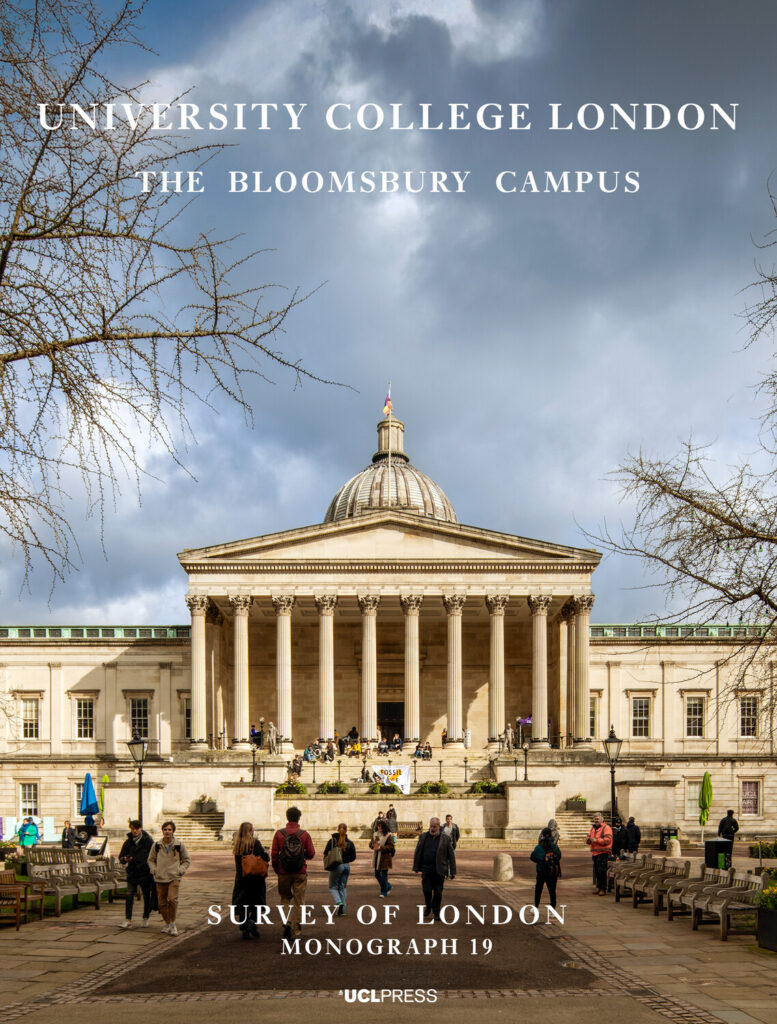
The first university in London, and the first in England to accept people of all faiths and creeds, University College London occupies a prestigious position in the history of British education. Since its foundation in 1826 and the construction shortly afterwards of its iconic neoclassical building in Gower Street, UCL has been an increasingly influential presence in the capital’s Bloomsbury district, shaping the character of its built environment and acting as a magnet for other academic institutions. Over two hundred years UCL has expanded to form an extensive campus, its sprawling footprint and varied building stock reflecting growth in student numbers and advances in education, technology and culture.
Having been part of UCL’s Bartlett School of Architecture since 2013, the Survey of London is uniquely placed to offer the first comprehensive account of the university’s buildings and the evolution of its historic Bloomsbury campus. This monograph, published in 2026 to coincide with the bicentenary of UCL’s foundation, provides a new understanding of this significant estate in central London, bringing to light a complex and engaging architectural story with many facets that have been previously overlooked or neglected. It charts a progression in UCL’s architecture from the Greek Revival classicism of the early nineteenth century, through Victorian experimentation and inter-war Neo-Georgian, to post-war Brutalism and today to the high-tech, energy efficient and adaptable buildings expected of a modern university.
Based on original documentary research and site investigation, and generously illustrated with more than 270 photographs, maps and drawings, many of them specially commissioned, the Survey’s monograph provides a valuable record and analysis of UCL’s Bloomsbury campus for the future.