
Publication date: 1 March 2027
DOI: https://doi.org/10.14324/111.9781806552726
Number of pages: 214
Number of illustrations: 24

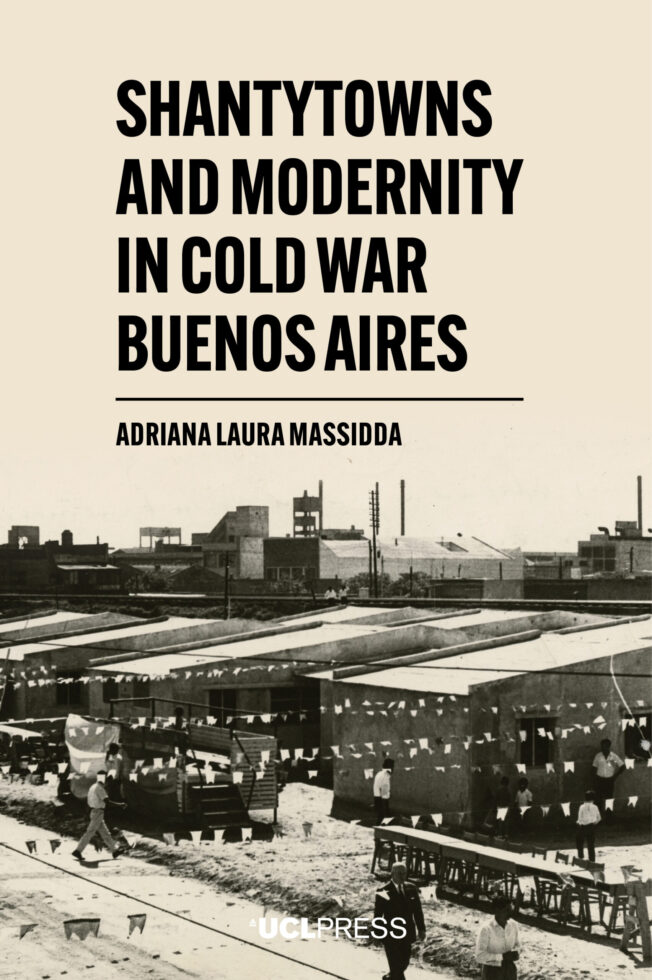
Shantytowns and Modernity in Cold War Buenos Aires
Adriana Laura Massidda (Author)
Series: Modern Americas
Shantytowns and Modernity in Cold War Buenos Aires is a ground-breaking work of urban history that analyses a wealth of previously unexamined historical sources to reconstruct the emergence and consolidation of Buenos Aires shantytowns through the 1950s and 1960s. It argues that, during these years, residents and government bodies piloted different modes of interaction establishing the paradigms followed in subsequent decades. Moreover, by tracing the conceptual and material history of the villas miseria (the local term for shantytowns) it is proposed that they radically altered the wider urban landscape and became sites where national and transnational politics, including ideological Cold War struggles, were manifested at the local level, becoming an essential part of the modern city.
Highlighting the ways in which micro-scale improvements, organised movements, local, national and transnational policies interacted, the book traces the complex history of these spaces. Shantytowns and Modernity in Cold War Buenos Aires deploys an innovative methodology integrating archival research, oral history, mapping, and visual analysis to tell the story of how the villas came into existence both as a conceptual entity and a specific urban typology where people lived and had to defend.
Related titles

Shantytowns and Modernity in Cold War Buenos Aires
Series: Modern Americas
Publication date: March 1, 2027
Open Access PDF ISBN: 9781806552726
Paperback ISBN: 9781806552719
Trim size (paperback): 23.4cm x 15.6cm
Shantytowns and Modernity in Cold War Buenos Aires is a ground-breaking work of urban history that analyses a wealth of previously unexamined historical sources to reconstruct the emergence and consolidation of Buenos Aires shantytowns through the 1950s and 1960s. It argues that, during these years, residents and government bodies piloted different modes of interaction establishing the paradigms followed in subsequent decades. Moreover, by tracing the conceptual and material history of the villas miseria (the local term for shantytowns) it is proposed that they radically altered the wider urban landscape and became sites where national and transnational politics, including ideological Cold War struggles, were manifested at the local level, becoming an essential part of the modern city.
Highlighting the ways in which micro-scale improvements, organised movements, local, national and transnational policies interacted, the book traces the complex history of these spaces. Shantytowns and Modernity in Cold War Buenos Aires deploys an innovative methodology integrating archival research, oral history, mapping, and visual analysis to tell the story of how the villas came into existence both as a conceptual entity and a specific urban typology where people lived and had to defend.