
Publication date: 30 March 2026
DOI: https://doi.org/10.14324/111.9781806550371
Number of illustrations: 21

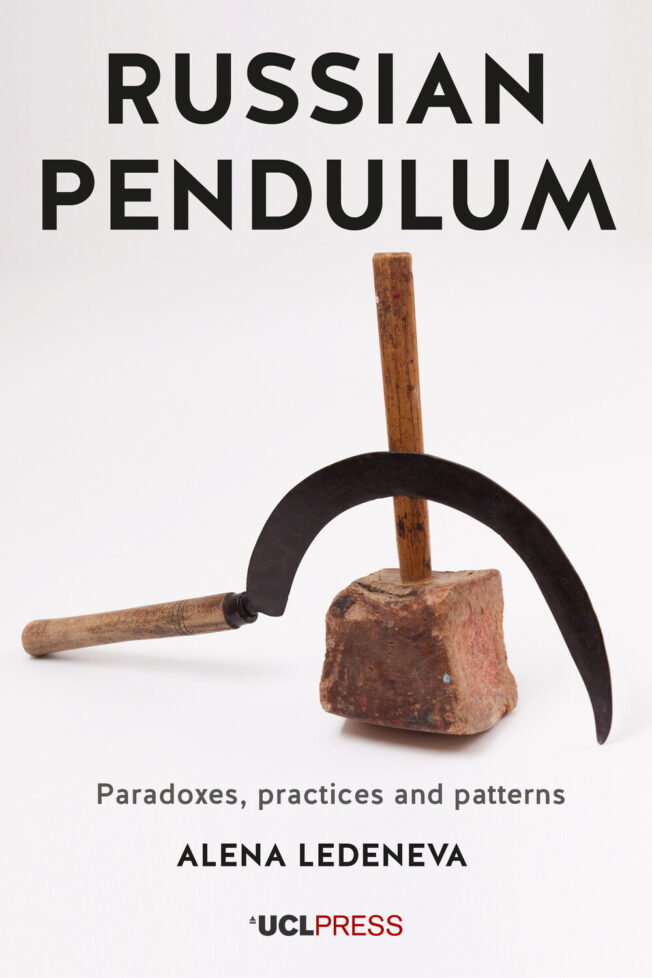
Russian Pendulum
Paradoxes, practices and patterns
Alena Ledeneva (Author)
In Russian Pendulum, Alena Ledeneva takes readers on a compelling journey to Russia, where tradition, modernity, power and people collide. Through the prism of ambivalence, the author unveils patterns that have shaped Russia’s politics and society for centuries, pointing to an intricate system of informal networks that are held together by practices of cooptation, control and camouflage.
For readers seeking to look beyond stereotypes, this book provides a brief yet nuanced exploration of Russia’s complexity and unpredictability. The ever-moving Russian pendulum dwells on paradoxes and the hidden practices that resolve them. Patterns such as doublethink, double standards, zigzags, cascades, waves and tides are captured in the author’s own artworks that introduce each chapter.
Nine musical compositions by Benjamin Woodgates add a further dimension, exploring these paradoxes, practices and patterns, and realising them in sound.
Drawing on the Global Informality Project (www.in-formality.com), the artwork and the music, Russian Pendulum establishes connections between Russia’s distinctive paradoxes and broader patterns of informality found worldwide. It is ideal for students, scholars and anyone seeking to understand hidden yet increasingly powerful forces.
List of illustrations and compositions
List of figures and tables
Preface
Acknowledgements
The prism of ambivalence: introduction to paradoxes, practices and patterns
1 Russians outside Russia: particles or waves
2 Russia and the West: not apart, not together
3 Zigzag modernisation: two steps forward, one step back
4 What works when democracy doesn’t: triangulation
5 From Moscow to Russia, from Russia to Moscow: the double pendulum
6 Is Russia a ‘normal’ economy: the cascades of redistribution
7 Russia’s entrepreneurs: on a tightrope
8 The system paradox: the ambivalence of power
9 Conclusion: circles, cycles, waves and tides
Appendix: Russia covered: The Economist select titles, 2006-22
Musical scores
Bibliography
Index
DOI: 10.14324/111.9781806550371
Number of illustrations: 21
Publication date: 30 March 2026
PDF ISBN: 9781806550371
EPUB ISBN: 9781806550388
Hardback ISBN: 9781806550357
Paperback ISBN: 9781806550364
Alena Ledeneva (Author) 
Alena Ledeneva is Professor of Politics and Society at University College London and a founder of the Global Informality Project (in-formality.com). She authored the trilogy on Russia: Russia's Economy of Favours (1998), How Russia Really Works (2006) and Can Russia Modernize? (2013), and edited The Global Encyclopedia of Informality. Vols. 1-3 (2018, 2024).





Postdigital Intimacies
Adrienne Evans, Jamie Hakim, Jessica Ringrose, Amy Shields Dobson, Shaka McGlotten,
16 March 2026
The Chronopolitics of Life
Nolwenn Bühler, Nils Graber, Victoria Boydell, Cinzia Greco,
04 December 2025

Evaluating Anti-Trafficking Interventions
Ella Cockbain, Aiden Sidebottom, Sheldon X. Zhang,
18 November 2025



Revisiting Childhood Resilience Through Marginalised and Displaced Voices
Wendy Sims-Schouten,
11 February 2025




Schooling for Refugee Children
Eleanore Hargreaves, Brian Lally, Bassel Akar, Jumana Al-Waeli, Jasmine Costello,
07 May 2024

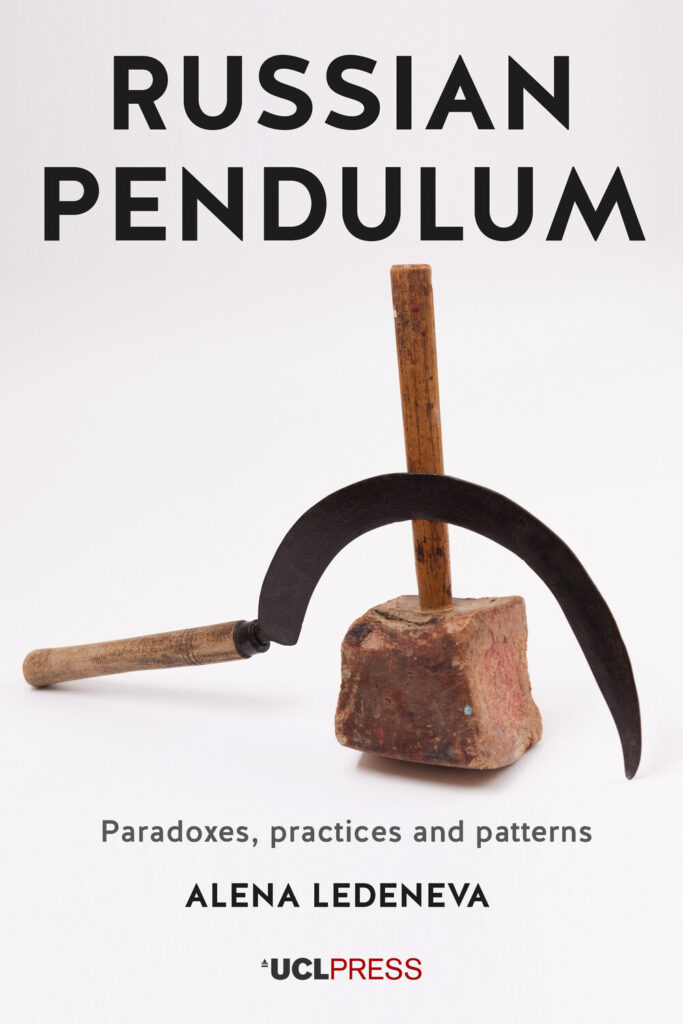
Russian Pendulum
Paradoxes, practices and patterns
Publication date: March 30, 2026
Open Access PDF ISBN: 9781806550371
Paperback ISBN: 9781806550364
Hardback ISBN: 9781806550357
Trim size (hardback): 23.4cm x 15.6cm
Trim size (paperback): 23.4cm x 15.6cm
In Russian Pendulum, Alena Ledeneva takes readers on a compelling journey to Russia, where tradition, modernity, power and people collide. Through the prism of ambivalence, the author unveils patterns that have shaped Russia’s politics and society for centuries, pointing to an intricate system of informal networks that are held together by practices of cooptation, control and camouflage.
For readers seeking to look beyond stereotypes, this book provides a brief yet nuanced exploration of Russia’s complexity and unpredictability. The ever-moving Russian pendulum dwells on paradoxes and the hidden practices that resolve them. Patterns such as doublethink, double standards, zigzags, cascades, waves and tides are captured in the author’s own artworks that introduce each chapter.
Nine musical compositions by Benjamin Woodgates add a further dimension, exploring these paradoxes, practices and patterns, and realising them in sound.
Drawing on the Global Informality Project (www.in-formality.com), the artwork and the music, Russian Pendulum establishes connections between Russia’s distinctive paradoxes and broader patterns of informality found worldwide. It is ideal for students, scholars and anyone seeking to understand hidden yet increasingly powerful forces.