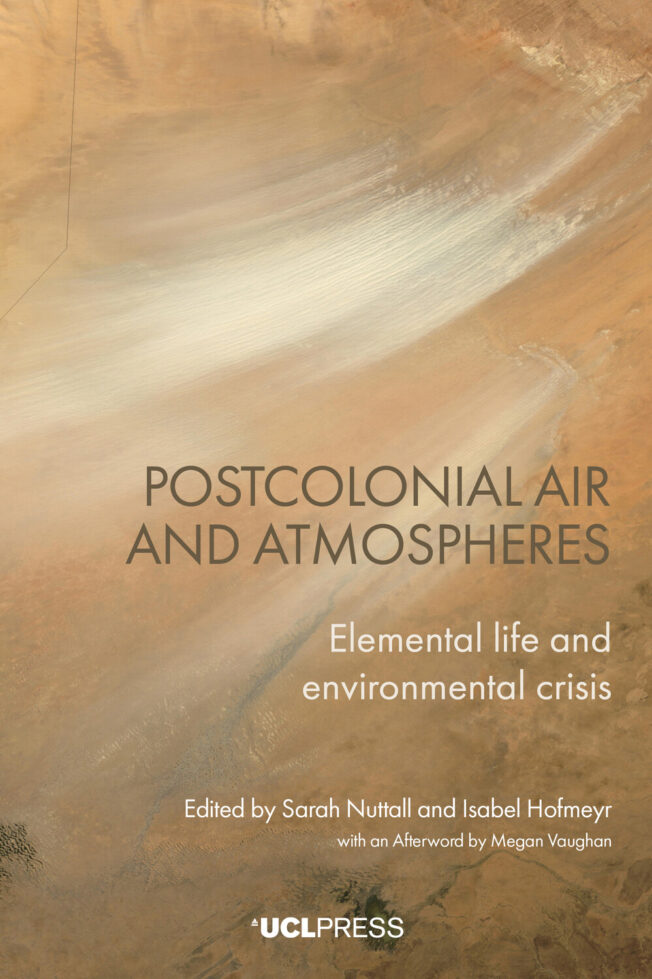

Postcolonial Air and Atmospheres
Elemental life and environmental crisis
Sarah Nuttall (Editor), Isabel Hofmeyr (Editor)
This volume puts two traditions of scholarship into conversation: Euro-American work on air and atmospheres, and emergent postcolonial debates on these themes. Drawing on the strengths of the first, this collection probes its limits, while mapping an emergent field of postcolonial research on air and atmospheres.
Postcolonial Air and Atmospheres recontextualizes debates on atmospheres and aesthetics, exploring these themes in relation to the uneven hemispheric terrains of material decay and toxicity. It extends the narrow spatial purview of the Euro-American scholarship by taking an empire-wide perspective, considering historical questions of air and enslavement alongside South Asian histories of air-conditioning and the toxic atmospheres of extractive industries. It develops a phenomenology of breathing in a range of postcolonial settings to revisit the theorizations of air and breath in western critical theoretical scholarship. The collection comprises three sections. ‘Affective Atmospheres’ explores the materialities of air while foregrounding atmospheres as sites of affect, politics and power in the postcolony. ‘Unfree and Impure Airs’ foregrounds clean and toxic air, who breathes them along with the politics and technologies of how these unequal forms of air were and are produced. ‘Breathing in’ centres practices of breath as a means to analyse air and atmospheres.
Introduction
Postcolonial Air and Atmospheres: Thinking with Hemispheric Elemental Media
Isabel Hofmeyr and Sarah Nuttall
I Affective Atmospheres
1 Necropolitical Atmospheres: Violence and Vulnerability in the Films of Pallavi Paul
Matthew Gandy
2 Queen Idia’s Air: Saturation, Conditioning and Power
Ruth Sacks
3 Mediterranean Winds: Transversal Dialogue in Turbulent Times
Lucy Sabin and Jorge Olcina Cantos
4 Fetid Ripples for the Birds: Air and Atmospheres on the Vaal Dam
Nina Barnett
II Unfree and Impure Airs
5 The Northern Cape Phytosphere, Artisinal Mining and Multispecies Remediation in Eureka
Helene Strauss
6 Black Body Being: Atmospheres of Water and Worth in Johannesburg
Potšišo Phasha
7 (Re)configuring Atmospheres: Heat, Miasma and Particles in Colonial India
Awadhendra Sharan
8 Archive/Nature: Environment and Labour in Ugandan State Archives
Edgar C. Taylor
9 Breath from the Sky: Aerial Ecologies in the Anthropocene
Maja Fowkes and Reuben Fowkes
III Breathing In/Out
10 Out of Breath, Out of Dreams: Laborious Rural Childhoods in Chinese and US Hinterlands Atmospheres
Esther Peeren
11 Breathing Out: Interoception, Aikido and the Art of the Inside
Louise Green
12 Out of Breath: An Essay in Ten Cycles of Respiration
Radhika Subramaniam
13 Hawe Ke Biradri: The Relatives of Air in Delhi NCR
Sumana Roy
IV
14 Liguqubele iZulu: Breath, Loss, Healing
Sethembile Msezane
Air and Atmosphere: An Afterword
Megan Vaughan
DOI: 10.14324/111.9781806551323
Number of illustrations: 53
Publication date: 01 September 2026
EPUB ISBN: 9781806551330
Sarah Nuttall (Editor) 
Sarah Nuttall is Professor of Literary and Cultural Studies at WISER at the University of the Witwatersrand in Johannesburg, South Africa. She was Director of WISER from 2013-2023. She is author, editor or co-editor of more than 15 books, including Johannesburg: The Elusive Metropolis (Duke UP/Wits UP), which will be published in a new edition in 2026, Entanglement: Literary and Cultural Reflections on Post-Apartheid (Wits UP) and Your History with Me: The Films of Penny Siopis (Duke UP). Her collaborative work in the environmental humanities has resulted, amongst others, in the widely read Reading for Water: Materiality and Method (Routledge, 2023).
Isabel Hofmeyr (Editor)
Isabel Hofmeyr is Professor Emeritus at the University of the Witwatersrand and was Global Distinguished Professor at New York University from 2013 to 2022. From 2018 to 2023, she co-directed a project Oceanic Humanities for the Global South with partners from Mozambique, India, Jamaica and Barbados. Recent publications include Dockside Reading: Hydrocoloniaism and the Custom House (2022) and two co-edited volumes, Reading for Water: Materiality and Method (2023) and Publishing from the South: A Centenary of Wits University Press (2024).
Postdigital Intimacies
Adrienne Evans, Jamie Hakim, Jessica Ringrose, Amy Shields Dobson, Shaka McGlotten,
16 March 2026
The Chronopolitics of Life
Nolwenn Bühler, Nils Graber, Victoria Boydell, Cinzia Greco,
04 December 2025
Evaluating Anti-Trafficking Interventions
Ella Cockbain, Aiden Sidebottom, Sheldon X. Zhang,
18 November 2025

Revisiting Childhood Resilience Through Marginalised and Displaced Voices
Wendy Sims-Schouten,
11 February 2025
Schooling for Refugee Children
Eleanore Hargreaves, Brian Lally, Bassel Akar, Jumana Al-Waeli, Jasmine Costello,
07 May 2024
Postcolonial Air and Atmospheres
Elemental life and environmental crisis
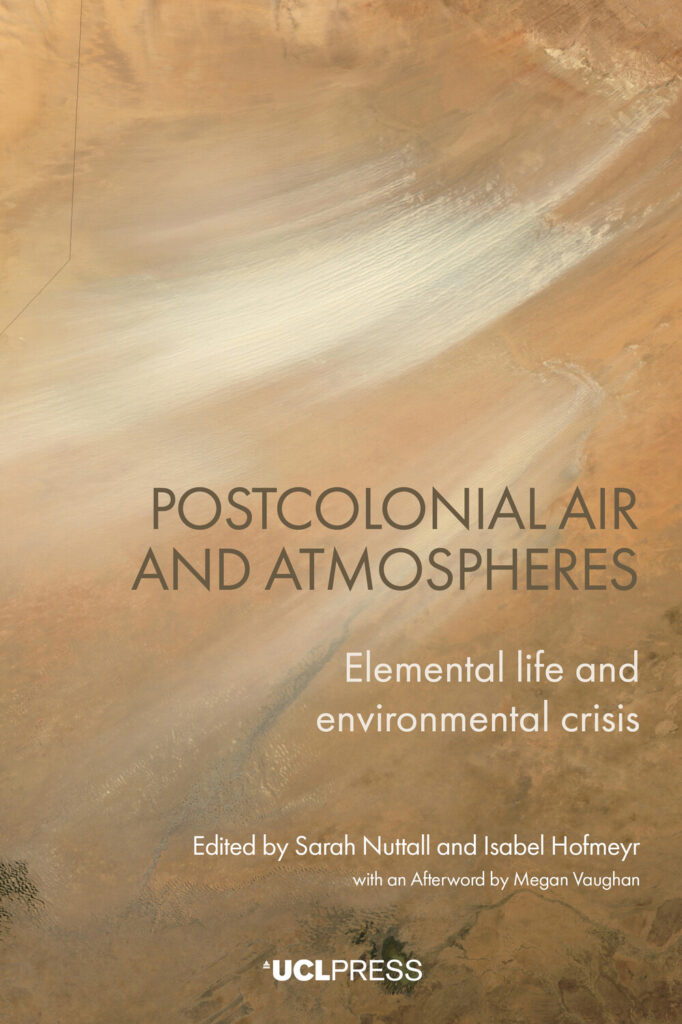
This volume puts two traditions of scholarship into conversation: Euro-American work on air and atmospheres, and emergent postcolonial debates on these themes. Drawing on the strengths of the first, this collection probes its limits, while mapping an emergent field of postcolonial research on air and atmospheres.
Postcolonial Air and Atmospheres recontextualizes debates on atmospheres and aesthetics, exploring these themes in relation to the uneven hemispheric terrains of material decay and toxicity. It extends the narrow spatial purview of the Euro-American scholarship by taking an empire-wide perspective, considering historical questions of air and enslavement alongside South Asian histories of air-conditioning and the toxic atmospheres of extractive industries. It develops a phenomenology of breathing in a range of postcolonial settings to revisit the theorizations of air and breath in western critical theoretical scholarship. The collection comprises three sections. ‘Affective Atmospheres’ explores the materialities of air while foregrounding atmospheres as sites of affect, politics and power in the postcolony. ‘Unfree and Impure Airs’ foregrounds clean and toxic air, who breathes them along with the politics and technologies of how these unequal forms of air were and are produced. ‘Breathing in’ centres practices of breath as a means to analyse air and atmospheres.