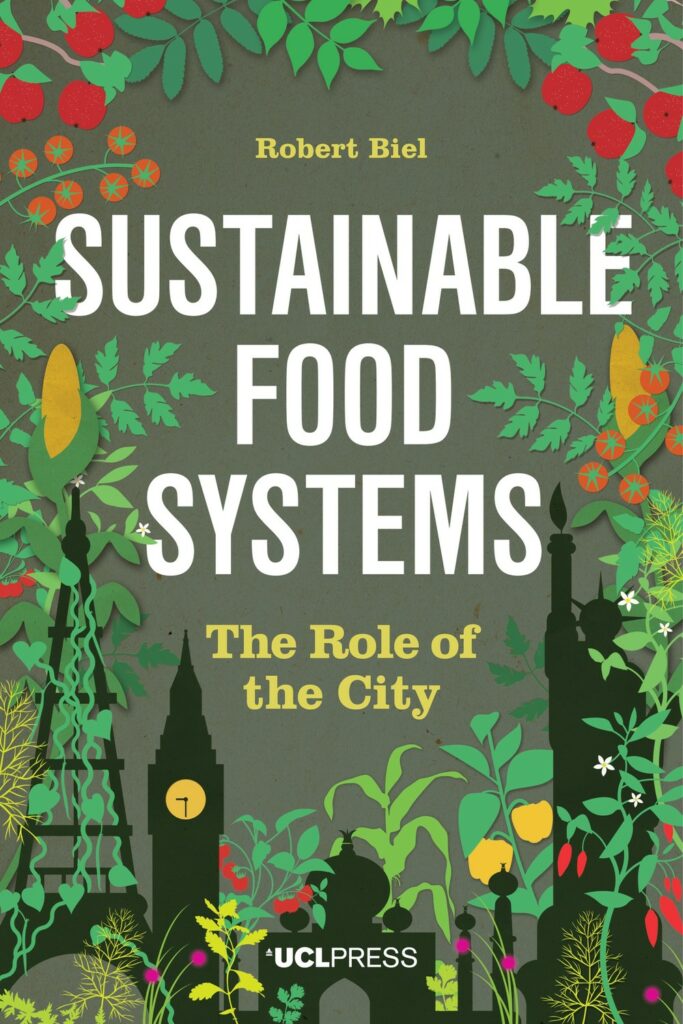
Sustainable Food Systems

Faced with a global threat to food security, it is perfectly possible that society will respond, not by a dystopian disintegration, but rather by reasserting co-operative traditions. **This book, by a leading expert in urban agriculture, offers a genuine solution to today’s global food crisis. By contributing more to feeding themselves, cities can allow breathing space for the rural sector to convert to more organic sustainable approaches.

Biel’s approach connects with current debates about agroecology and food sovereignty, asks key questions, and proposes lines of future research. He suggests that today’s food insecurity – manifested in a regime of wildly fluctuating prices – reflects not just temporary stresses in the existing mode of production, but more profoundly the troubled process of generating a new one. He argues that the solution cannot be implemented at a merely technical or political level: the force of change can only be driven by the kind of social movements which are now daring to challenge the existing unsustainable order.

Drawing on both his academic research and teaching, and 15 years’ experience as a practicing urban farmer, Biel brings a unique interdisciplinary approach to this key global issue, creating a dialogue between the physical and social sciences.
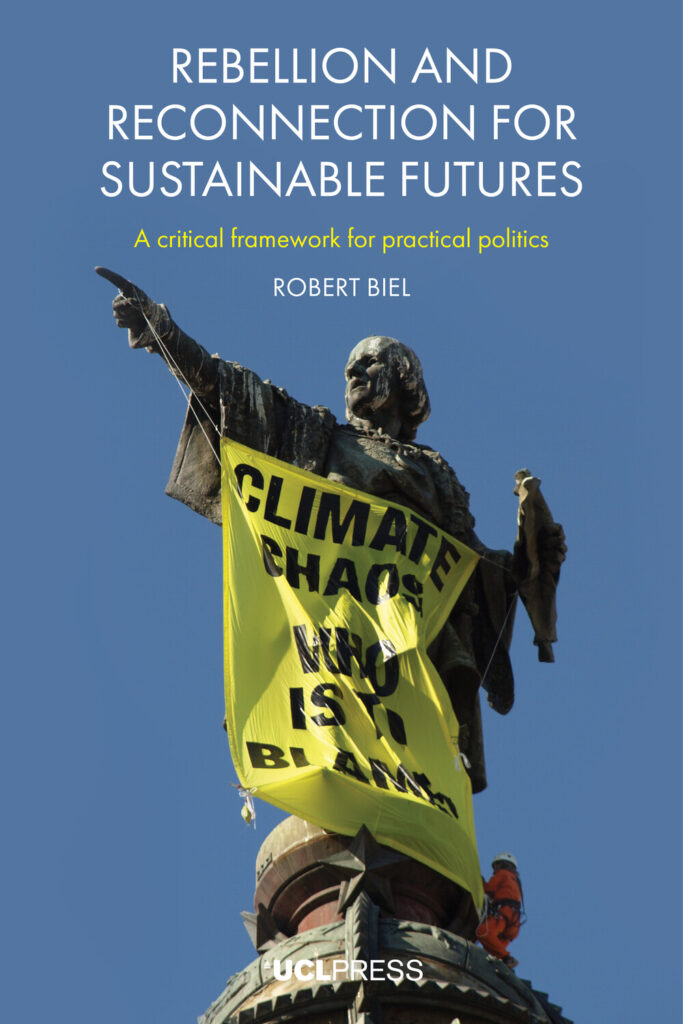
Rebellion and Reconnection for Sustainable Futures

We stand at a point of crisis for human society and life on Earth, with sustainability a constant theme in global discourse. Governments, industries and individuals attempt to take constructive action, but their steps are everywhere countered by the habits and relationships built over 300 years of capitalism, while right-wing populism and climate denial openly hold them back. Rebellion and Reconnection for Sustainable Futures proposes an urgent change of direction.

Grounded in the critical and theoretical tradition of political ecology, the book calls for a practical politics that rebels against the dominance of nature, resists fascist populism and reconnects with human tradition. Robert Biel argues that two forms of ‘remembering’ are needed, first that we embrace humanity’s past connection with socio-ecological change through deep time, and second that we assimilate still-valuable socialist traditions such as dignity and creativity of work. From this basis, he proposes a novel synthesis between complex systems research, Indigenous one-ness with nature, the ‘good Anthropocene’, and Marxist perspectives on nature. This unlocks a broad interrogation of the COVID experience by drawing on notions of biopolitics and queer theory, while also re-framing theories of imperialism to critique the central role of racism. Written in an engaging style, the book builds a compelling case for a new practical and actionable politics based on reclaiming what we have lost.

Travel Behaviour Reconsidered in an Era of Decarbonisation

The transport system is central to our lives as our means to travel, but also has major impact on our environment. This has become most salient in recent years through its contribution to climate change. However, this perspective has only had a minor impact on the conventional economic analysis and modelling of transport investments, creating a dissonance between the traditional objectives of investment and the strategic need to reduce carbon emissions to Net Zero by 2050.

Travel Behaviour Reconsidered in an Era of Decarbonisation argues that our transport networks are mature, and the objective should be to improve operational efficiency. Over the past half century, large public expenditures in roads and railways were justified by an analytic approach to the benefits of investment, primarily the value of the time saved through faster travel, to both business and non-business users of the networks. However, average travel time has not changed over this period. People have taken the benefit of faster travel as better access to people, places, activities and services, with the ensuing enhanced opportunities and choices. This book argues that the basis of orthodox transport economic analysis has been misconceived and a fresh perspective on economic analysis is now needed.

Obstacles to Environmental Progress

Why, when so many people understand the severity of environmental problems, is progress so slow and sustainability such a distant goal? What gets in the way? Perhaps you have immediately thought of several barriers. In Obstacles to Environmental Progress, Peter Schulze identifies 18 practical obstacles that routinely and predictably hinder U.S. progress on existing environmental problems. The obstacles apply to problems small and large and, in most cases, regardless of whether an issue is controversial. Though the book focuses on the U.S., most of the obstacles pertain elsewhere as well.

The obstacles fall into three categories: challenges to anticipating, detecting, and understanding problems; political and economic factors that interfere with responding; and obstacles to effective responses. While all the obstacles are predictable and common, they have not been systematically studied as related phenomena, perhaps because they span a wide range of academic disciplines.

In practice, they often arise as surprises that are then addressed in an ad hoc manner. Might they be better understood and thus more readily anticipated and overcome or avoided?

The book seeks to hasten environmental progress by forewarning and thus forearming those who are striving or will soon be striving for environmental progress, and by drawing scholarly attention to the obstacles as a set of related phenomena to systematically understand and more quickly overcome.

Sign up to our newsletter

Don't miss out!
Subscribe to the UCL Press newsletter for the latest open access books,
journal CfPs, news and views from our authors and much more!