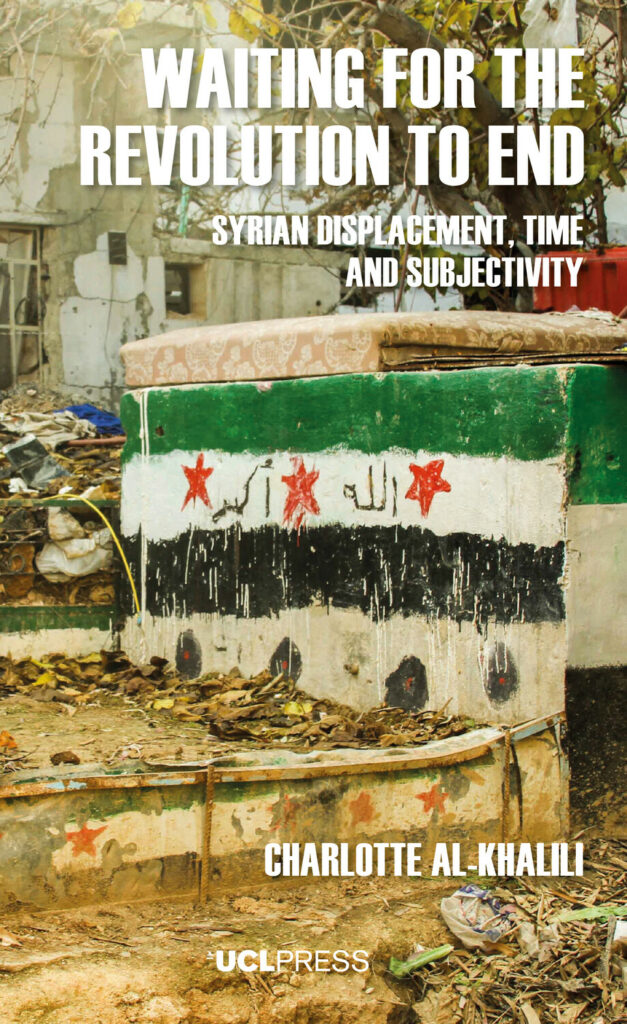
Waiting For The Revolution To End

Waiting for the Revolution to End explores the Syrian revolution through the experiences of citizens in exile. Based on more than three years of embedded fieldwork with Syrians displaced in the border city of Gaziantep (southern Turkey), the book places the Syrian revolution and its tragic aftermath under ethnographic scrutiny. It charts the evolution from peaceful uprising (2011) to armed confrontation (2012), descent into fully fledged conflict (2013) and finally to proxy war (2015), to propose an understanding of revolution beyond success and failure.

While the Assad regime remains in place, the Syrian revolution (al-thawra) still holds a transformational power that can be located on intimate and world-making scales. Charlotte Al-Khalili traces the unintended consequences of revolution and its unexpected consequences to reveal the reshaping of Syrian life-worlds and exiles’ evolving theorizations, experiences and imaginations of al-thawra. She describes the in-between spatio-temporal realm inhabited by Syrians displaced to Turkey as they await the revolution’s outcomes, and maps the revolution’s multidimensional and multi-scalar effects on their everyday life. By following the chronology of events inside Syria and Syrians’ geography of displacement, the book makes the relation between revolution and displacement its centerpiece, both as an ethnographic object and an analytical device.
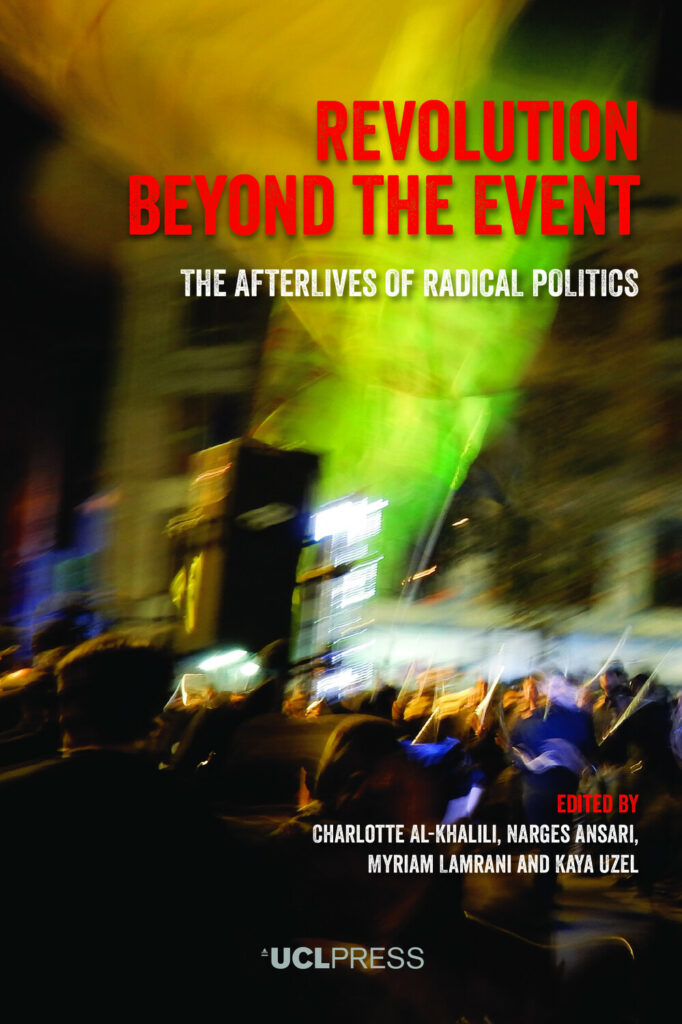

Revolution Beyond the Event

Revolution Beyond the Event brings together leading international anthropologists alongside emerging scholars to examine revolutionary legacies from the MENA region, Latin America and the Caribbean. It explores the idea that revolutions have varied afterlives that complicate the assumptions about their duration, pace and progression, and argues that a renewed focus on the temporality of radical politics is essential to our understanding of revolution. Approaching revolution through its relationship to time, the book is a critical intervention into attempts to define revolutions as bounded events that act as sequential transitions from one political system to another. It pursues an ethnographically driven rethinking of the temporal horizons that are at stake in revolutionary processes, arguing that linear views of revolution are inextricably tied to notions of progress and modernity. Through a careful selection of case studies, the book provides a critical perspective on the lived realities of revolutionary afterlives, challenging the liberal humanist assumptions implicit in the ‘modern’ idea of revolution, and reappraising the political agency of people caught up in revolutionary situations across a variety of ethnographic contexts.

The Intimate Life of Dissent

The Intimate Life of Dissent examines the meanings and implications of public acts of dissent, drawing on examples from ethnography and history. Acts of dissent are never simply just about abstract principles, but also come at great personal risk to both the dissidents and to those close to them. Dissent is, therefore, embedded in deep, complex and sometimes contradictory intimate relations. This book puts acts of high principle back into the personal relations out of which they emerge and take effect, raising new questions about the relationship between intimacy and political commitment. It does so through an introduction and eight individual chapters, drawing on examples including Sri Lankan leftists, Soviet dissidents, Tibetan exiles, Kurdish prisoners, British pacifists, Indonesian student activists and Jewish peace activists.

The Intimate Life of Dissent will be of interest to postgraduate students and researchers of anthropology, history, political theory and sociology. Written in a clear and accessible style, it is also suitable for teaching introductory undergraduate courses on political anthropology.

The Global Encyclopaedia of Informality, Volume 3

For a post-human hitchhiker, human life – with its anxiety, ageing, illness and constant need for problem-solving – may look unviable. Yet, for humans, the life struggle is softened by human touch, human emotion and human cooperation.

The Global Encyclopaedia of Informality, Volume 3 continues the journey of the two previous volumes into the world’s open secrets, unwritten rules and hidden practices. It focuses on issues of emotional ambivalence and pressures of the digital age. The informal practices presented in this volume demonstrate the urgency of alleviating tensions between continuity and all-too-rapid change and the need to tackle the central problem of modern societies – uncertainty.

The volume takes a reader on a ‘biographical’ journey through elusive, taken-for-granted or banal ways of getting things done from over 70 countries and world regions. It offers innovative understanding of the significance of fringes, and challenges the assumption that informality is associated exclusively with poverty, underdevelopment, the Global South, oppressive regimes or the former socialist countries of Eastern Europe and Central Asia. It also maps the patterns of informality around the globe; identifies specific informal practices in a context-sensitive way; and documents their ambivalent impact on people engaged in problem-solving, on societies in which these problems arise, and on humanity overall.

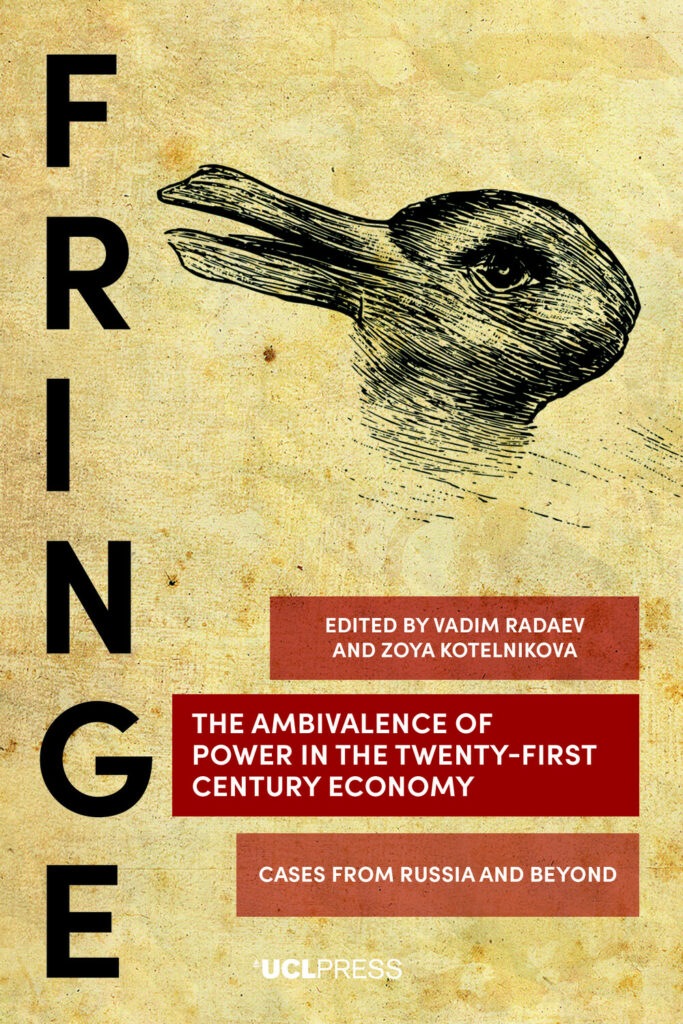
The Ambivalence of Power in the Twenty-First Century Economy

The Ambivalence of Power in the Twenty-First Century Economy contributes to the understanding of the ambivalent nature of power, oscillating between conflict and cooperation, public and private, global and local, formal and informal, and does so from an empirical perspective. It offers a collection of country-based cases, as well as critically assesses the existing conceptions of power from a cross-disciplinary perspective.

The diverse analyses of power at the macro, meso or micro levels allow the volume to highlight the complexity of political economy in the twenty-first century. Each chapter addresses key elements of that political economy (from the ambivalence of the cases of former communist countries that do not conform with the grand narratives about democracy and markets, to the dual utility of new technologies such as face-recognition), thus providing mounting evidence for the centrality of an understanding of ambivalence in the analysis of power, especially in the modern state power-driven capitalism.

Anchored in economic sociology and political economy, this volume aims to make ‘visible’ the dimensions of power embedded in economic practices. The chapters are predominantly based on post-communist practices, but this divergent experience is relevant to comparative studies of how power and economy are interrelated.

Sign up to our newsletter

Don't miss out!
Subscribe to the UCL Press newsletter for the latest open access books,
journal CfPs, news and views from our authors and much more!