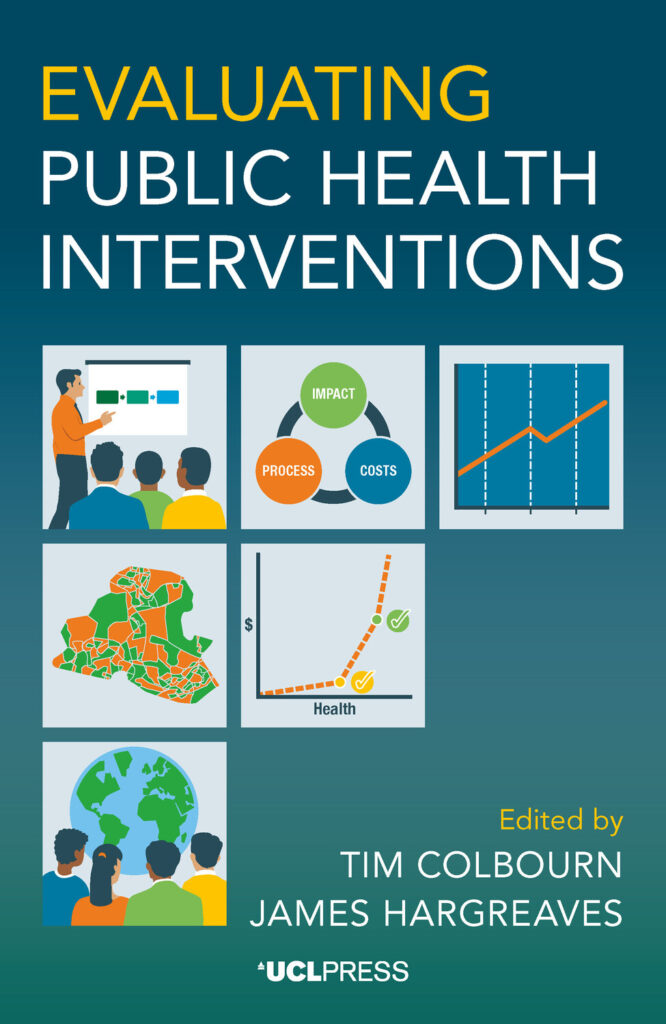
Evaluating Public Health Interventions

Public health interventions include any effort or policy that attempts to improve the health among individuals or an entire population. They can be run by governmental health departments or non-governmental organisations and can include, educational programmes, screening programmes, vaccination programmes, environmental improvements and health promotion campaigns. Interventions that include multiple independent or interacting components are referred to as complex. Evaluating and predicting the efficacy of any public health intervention, as well as calculating the cost effectiveness is essential.

Using examples from multiple published studies conducted around the world, this textbook shows readers how to evaluate public health interventions in real world settings. It will enable readers to understand how to investigate whether a public health intervention works, for whom, when, where, how, and why. It provides a comprehensive introduction to key areas of evaluation including understanding complex interventions, developing programme theories, community engagement in evaluation, and the main methods used in process, impact and economic evaluation. It explains how different methods can be used individually and in combination to answer different kinds of evaluation question and at different phases in an evaluation cycle and considers how the results of evaluations can be brought together to inform action.

This textbook is the ideal guide for students, practitioners and policy makers in the field of health policy and evaluation.
Generalism in Clinical Practice and Education

Generalism is a key approach to healthcare organisation and delivery that enables person-centred, dynamic and cost-effective patient care. With its emphasis on adaptability, generalism requires expansive, nurturing and personalised approaches to clinical education in which a generalist attends to and explores patient priorities when problem-setting and co-creating management plans.

Generalism in Clinical Practice and Education outlines a generalist philosophy of practice which is brought to life through interleaved examples. Written by a range of international clinicians, patients and academics, this book does not prescribe one ‘right’ way to do generalism. Rather, it seeks to inspire readers’ future engagement with generalism in practice and learning through sharing underpinning concepts, values and principles. This ‘big picture’ attention to generalism across public health, social determinants of health and clinical care is at the heart of sustainable and efficient use of resources to prioritise those in need. The book explores four key principles which in practice aim to achieve creative, inclusive and agile approaches to clinical care. The goal is to support generalism in clinical practice and education, and to produce clinical practitioners and learners that enjoy, embrace and enhance future clinical care.

Sign up to our newsletter

Don't miss out!
Subscribe to the UCL Press newsletter for the latest open access books,
journal CfPs, news and views from our authors and much more!