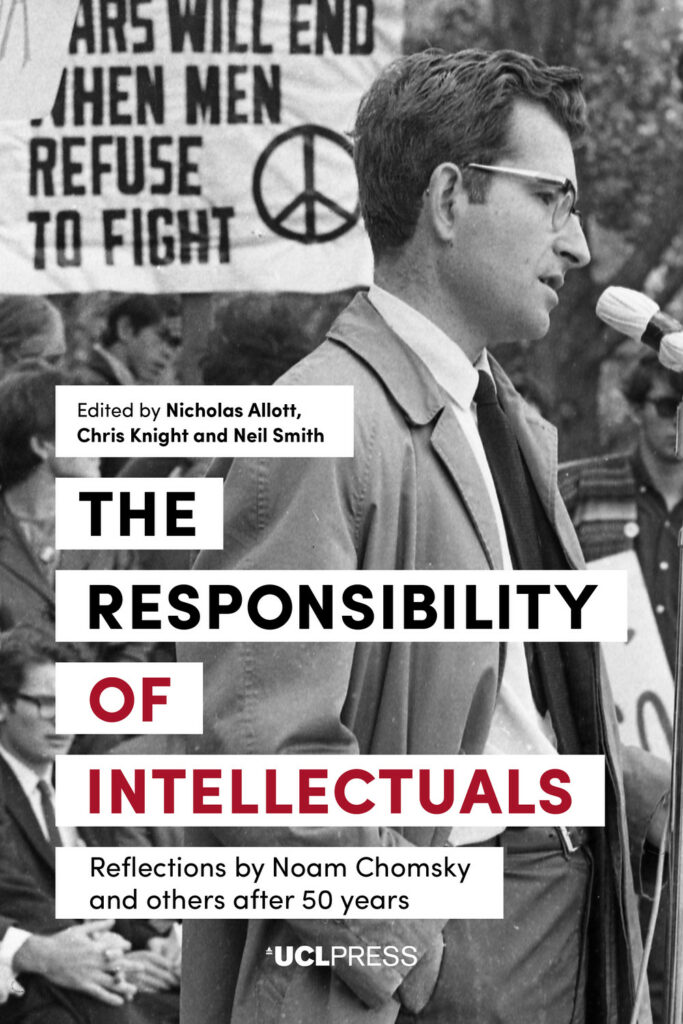
The Responsibility of Intellectuals

With the publication of ‘The Responsibility of Intellectuals’ half a century ago, Noam Chomsky burst onto the US political scene as a leading critic of the war in Vietnam. Privilege, he argues, brings with it the responsibility to tell the truth and expose lies, but our intellectual culture only pays lip-service to this ideal. The essay has been described as ‘the single most influential piece of anti-war literature’ of the Vietnam war period.

Since then, Chomsky has continued to equip a growing international audience with the facts and arguments needed to understand – and change – our world. According to The New York Times, Chomsky ‘may be the most widely read American voice on foreign policy on the planet today.’

This book revisits ‘The Responsibility of Intellectuals’ half a century on. It includes six new essays written to celebrate Chomsky’s famous intervention and explore its relevance in today’s world. Nicholas Allott, Chris Knight, Milan Rai and Neil Smith have studied and written about Chomsky’s thought for many years, while Craig Murray and Jackie Walker describe the personal price they have paid for speaking out. The book finishes with Chomsky’s recollections of the background to the original publication of his essay, followed by extensive commentary from him on its 50th anniversary.
With the publication of ‘The Responsibility of Intellectuals’ half a century ago, Noam Chomsky burst onto the US political scene as a leading critic of the war in Vietnam. Privilege, he argues, brings with it the responsibility to tell the truth and expose lies, but our intellectual culture only pays lip-service to this ideal. The essay has been described as ‘the single most influential piece of anti-war literature’ of the Vietnam War period. Since then, Chomsky has continued to equip a growing international audience with the facts and arguments needed to understand – and change – our world. According to The New York Times, Chomsky ‘may be the most widely read American voice on foreign policy on the planet today’. This book revisits ‘The Responsibility of Intellectuals’ half a century on. It includes six new essays written to celebrate Chomsky’s famous intervention and explore its relevance in today’s world. Nicholas Allott, Chris Knight, Milan Rai and Neil Smith have studied and written about Chomsky’s thought for many years, while Craig Murray and Jackie Walker describe the personal price they have paid for speaking out. The book finishes with Chomsky’s recollections of the background to the original publication of his essay, followed by extensive commentary from him on its 50th anniversary.

Gabriel Harvey and the History of Reading

Few articles in the humanities have had the impact of Lisa Jardine and Anthony Grafton’s seminal ‘Studied for Action’ (1990), a study of the reading practices of Elizabethan polymath and prolific annotator Gabriel Harvey. Their excavation of the setting, methods and ambitions of Harvey’s encounters with his books ignited the History of Reading, an interdisciplinary field which quickly became one of the most exciting corners of the scholarly cosmos. A generation inspired by the model of Harvey fanned out across the world’s libraries and archives, seeking to reveal the many creative, unexpected and curious ways that individuals throughout history responded to texts, and how these interpretations in turn illuminate past worlds.

Three decades on, Harvey’s example and Jardine’s work remain central to cutting-edge scholarship in the History of Reading. By uniting ‘Studied for Action’ with published and unpublished studies on Harvey by Jardine, Grafton and the scholars they have influenced, this collection provides a unique lens on the place of marginalia in textual, intellectual and cultural history. The chapters capture subsequent work on Harvey and map the fields opened by Jardine and Grafton’s original article, collectively offering a posthumous tribute to Lisa Jardine and an authoritative overview of the History of Reading.

The First Hebrew Shakespeare Translations

This first bilingual edition and analysis of the earliest Shakespeare plays translated into Hebrew – Isaac Edward Salkinson’s Ithiel the Cushite of Venice (Othello) and Ram and Jael (Romeo and Juliet) – offers a fascinating and unique perspective on global Shakespeare. Differing significantly from the original English, the translations are replete with biblical, rabbinic, and medieval Hebrew textual references and reflect a profoundly Jewish religious and cultural setting. The volume includes the full text of the two Hebrew plays alongside a complete English back-translation with a commentary examining the rich array of Hebrew sources and Jewish allusions that Salkinson incorporates into his work. The edition is complemented by an introduction to the history of Jewish Shakespeare reception in Central and Eastern Europe; a survey of Salkinson’s biography including discussion of his unusual status as a Jewish convert to Christianity; and an overview of his translation strategies. The book makes Salkinson’s pioneering work accessible to a wide audience, and will appeal to anyone with an interest in multicultural Shakespeare, translation studies, the development of Modern Hebrew literature, and European Jewish history and culture.

Sign up to our newsletter

Don't miss out!
Subscribe to the UCL Press newsletter for the latest open access books,
journal CfPs, news and views from our authors and much more!