Rethinking the Pavilion

Rethinking the Pavilion investigates one unique project in detail, the Vajrasana Buddhist Retreat Centre in rural Suffolk, completed by Walters & Cohen Architects in 2018. The result was an innovative building typology that has never been designed before in any western country. The process by which the Vajrasana project came into existence has come to define and shape the way in which the practice makes architecture, through a deepened understanding of how buildings can exert powerful social impacts on all who use them.

It was the Vajrasana Buddhist Retreat Centre project that enabled Walters & Cohen Architects to shift the focus away from the ideal pavilion to the social pavilion. While pavilions are usually seen as finished objects, this book argues that they can be seen as a process, namely a social process. The book describes how shared experience defines a new way of working towards an architecture that rediscovers and enriches its communal purpose. The ethos of Walters & Cohen’s practice has thus become one that encourages a broader conversation about architecture, with buildings seeking to convey a raw sense of place and to reduce the many complexities of site and programme to the simplest arrangement and expression.
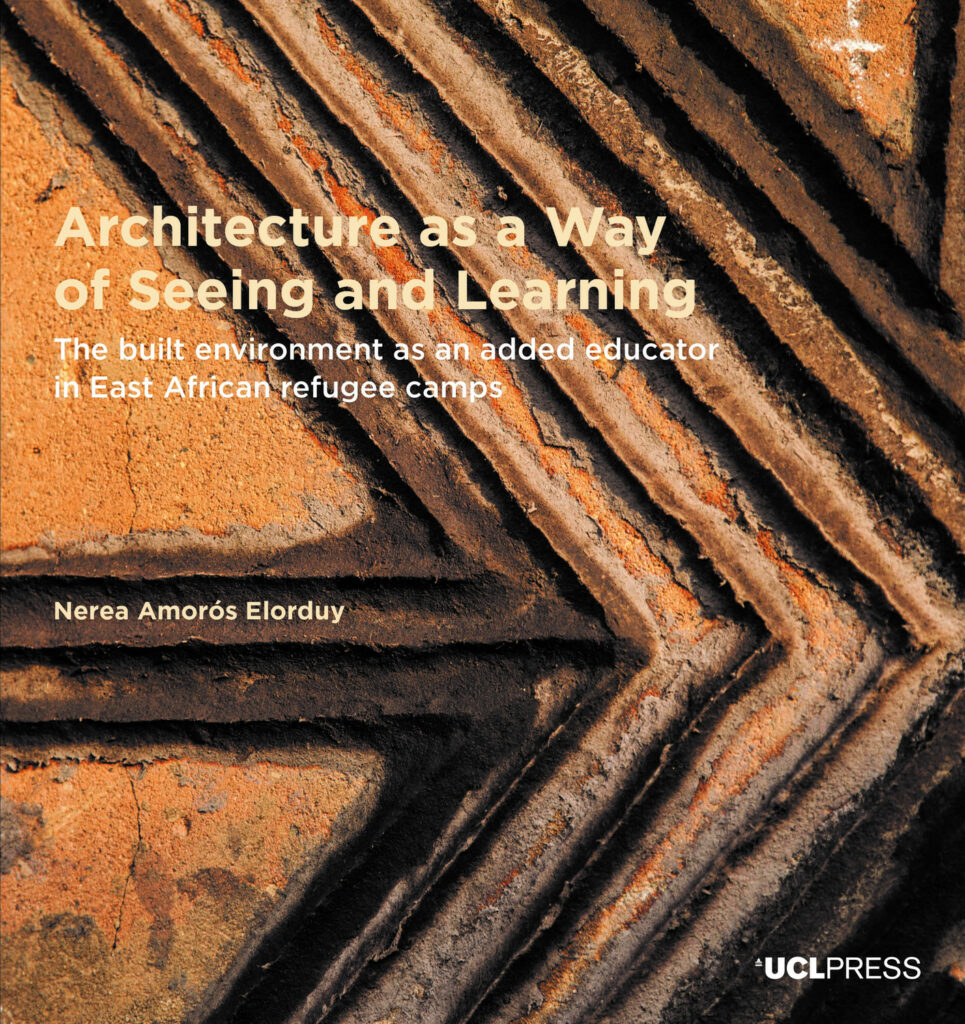
Architecture as a Way of Seeing and Learning

At the beginning of 2020, 66 long-term refugee camps existed along the East African Rift. Millions of young children have been born at the camps and have grown up there, yet it is unknown how their surrounding built environments affect their learning and development.

Architecture as a Way of Seeing and Learning presents an architect’s take on questions many academics and humanitarians ask. Is it relevant to look at camps through an urban lens and focus on their built environment? Which analytical benefits can architectural and design tools provide to refugee assistance and specifically to young children’s learning? And which advantages can assemblage thinking and situated knowledges bring about in analysing, understanding and transforming long-term refugee camps?

Responding to the extreme lack of information about East African camps, Nerea Amorós Elorduy has built contextualised knowledge – nuanced, situated and participatory – to describe, study and transform the East African long-term camps, and uncover hidden agencies in refugee assistance. She uses architecture as a means to create new knowledge collectively, include more local voices and speculate on how to improve the educational landscape for young children.

With this book, Amorós Elorduy brings nuance, contextualisation and empathy to the study and management of long-term refugee camps in East Africa. It is empathy, she argues, that will help change mindsets, decolonise humanitarian refugee assistance and its study. Crossing architecture, humanitarian aid and early career development, this book offers many practical learnings.

Fabricate 2024

Fabricate 2024: Creating Resourceful Futures is the fifth volume in the series of Fabricate publications. The first conference – ‘Making Digital Architecture’ – explored the ways in which technology, design and industry are shaping the world around us. Since then, we have become finely attuned to the negative impacts of this shaping. The 2024 conference, hosted in Copenhagen, sets focus on the pressing need to develop new models for architectural production that rethink how resource is deployed, its intensity, its socio-ecological origins and sensitivity to environment.

This book features the work of designers, engineers and makers operating within the built environment. It documents disruptive approaches that reconsider how fabrication can be leveraged to address our collective and entangled challenges of resource scarcity, climate emergency and burgeoning demand. Exploring case studies of completed buildings and works-in-progress, together with interviews with leading thinkers, this edition of Fabricate offers a plurality of tangible models for design and production that set a creative and responsible course towards resourceful futures.

Fabricate 2011

FABRICATE is an international peer reviewed conference that takes place every three years with a supporting publication on the theme of Digital Fabrication. Discussing the progressive integration of digital design with manufacturing processes, and its impact on design and making in the 21st century, FABRICATE brings together pioneers in design and making within architecture, construction, engineering, manufacturing, materials technology and computation. Discussion on key themes includes: how digital fabrication technologies are enabling new creative and construction opportunities from component to building scales, the difficult gap that exists between digital modelling and its realisation, material performance and manipulation, off-site and on-site construction, interdisciplinary education, economic and sustainable contexts. FABRICATE features cutting-edge built work from both academia and practice, making it a unique event that attracts delegates from all over the world. FABRICATE 2011, 2014 and 2017 are now all available to download free from UCL Press.

Drawing Futures

Drawing Futures brings together international designers and artists for speculations in contemporary drawing for art and architecture.

Despite numerous developments in technological manufacture and computational design that provide new grounds for designers, the act of drawing still plays a central role as a vehicle for speculation. There is a rich and long history of drawing tied to innovations in technology as well as to revolutions in our philosophical understanding of the world. In reflection of a society now underpinned by computational networks and interfaces allowing hitherto unprecedented views of the world, the changing status of the drawing and its representation as a political act demands a platform for reflection and innovation. Drawing Futures will present a compendium of projects, writings and interviews that critically reassess the act of drawing and where its future may lie.

Drawing Futures focuses on the discussion of how the field of drawing may expand synchronously alongside technological and computational developments. The book coincides with an international conference of the same name, taking place at The Bartlett School of Architecture, UCL, in November 2016. Bringing together practitioners from many creative fields, the book discusses how drawing is changing in relation to new technologies for the production and dissemination of ideas.

The Covert Life of Hospital Architecture

The Covert Life of Hospital Architecture addresses hospital architecture as a set of interlocked, overlapping spatial and social conditions. It identifies ways that planned-for and latent functions of hospital spaces work jointly to produce desired outcomes such as greater patient safety, increased scope for care provider communication and more intelligible corridors.

By advancing space syntax theory and methods, the volume brings together emerging research on hospital environments. Opening with a description of hospital architecture that emphasizes everyday relations, the sequence of chapters takes an unusually comprehensive view that pairs spaces and occupants in hospitals: the patient room and its intervisibility with adjacent spaces, care teams and on-ward support for their work and the intelligibility of public circulation spaces for visitors. The final chapter moves outside the hospital to describe the current healthcare crisis of the global pandemic as it reveals how healthcare institutions must evolve to be adaptable in entirely new ways. Reflective essays by practicing designers follow each chapter, bringing perspectives from professional practice into the discussion.

The Covert Life of Hospital Architecture makes the case that latent dimensions of space as experienced have a surprisingly strong link to measurable outcomes, providing new insights into how to better design hospitals through principles that have been tested empirically. It will become a reference for healthcare planners, designers, architects and administrators, as well as for readers from sociology, psychology and other areas of the social sciences.

Sign up to our newsletter

Don't miss out!
Subscribe to the UCL Press newsletter for the latest open access books,
journal CfPs, news and views from our authors and much more!