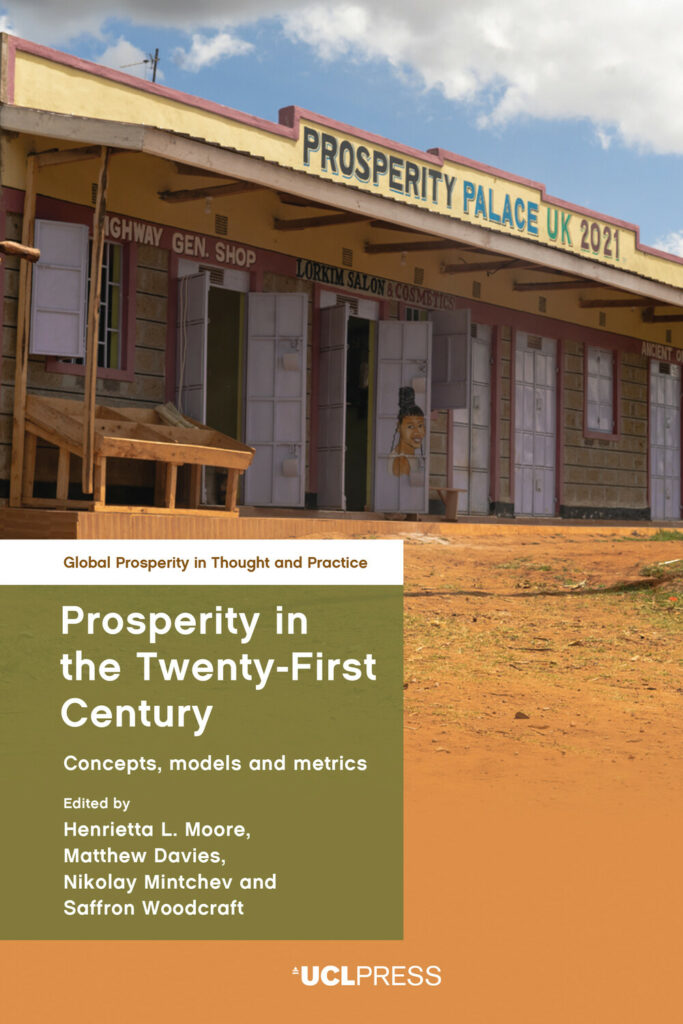
Prosperity in the Twenty-First Century

Prosperity in the Twenty-First Century sets out a new vision for prosperity in the twenty-first century and how it can be achieved for all.
The volume challenges orthodox understandings of economic models, but goes beyond contemporary debates to show how social innovation drives economic value. Drawing on substantive research in the UK, Lebanon and Kenya, it develops new concepts, frameworks, models and metrics for prosperity across a wide range of contexts, emphasising commonalities and differences. Its distinctive approach goes beyond defining and measuring prosperity – addressing the debate about the failures of GDP – to formulating and describing what is needed to make prosperity a realisable proposition for specific people living in specific locales.

Departing from general propositions about post-growth to delineate pathways to prosperity, the volume emphasises that visions of the good life are diverse and require empirical work co-designed with local communities and stakeholders to drive change. It is essential reading for policymakers who are stuck, local government officers who need new tools, activists who wonder what is next, academics in need of refreshment, and students and people of all ages who want a way forward.
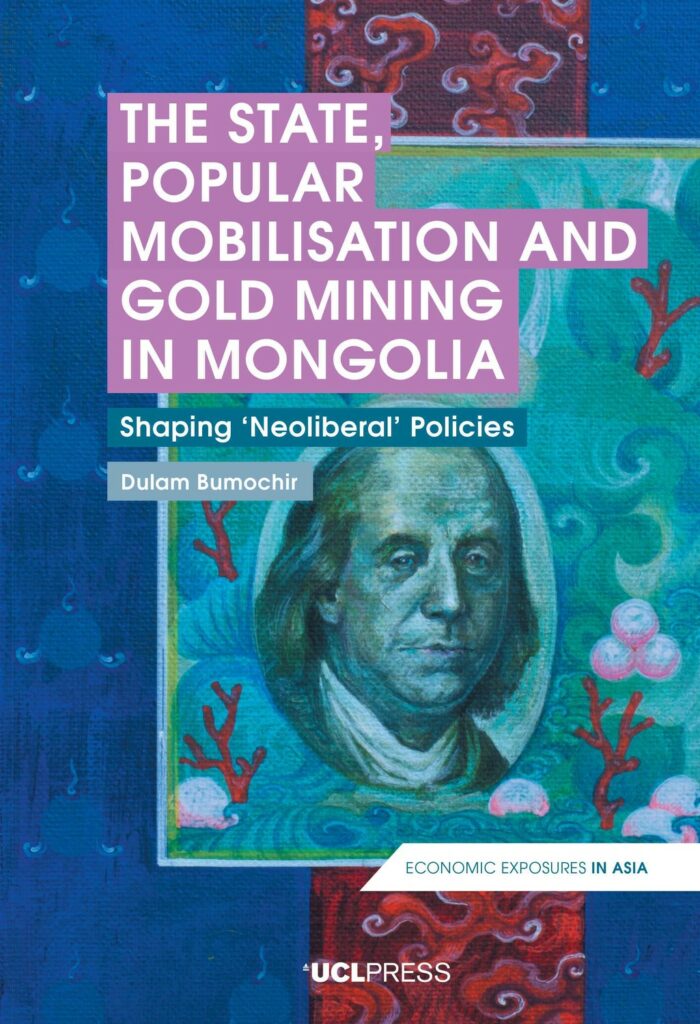

The State, Popular Mobilisation and Gold Mining in Mongolia

Mongolia’s mining sector, along with its environmental and social costs, have been the subject of prolonged and heated debate. This debate has often cast the country as either a victim of the ‘resource curse’ or guilty of ‘resource nationalism’.

In The State, Popular Mobilisation and Gold Mining in Mongolia, Dulam Bumochir aims to avoid the pitfalls of this debate by adopting an alternative theoretical approach. He focuses on the indigenous representations of nature, environment, economy, state and sovereignty that have triggered nationalist and statist responses to the mining boom. In doing so, he explores the ways in which these responses have shaped the apparently ‘neo-liberal’ policies of twenty-first century Mongolia, and the economy that has emerged from them, in the face of competing mining companies, protest movements, international donor organizations, economic downturn, and local and central government policies.

Applying rich ethnography to a nuanced and complex picture, Bumochir’s analysis is essential reading for students and researchers studying the environment and mining, especially in Central and North East Asia and post-Soviet regions, and also for readers interested in the relationship between neoliberalism, nationalism, environmentalism and state.

The Global Encyclopaedia of Informality, Volume 3

For a post-human hitchhiker, human life – with its anxiety, ageing, illness and constant need for problem-solving – may look unviable. Yet, for humans, the life struggle is softened by human touch, human emotion and human cooperation.

The Global Encyclopaedia of Informality, Volume 3 continues the journey of the two previous volumes into the world’s open secrets, unwritten rules and hidden practices. It focuses on issues of emotional ambivalence and pressures of the digital age. The informal practices presented in this volume demonstrate the urgency of alleviating tensions between continuity and all-too-rapid change and the need to tackle the central problem of modern societies – uncertainty.

The volume takes a reader on a ‘biographical’ journey through elusive, taken-for-granted or banal ways of getting things done from over 70 countries and world regions. It offers innovative understanding of the significance of fringes, and challenges the assumption that informality is associated exclusively with poverty, underdevelopment, the Global South, oppressive regimes or the former socialist countries of Eastern Europe and Central Asia. It also maps the patterns of informality around the globe; identifies specific informal practices in a context-sensitive way; and documents their ambivalent impact on people engaged in problem-solving, on societies in which these problems arise, and on humanity overall.

The Global Encyclopaedia of Informality, Volume 2

Alena Ledeneva invites you on a voyage of discovery to explore society’s open secrets, unwritten rules and know-how practices. Broadly defined as ‘ways of getting things done’, these invisible yet powerful informal practices tend to escape articulation in official discourse. They include emotion-driven exchanges of gifts or favours and tributes for services, interest-driven know-how (from informal welfare to informal employment and entrepreneurship), identity-driven practices of solidarity, and power-driven forms of co-optation and control. The paradox, or not, of the invisibility of these informal practices is their ubiquity. Expertly practised by insiders but often hidden from outsiders, informal practices are, as this book shows, deeply rooted all over the world, yet underestimated in policy. Entries from the five continents presented in this volume are samples of the truly global and ever-growing collection, made possible by a remarkable collaboration of over 200 scholars across disciplines and area studies.

By mapping the grey zones, blurred boundaries, types of ambivalence and contexts of complexity, this book creates the first Global Map of Informality. The accompanying database ([www.in-formality.com][1]) is searchable by region, keyword or type of practice, so do explore what works, how, where and why!

The Global Encyclopaedia of Informality, Volume 1

Alena Ledeneva invites you on a voyage of discovery, to explore society’s open secrets, unwritten rules and know-how practices. Broadly defined as ‘ways of getting things done’, these invisible yet powerful informal practices tend to escape articulation in official discourse. They include emotion-driven exchanges of gifts or favours and tributes for services, interest-driven know-how (from informal welfare to informal employment and entrepreneurship), identity-driven practices of solidarity, and power-driven forms of co-optation and control. The paradox, or not, of the invisibility of these informal practices is their ubiquity. Expertly practised by insiders but often hidden from outsiders, informal practices are, as this book shows, deeply rooted all over the world, yet underestimated in policy. Entries from the five continents featured in this volume are samples of the truly global and ever-growing collection, made possible by a remarkable collaboration of over 200 scholars across disciplines and area studies.

By mapping the grey zones, blurred boundaries, types of ambivalence and contexts of complexity, this book creates the first Global Map of Informality. The accompanying database is searchable by region, keyword or type of practice, so do explore what works, how, where and why!

Consumer Data Research

Big Data collected by customer-facing organisations – such as smartphone logs, store loyalty card transactions, smart travel tickets, social media posts, or smart energy meter readings – account for most of the data collected about citizens today. As a result, they are transforming the practice of social science. Consumer Big Data are distinct from conventional social science data not only in their volume, variety and velocity, but also in terms of their provenance and fitness for ever more research purposes. The contributors to this book, all from the Consumer Data Research Centre, provide a first consolidated statement of the enormous potential of consumer data research in the academic, commercial and government sectors – and a timely appraisal of the ways in which consumer data challenge scientific orthodoxies.

The Ambivalence of Power in the Twenty-First Century Economy

The Ambivalence of Power in the Twenty-First Century Economy contributes to the understanding of the ambivalent nature of power, oscillating between conflict and cooperation, public and private, global and local, formal and informal, and does so from an empirical perspective. It offers a collection of country-based cases, as well as critically assesses the existing conceptions of power from a cross-disciplinary perspective.

The diverse analyses of power at the macro, meso or micro levels allow the volume to highlight the complexity of political economy in the twenty-first century. Each chapter addresses key elements of that political economy (from the ambivalence of the cases of former communist countries that do not conform with the grand narratives about democracy and markets, to the dual utility of new technologies such as face-recognition), thus providing mounting evidence for the centrality of an understanding of ambivalence in the analysis of power, especially in the modern state power-driven capitalism.

Anchored in economic sociology and political economy, this volume aims to make ‘visible’ the dimensions of power embedded in economic practices. The chapters are predominantly based on post-communist practices, but this divergent experience is relevant to comparative studies of how power and economy are interrelated.

Sign up to our newsletter

Don't miss out!
Subscribe to the UCL Press newsletter for the latest open access books,
journal CfPs, news and views from our authors and much more!