We are currently upgrading our shopping cart; in the interim all orders are being diverted to Waterstones. If you would like to redeem a promotional code, or are an author wanting to place an order, please email us.

Contact us

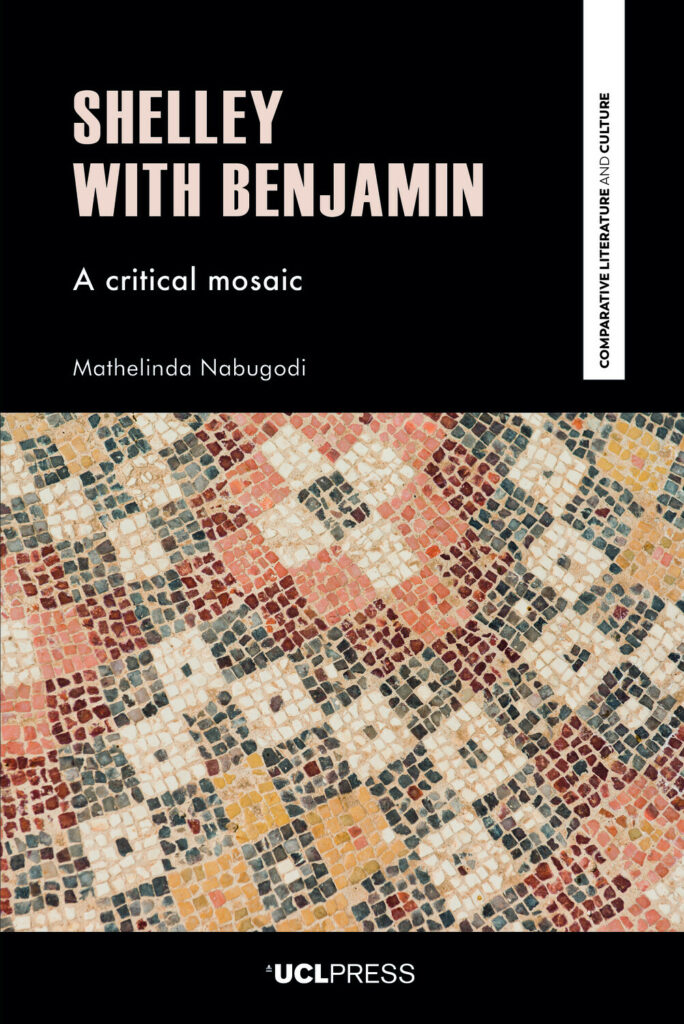
Shelley with Benjamin

*Yet what surprises me most of all at this time is that what I have written consists, as it were, almost entirely of quotations. – Compositions so produced are to poetry what mosaic is to painting. – It is the craziest mosaic technique you can imagine – and the very mind which directs the hands in formation is incapable of accounting to itself for the origin, the gradations, or the media of the process.

Shelley with Benjamin: A critical mosaic is an experiment in comparative reading. Born a century apart, Percy Bysshe Shelley and Walter Benjamin are separated by time, language, temperament and genre – one a Romantic poet known for his revolutionary politics and delicate lyricism, the other a melancholy intellectual who pioneered a dialectical method of thinking in constellations. Yet, as the above montage of citations from their works demonstrates, their ideas are mutually illuminating: the mosaic is but one of several images that both use to describe how literature lives on through practices of citation, translation and critical commentary.

In a series of close readings that are by turns playful, erotic and violent, Mathelinda Nabugodi unveils affinities between two writers whose works are simultaneously interventions in literary history and blueprints for an emancipated future. In addition to offering fresh interpretations of both major and minor writings, she elucidates the personal and ethical stakes of literary criticism. Throughout the book, marginal annotations and interlinear interruptions disrupt the faux-objective and colourblind stance of standard academic prose in an attempt to reckon with the barbarism of our past and its legacy in the present.

The book will appeal to readers of Shelley and Benjamin as well as those with an interest in comparative literature, literary theory, romantic poetics, and creative critical writing.
Passages

The study of literature and culture is marked by various distinct understandings of passages – both as phenomena and critical concepts. These include the anthropological notion of rites of passage, the shopping arcades (Passagen) theorized by Walter Benjamin, the Middle Passage of the Atlantic slave trade, present-day forms of migration and resettlement, and understandings of translation and adaptation. Whether structural, semiotic, spatial/geographic, temporal, existential, societal or institutional, passages refer to processes of (status) change. They enable entrances and exits, arrivals and departures, while they also foster moments of liminality and suspension. They connect and thereby engender difference.

This volume is an exploration of passages as contexts and processes within which liminal experiences and encounters are situated. It aims to foster a concept-based, interdisciplinary dialogue on how to approach and theorize such a term. Based on the premise that concepts travel through times, contexts and discursive settings, a conceptual approach to passages provides the authors of this volume with the analytical tools to (re-)focus their research questions and create a meaningful exchange across disciplinary, national and linguistic boundaries.

Contributions from senior scholars and early-career researchers whose work focuses on areas such as cultural memory, performativity, space, media, (cultural) translation, ecocriticism, gender and race utilize specific understandings of passages and liminality, reflecting on their value and limits for their research.

Sign up to our newsletter

Don't miss out!
Subscribe to the UCL Press newsletter for the latest open access books,
journal CfPs, news and views from our authors and much more!