Shopping with Allah

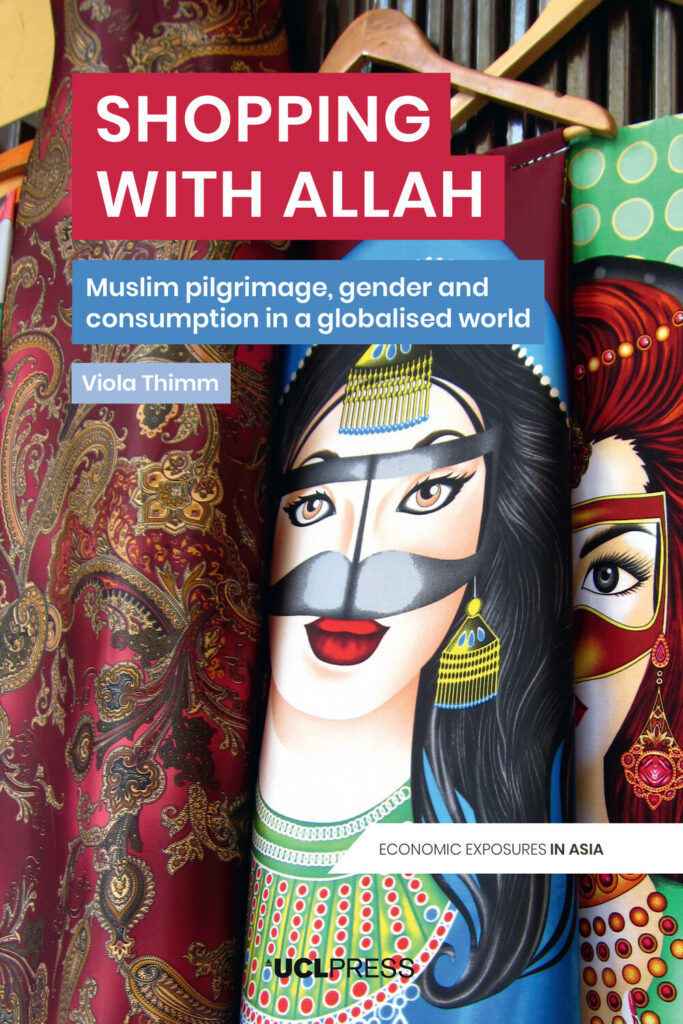
Shopping with Allah illustrates the ways in which religion is mobilised in package tourism and how spiritual, economic and gendered practices are combined in a form of tourism where the goal is not purely leisure but also ethical and spiritual cultivation.

Focusing on the intersection of gender and Islam, Viola Thimm shows how this intersection develops and changes in a pilgrimage-tourism nexus as part of capitalist and halal consumer markets. Based on extensive ethnographic fieldwork in Malaysia, the United Arab Emirates and Oman, Thimm sheds light on how Islam and gender frame Malaysian religious tourism and pilgrimage to the Arabian Peninsula, but she raises many issues that are of great importance beyond these regional contexts.

This book also offers an innovative methodological-analytical toolkit to research mobility and intersectionality across socio-geographic scales ‘Scaling Holistic Intersectionality’. By bringing methodological holism into a fruitful engagement with the antiracist-feminist framework intersectionality, Thimm argues that hierarchical relationships, i.e. marginalisation, power and empowerment, can shift for an individual or a social group depending upon the social sphere.

Shopping with Allah will primarily be of interest to readers within the anthropology of gender, the anthropology of Islam and the anthropology of religion more broadly.

The Hipster Economy

Today, being authentic has become an aspiration and an imperative. The notion of authenticity shapes the consumption habits of individuals in the most diverse contexts such as food and drinks, clothing, music, tourism and the digital sphere, even leading to the resurgence of apparently obsolescent modes of production such as craft. It also significantly transforms urban areas, their local economies and development. The Hipster Economy analyses this complex set of related phenomena to argue that the quest for authenticity has been a driver of Western societies from the emersion of capitalism and industrial society to today.

From this premise, the book advances multiple original contributions. First, it explains why and how authenticity has become a fundamental value orienting consumers’ taste in late modern capitalism; second, it proposes a novel conceptualisation of the aesthetic regime of consumption; third, the book constitutes the first detailed analysis of the resurgence of the neo-craft industries, their entrepreneurs, and the economic imaginary of consumption underpinning them, and fourth, it analyses how the hipster economy is impacting the urban space, favouring new logic of urban development with contrasting outcomes.

Antarcticness

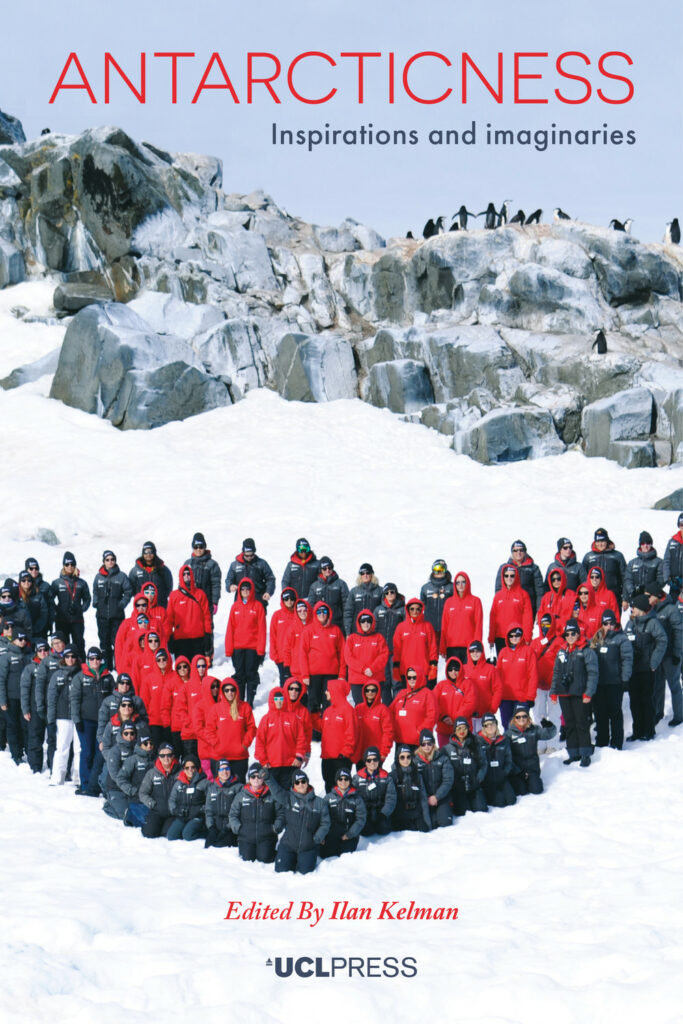
Antarcticness joins disciplines, communication approaches and ideas to explore meanings and depictions of Antarctica. Personal and professional words in poetry and prose, plus images, present and represent Antarctica, as presumed and as imagined, alongside what is experienced around the continent and by those watching from afar. These understandings explain how the Antarctic is viewed and managed while identifying aspects which should be more prominent in policy and practice.

The authors and artists place Antarctica, and the perceptions and knowledge through Antarcticness, within inspirations and imaginations, without losing sight of the multiple interests pushing the continent’s governance as it goes through rapid political and environmental changes. Given the diversity and disparity of the influences and changes, the book’s contributions connect to provide a more coherent and encompassing perspective of how society views Antarctica, scientifically and artistically, and what the continent provides and could provide politically, culturally and environmentally.

Offering original research, art and interpretations of different experiences and explorations of Antarctica, explanations meld with narratives while academic analyses overlap with first-hand experiences of what Antarctica does and does not – could and could not – bring to the world.

Sign up to our newsletter

Don't miss out!
Subscribe to the UCL Press newsletter for the latest open access books,
journal CfPs, news and views from our authors and much more!